Anthropic Ships Finance Agents, Cerebras Eyes $27B IPO, First AI Insurance Product Launches
Anthropic releases 10 pre-built financial AI agents, Cerebras targets a $27B IPO, and Corgi launches insurance for AI hallucinations. Plus SAP acquires.
 ByAsh·6 min read
Four stories this week that signal where AI money is actually flowing - from pre-built enterprise agents to chip IPOs to insuring AI mistakes. Here's what I'm watching and why it matters for anyone picking AI tools in 2026.
Anthropic Launches 10 Pre-Built Finance Agents
Anthropic released ten preconfigured AI agents designed specifically for the financial sector. These agents target tasks that investment banks, asset managers, and insurance companies perform daily - from compliance document review to portfolio risk analysis to client reporting automation.
This isn't a generic chatbot bolted onto a banking interface. Each agent comes with pre-built workflows, domain-specific guardrails, and audit trails that financial regulators require. The move puts Anthropic directly in competition with Bloomberg Terminal's AI features, Palantir's financial products, and the dozens of fintech startups building LLM wrappers around financial data.
The timing aligns with Anthropic's broader commercial acceleration. According to CNN Business, Anthropic now wins about 70% of head-to-head matchups against OpenAI among first-time business buyers. Their coding agent revenue topped $2.5 billion by February 2026 - doubling from $1 billion at the end of 2025. I've been covering this shift in our Claude review for months: Anthropic is positioning Claude not as a consumer chatbot but as enterprise infrastructure.
My take: If you work in finance and you're evaluating AI tools, these pre-built agents are worth testing before building custom solutions. The biggest cost in enterprise AI isn't the subscription - it's the integration and compliance work. Pre-built agents with audit trails skip months of that. For everyone else, this signals that Claude is becoming an enterprise-first product, which means consumer features (like the free tier I rely on daily) benefit from enterprise revenue subsidizing development.
Cerebras Targets $27B IPO
Cerebras, the AI chip startup that builds wafer-scale processors designed specifically for AI training and inference, is on track for a major IPO that could value the company at $26.6 billion or more. This would make it one of the largest chip IPOs in history and the biggest pure-play AI hardware company to go public.
The context: Foxconn reported a 29.7% revenue increase in April driven by AI server demand. Fleet Data Centers just closed a $4.6 billion financing deal for a new facility in Nevada. The entire AI infrastructure stack - chips, servers, data centers, power - is experiencing a capital investment boom that dwarfs what's happening in AI software.
Why this matters for AI tool users: chip availability and pricing directly affect what ChatGPT, Claude, and every other AI tool can offer at what price. More chip competition (Cerebras vs Nvidia vs AMD vs custom chips from Google and Amazon) means lower compute costs, which means either cheaper subscriptions or more capability at the same $20/mo (≈₹1,860/mo) price point.
My take: I don't cover chips directly on RawPickAI, but I track them because they're the upstream variable that determines everything downstream. When I review tools like Cursor or Windsurf, the cost-per-completion is directly tied to inference costs, which are directly tied to chip prices. A successful Cerebras IPO means more capital flowing into AI chip competition, which means better tools at lower prices for developers within 12-18 months.
First AI Insurance Product Goes Live
Corgi launched what appears to be the first dedicated insurance product for AI agent failures. The coverage targets liability gaps that existing business insurance doesn't cover: hallucinations that produce incorrect advice, copyright infringement from AI-generated content, data leaks through AI systems, and biased algorithmic decisions that harm customers.
This is significant because it addresses a real gap that every company deploying AI faces. Traditional professional liability insurance wasn't designed for scenarios where an AI agent gives a customer incorrect medical information or generates content that infringes someone's copyright. As AI agents move from internal tools to customer-facing products, the liability question has shifted from theoretical to urgent.
My take: If you're using AI tools to produce client-facing content - blog posts, marketing copy, product descriptions, legal summaries - the liability for errors sits with you, not with OpenAI or Anthropic. I've flagged this in multiple reviews: AI-generated content needs human review before publication. Insurance doesn't replace that discipline, but it does acknowledge that AI errors are now a measurable business risk. For solo creators and freelancers, the practical takeaway is: always verify AI output before sending it to clients. For companies deploying AI agents at scale, AI-specific insurance is now available and probably worth evaluating.
SAP Acquires Prior Labs for Over $1 Billion
SAP signed a definitive agreement to acquire Prior Labs, committing over $1 billion across four years to build what they're calling "the next frontier AI lab for structured data." Prior Labs will remain an independent entity within SAP, maintaining its team and open-source model approach.
This is the largest AI acquisition by a European enterprise software company. It signals that the enterprise AI race is no longer just about language models - it's about AI that understands structured business data: databases, spreadsheets, ERPs, CRMs. Prior Labs' specialty is exactly this: models trained on tabular and structured data rather than text and images.
My take: For Notion AI, Coda AI, and every tool that works with structured business data, this acquisition means stronger competition is coming. SAP touches millions of businesses globally. If Prior Labs' technology gets embedded into SAP's products, every mid-to-large enterprise will have AI-powered data analysis built into the ERP they already use. The independent tools will need to offer something SAP can't - which means better UX, lower prices, or niche specialization.
What This Tells Us About AI in May 2026
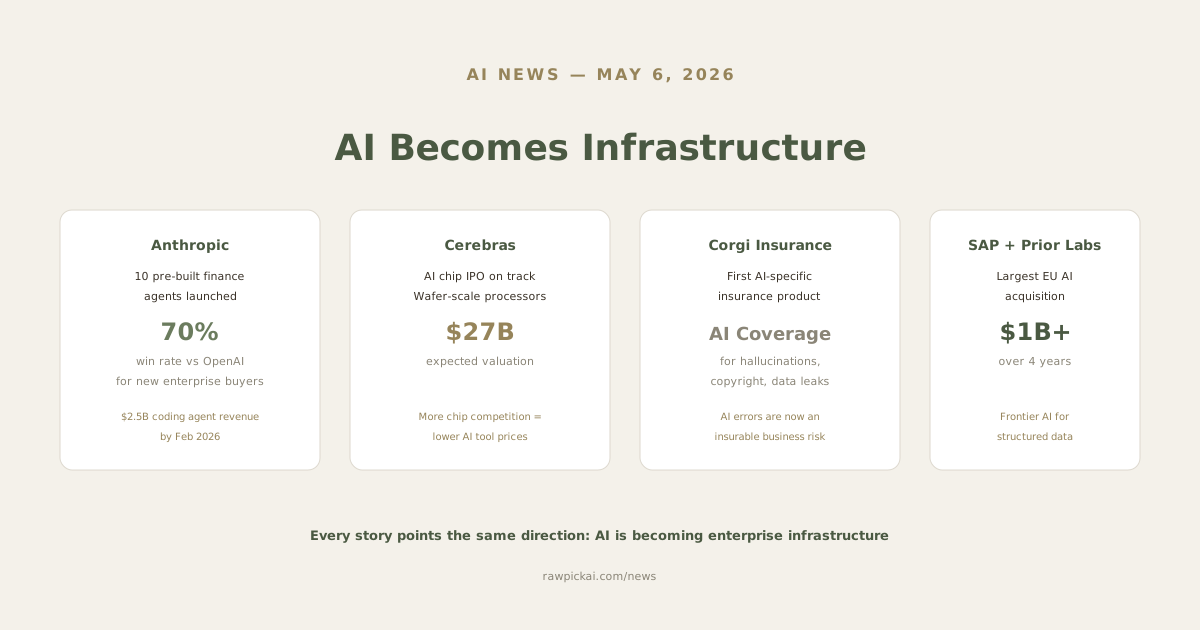
Every story this week points to the same pattern: AI is becoming infrastructure. Anthropic is building pre-packaged enterprise solutions, not just models. Cerebras is building dedicated AI chips, not general-purpose processors. Insurance companies are creating AI-specific products. SAP is acquiring AI labs to embed intelligence into existing enterprise software.
For individual developers and creators - my core readers - this means the tools you use daily ($20/mo for Claude or ChatGPT) are being subsidized by enterprise revenue. That's good news. Enterprise money funds the R&D that makes consumer tools better. The risk is that consumer features get deprioritized in favor of enterprise contracts, but so far both Anthropic and OpenAI have maintained strong consumer products alongside their enterprise push.
I'll be watching whether Anthropic's finance agents signal a broader wave of pre-built industry agents. If Claude gets pre-built agents for marketing, legal, and healthcare, that changes the value proposition for specialized AI tools in those verticals.
Published May 6, 2026. Prices at ≈₹93/USD.