Anthropic + Gates Foundation Commit $200M to Health and Education AI
Anthropic and the Gates Foundation pledge $200M over 4 years for AI in healthcare, education, and agriculture. India and Africa are primary targets.
 ByAsh·4 min read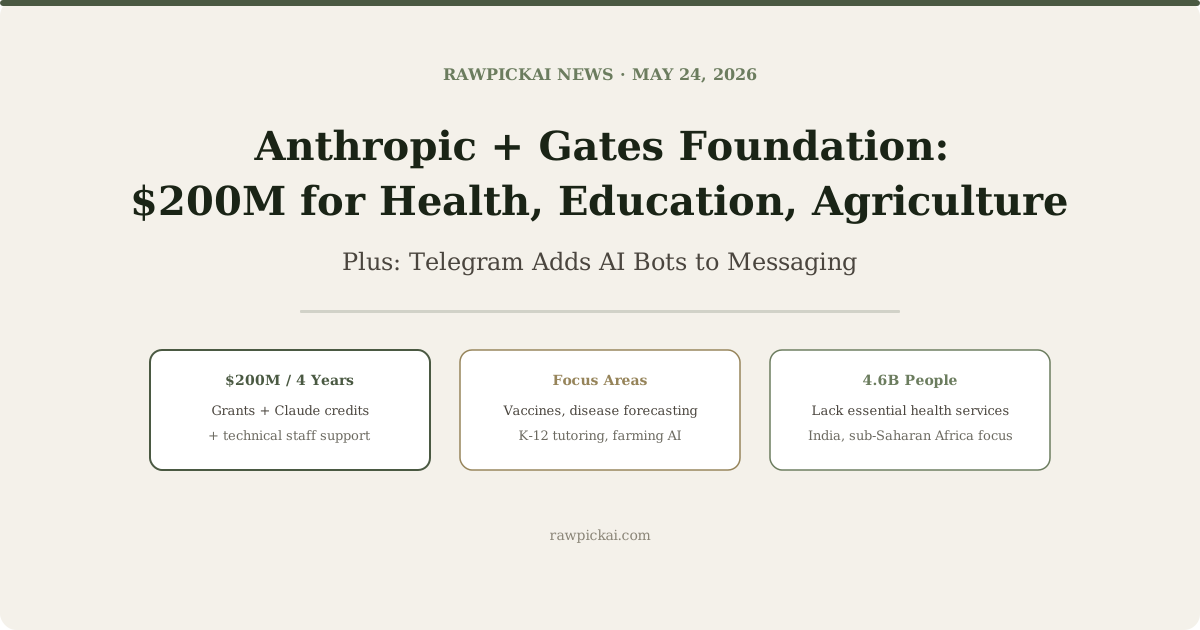
Anthropic and the Bill and Melinda Gates Foundation announced a $200 million, four-year partnership to develop AI tools for healthcare, education, agriculture, and economic mobility. The commitment is the Gates Foundation's largest AI investment to date, 4x larger than its $50 million OpenAI partnership announced in January for African clinic expansion.
The timing is deliberate. This announcement came the same week Anthropic reported $10.9 billion in projected Q2 revenue and its first operating profit. Anthropic is simultaneously preparing for an October IPO at $900 billion. A $200 million philanthropic commitment right before going public sends a specific signal: we're not just profitable, we're responsible.
Where the money goes
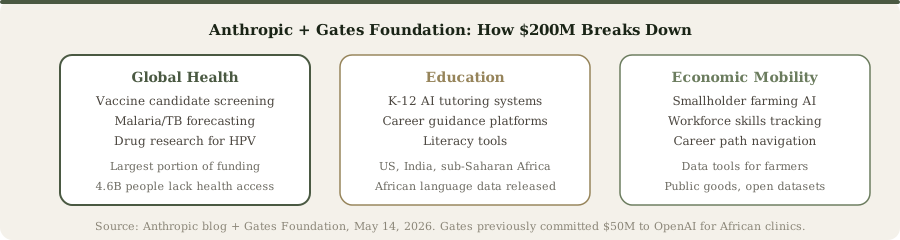
The partnership splits across three areas:
Global health (largest portion): Claude will be used to screen vaccine candidates computationally before pre-clinical trials, focusing on diseases like polio and HPV. Anthropic is also partnering with the Gates Foundation's Institute for Disease Modeling to improve forecasting for malaria and tuberculosis treatment deployment. With 4.6 billion people worldwide lacking access to essential health services, the scale of the problem matches the scale of the commitment.
Education: AI tutoring systems and career guidance platforms for K-12 students, rolling out in the US, India, and sub-Saharan Africa. The partnership will develop knowledge graphs specifically designed for teachers in these regions and release African language training data publicly so other AI companies can improve their models too.
Economic mobility: AI tools for smallholder farmers (better data for crop decisions) and workforce skills tracking that helps workers navigate career transitions. This is the least flashy component but potentially the most impactful for daily life in low-income regions.
The India angle matters
For readers in India, this partnership has direct implications. The education component specifically targets Indian K-12 students with AI tutoring tools built on Claude. If Anthropic deploys Claude-based tutoring at scale in Indian schools, it would be the largest real-world Claude deployment outside of enterprise software.
The agricultural component also matters for India's 140+ million farming households. AI tools that help farmers make better planting, irrigation, and market timing decisions could have outsized impact in a country where agriculture employs 42% of the workforce.
Whether these tools will be available in Hindi and regional languages isn't confirmed yet, but the public release of African language data suggests Anthropic is serious about non-English AI performance.
Gates Foundation: Anthropic vs OpenAI

The $200 million Anthropic partnership dwarfs the Gates Foundation's $50 million OpenAI deal (Horizon1000) announced in January. Horizon1000 focused narrowly on improving operations in 1,000 African primary healthcare clinics. The Anthropic partnership spans three continents, four sectors, and includes public data releases that benefit the entire AI ecosystem.
This doesn't mean the Gates Foundation is picking sides. Bill Gates has publicly stated that the AI investment boom resembles the early internet era, and the foundation is hedging by backing both major players. But the 4x difference in commitment size suggests where the foundation sees the most potential for impact.
Telegram adds AI bots to messaging

In other news, Telegram introduced AI assistant bots that can read, filter, and reply to messages based on user-defined permissions. This isn't just a chatbot integration. Telegram is positioning AI as an embedded assistance layer inside conversations, not a separate app you switch to.
The pattern is now clear across the industry: Google launched Gemini Spark as a 24/7 agent, ChatGPT has Operator for autonomous tasks, and now Telegram is embedding AI directly into messaging. The race is no longer about building the best chatbot. It's about building agents that live inside the tools people already use.
For messaging-heavy workflows (customer support, team coordination, community management), Telegram's approach could be more practical than switching to a separate AI app. But the privacy implications of AI bots reading your messages deserve scrutiny that Telegram hasn't fully addressed.
My take

The India and sub-Saharan Africa focus in the Gates partnership is the detail that matters most for our audience. If Claude-powered tutoring tools reach Indian classrooms at scale, it validates something our 2026 AI Tools Reality Check showed: the best AI tools are increasingly accessible at prices (or free tiers) that work globally, not just in the US.
The public release of African language data is arguably the most consequential part of the entire partnership. AI models perform poorly on non-English languages because training data is scarce. Releasing this data publicly means every AI company benefits, not just Anthropic. That's the kind of structural investment that compounds over years.
For individual AI tool users, nothing changes immediately. But if you're in India and wondering when Claude gets meaningfully better in Hindi, this partnership is the clearest signal that it's on the roadmap.
Sources: Anthropic Blog, Gates Foundation, PYMNTS, Benzinga
Related: Claude Review · ChatGPT Review · Perplexity Review · 2026 AI Tools Reality Check · Transparency Index · Anthropic $10.9B Revenue · Karpathy Joins Anthropic