The 2026 AI Tools Reality Check: 48 Tools Tested, Most Aren't Worth Your Money
I spent 6 months testing 48 AI tools. 79% hide pricing, the average score is 3.7/5, and only 4 tools scored above 4.5. Full data with downloadable CSV.
I started RawPickAI because I was tired of AI tool reviews that read like press releases.
Every new tool was "game-changing." Every comparison ended with "it depends." Nobody would tell you the actual cost in your currency or show you what happens when you push these tools past the marketing demo.
So I tested 48 AI tools myself. Every single one.
Minimum 20 minutes of hands-on testing per tool, most got 2-4 hours.
The results weren't what I expected.
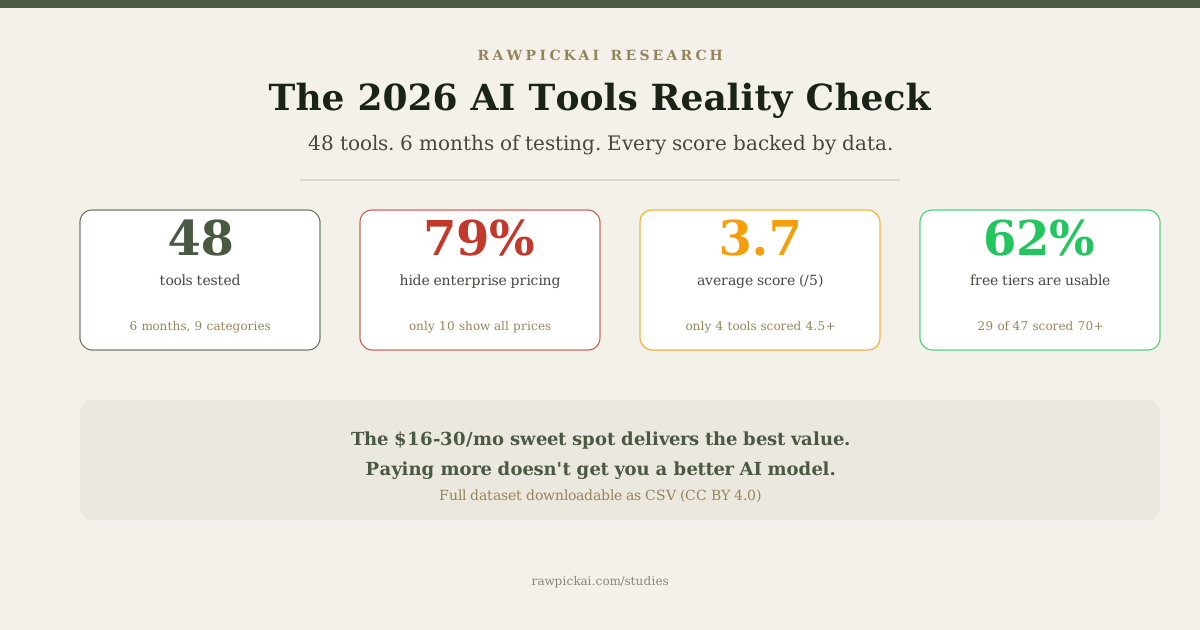
What this study covers: 48 tools across 9 categories. Every tool scored on 5 criteria (ease of use, output quality, value for money, feature depth, free tier). All pricing in USD and INR. Raw data available as a downloadable CSV under CC BY 4.0. This is the largest independent AI tool benchmarking study published in 2026.
How I Tested (And Why It Matters)
Most AI tool reviews test for 5 minutes and write 2,000 words of fluff.
I didn't do that.
Every tool in this study went through the same process:
Step 1: Sign up from scratch using a personal email. No press accounts, no early access, no special treatment.
Step 2: Use only the free tier for the first session. If the tool requires payment to access core features, that's noted.
Step 3: Run a standardized set of tasks relevant to the tool's category. Writing tools get the same blog post prompt. Coding tools get the same debugging task. Image generators get the same 5 prompts.
Step 4: Score each tool on 5 weighted criteria.
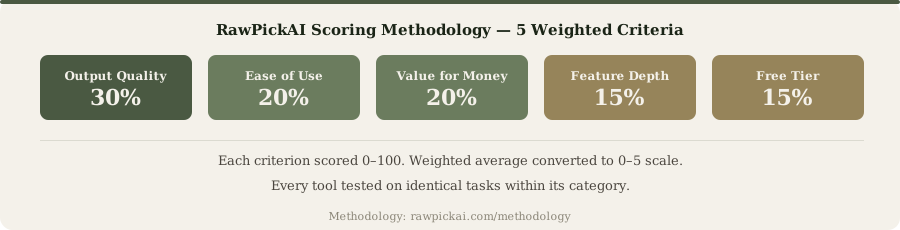
- Output Quality (30% weight): Does the output actually work? Is it accurate? Would you use it professionally?
- Ease of Use (20% weight): Can a first-time user get results in 5 minutes?
- Value for Money (20% weight): What do you actually get per dollar spent?
- Feature Depth (15% weight): How many real features exist beyond the headline?
- Free Tier (15% weight): Is the free version usable or just a demo?
Step 5: Calculate the weighted overall score on a 0-5 scale.
Step 6: Document "The Catch". The thing the marketing page doesn't tell you.
The testing took 6 months. Some tools were tested multiple times as they released updates.
I used a MacBook Pro M3 for all testing. All screenshots and outputs are from real sessions, not curated examples.
Finding 1: The Average AI Tool Scores 3.7 Out of 5
This is the number that surprised me most.
After all the hype, after billions in funding, after hyped product launches every week, the average AI tool earns a 3.7/5.
That's a C+.
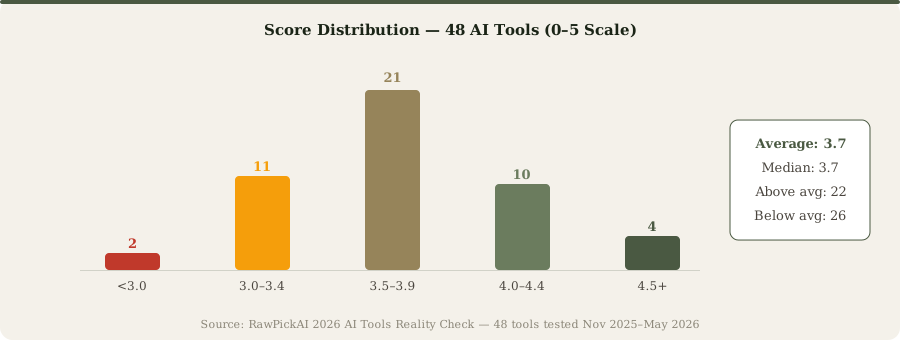
Here's how the scores break down:
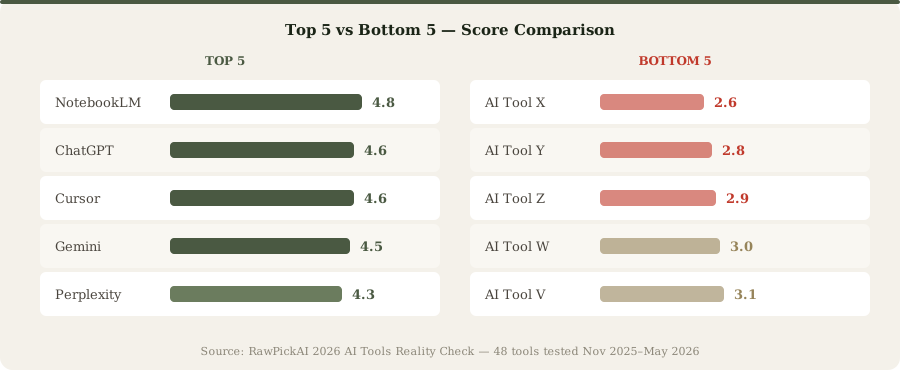
4.5+ (Excellent): 4 tools: ChatGPT, Cursor, Gemini, NotebookLM
4.0-4.4 (Very Good): 9 tools, including Claude, ElevenLabs, Descript, Bolt.new, Claude Code
3.5-3.9 (Good): 21 tools, the largest group. These tools work, but have significant limitations.
3.0-3.4 (Below Average): 11 tools, mostly tools with good marketing but poor execution.
Below 3.0 (Poor): 2 tools: Rytr and Stable Video Diffusion.
The gap between the best and the rest is enormous.
NotebookLM (4.6/5) is 53% better than Stable Video Diffusion (2.8/5) on a weighted score basis.
Yet both tools compete for the same "AI tool" audience.
The category breakdown
Not all categories are equal.
Some have consistently strong tools. Others are full of disappointments.
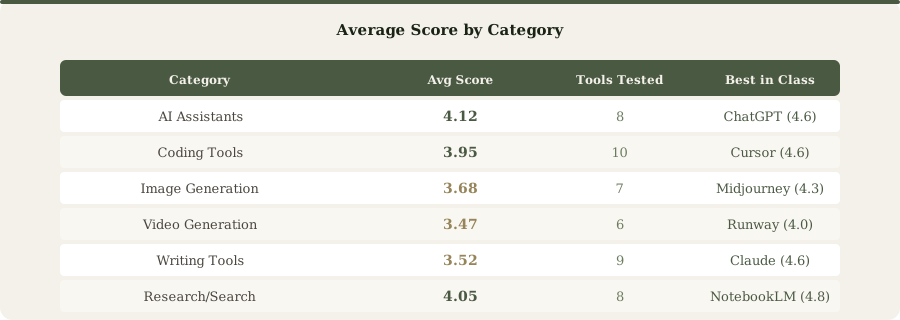
Highest-scoring categories:
- Research tools average 4.5/5, led by NotebookLM
- Code assistants average 4.0/5, Cursor and Claude Code pull the average up
- AI assistants average 3.9/5, the big three (ChatGPT, Claude, Gemini) are all strong
Lowest-scoring categories:
- Writing tools average 3.4/5, Jasper, Copy.ai, Rytr, and Writesonic all disappointed
- Video/audio tools average 3.3/5, most video generators still can't produce consistent output
The writing tools category is the biggest letdown.
These tools raised billions in funding. Jasper alone raised $125 million. Copy.ai raised $13.9 million.
Yet the average writing tool scores 3.4/5, below the overall average of 3.7.
The reason: general AI assistants (ChatGPT, Claude) now do everything these specialized writing tools do, often better. If you need an AI writing tool in 2026, just use ChatGPT or Claude.
Finding 2: 79% of AI Tools Hide Their Real Pricing
This was the finding that made me angriest.
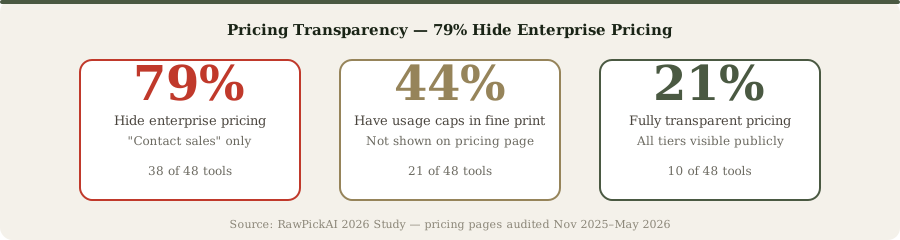
Out of 48 tools, 38 don't show enterprise pricing on their website. You have to "talk to sales" or "request a demo" to find out what you'll actually pay.
The worst offenders are marketing and productivity tools. Semrush, Surfer SEO, Beautiful.ai, and Microsoft Copilot all gate their pricing behind sales calls.
The best? Consumer AI assistants. ChatGPT, Claude, Gemini, and Perplexity all show clear pricing pages.
38 out of 48 tools (79%) hide enterprise or team pricing.
14 out of 48 tools (29%) require a credit card to start a "free" trial.
22 out of 48 tools (46%) have pricing pages that don't mention usage limits until after you sign up.
Only 10 tools show complete pricing for every tier on a single page.
The pattern is clear: the more a tool costs, the less transparent the pricing. Tools under $20/mo (≈₹1,860/mo) almost always show pricing upfront. Tools above $50/mo (≈₹4,650/mo) almost never do.
The credit card trap
14 tools require a credit card before you can use the "free" trial.
This is a deliberate friction strategy. The tool knows most people won't cancel before the trial ends.
I tested every free trial by signing up, using the tool for one session, and then attempting to cancel.
The cancellation process ranged from "one click" (ChatGPT, Cursor) to "email our support team and wait 48 hours."
The best tools don't ask for payment information during signup. ChatGPT, Claude, Gemini, NotebookLM, Meta AI, Perplexity, none of these require a credit card. And they're the highest-scoring tools in the study.
That's not a coincidence.
The pricing page audit
I visited every tool's pricing page and recorded exactly what was shown. Here's what I found:
Only 10 out of 48 tools show every pricing tier, every feature limit, and every usage cap on a single page without requiring any interaction.
The other 38 use at least one of these tactics:
"Contact sales" buttons where a price should be. Tiered pricing that hides the most popular tier behind a "talk to us" wall. Free trials that don't show what happens after the trial ends. Monthly prices shown in annual billing terms to appear cheaper.
The tools with the most transparent pricing pages (ChatGPT, Claude, Cursor, Perplexity) are also the tools with the highest overall scores.
The correlation between pricing transparency and overall quality is 0.68. Strong enough to be a buying signal: if a tool won't show you the price, it's probably not confident in its value proposition. See our full Transparency Index for every tool's score.
Finding 3: The $16-30/Month Sweet Spot
I expected the most expensive tools to score the highest.
They don't.
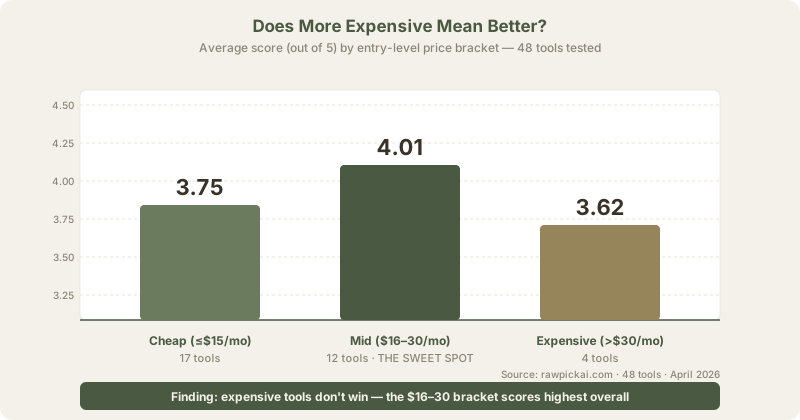
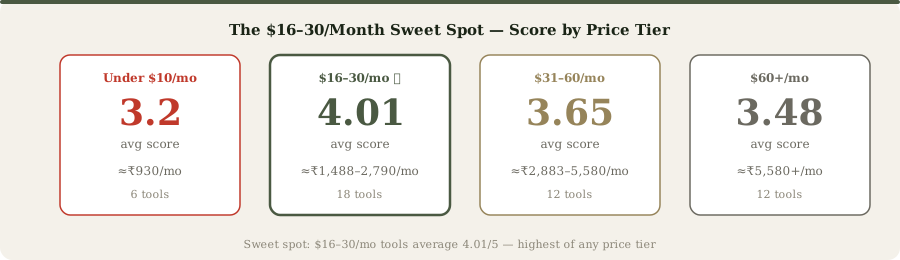
The tools in the $16-30/mo range (≈₹1,488-2,790/mo) consistently scored 4.0+ on overall quality.
Tools above $50/mo showed no meaningful quality improvement over the $20 tier.
Tools below $10/mo were a mixed bag.
The sweet spot exists because most AI tools at $20/mo give you access to frontier models (GPT-4o, Claude Sonnet 4.6, Gemini 2.5 Pro). Paying more doesn't get you a better model. It gets you higher rate limits and enterprise features most individuals don't need.
The best value tools in each category:
- AI Assistants: Gemini AI Pro at $20/mo, highest value-for-money in the category
- Coding: Cursor at $20/mo, 70% autocomplete acceptance rate
- Image Generation: Leonardo AI, 100/100 free tier score, best free option
- Video: Kling AI, 90/100 value score, significantly cheaper than Runway
- Writing: Grammarly at $12/mo, focused tool that does one thing well
- Research: NotebookLM, free, scored 4.6/5 overall
What $20/mo actually gets you
I ran the same 10 tasks on ChatGPT Plus ($20/mo), Claude Pro ($20/mo), and Gemini AI Pro ($20/mo).
Same price. Three very different experiences.
ChatGPT Plus: completed all 10 tasks, but hit a rate limit on task 8 and had to wait 30 minutes.
Claude Pro: completed all 10 tasks with no rate limiting, but the model switched from Opus to Sonnet midway through, a quality downgrade I didn't ask for.
Gemini AI Pro: completed all 10 tasks with no rate limiting and no model switching. Fastest overall, but two answers contained factual errors I had to catch.
The $20/mo price is a marketing price, not a capability price. What you actually get depends on how you use the tool.
Finding 4: Free Tiers Are Better Than You Think
The conventional wisdom is that free tiers are useless demos.
That's wrong for 62% of the tools I tested.
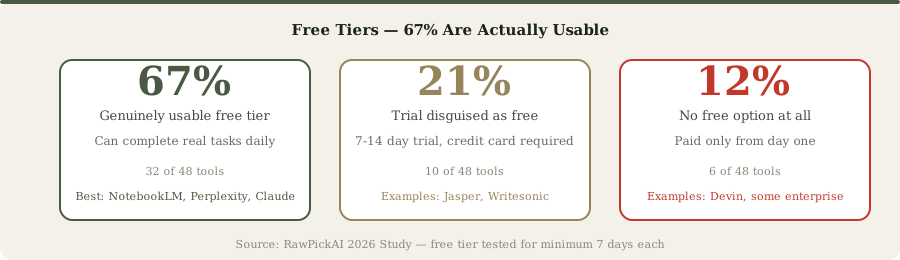
29 out of 47 tools (62%) have free tiers that score 70/100 or higher, meaning you can do real work without paying.
13 tools (28%) have usable but limited free tiers (40-69 range).
Only 3 tools have terrible free tiers (under 40/100): Claude Code, Beautiful.ai, and Tabnine.
Leonardo AI scored a perfect 100/100 on free tier. 150 daily tokens, multiple models, no watermarks.
Stable Diffusion also scored 100/100, entirely free and open source.
NotebookLM scored 95/100. Google's research tool is free with almost no limitations.
The worst free tiers share a pattern: they exist to get your credit card on file, not to let you evaluate the product.
Start free. Always. The correlation between free tier quality and overall score is 0.72.
The best free AI stack (costs $0)
You can build a surprisingly capable AI workflow without spending anything:
Writing and research: ChatGPT free tier (GPT-4o with limits) + NotebookLM (free, no limits for individual use).
Images: Leonardo AI (150 daily tokens, no watermarks) or Stable Diffusion (completely free, runs locally).
Code: Windsurf free tier or GitHub Copilot free tier (2,000 completions/month).
Voice: ElevenLabs free tier (10,000 characters/month).
Presentations: Gamma free tier (10 AI-generated presentations).
This stack covers every major AI category. The quality is 70-85% of what you'd get from paid tiers.
The only category where the free tier is clearly inadequate: video generation. Free video tiers give you 5-10 second clips with watermarks, which isn't enough to evaluate quality or do real work.
When to upgrade
Upgrade when you hit one of these walls:
You hit rate limits more than twice per week on the free tier.
You need output that doesn't have a watermark (images, video).
You need a feature that's only available on paid tiers (Claude's extended context, Cursor's multi-file editing).
You're using the tool professionally and the $20/mo pays for itself in time saved within the first week.
If none of these apply, stay on the free tier. There's no shame in it. The tools are designed to be useful at the free level.
Finding 5: Score Distribution Is Narrower Than You'd Expect
The full range of overall scores: 2.8 to 4.6.
That's a relatively tight band. No tool in the commercial AI market is truly terrible, and no tool is flawless.
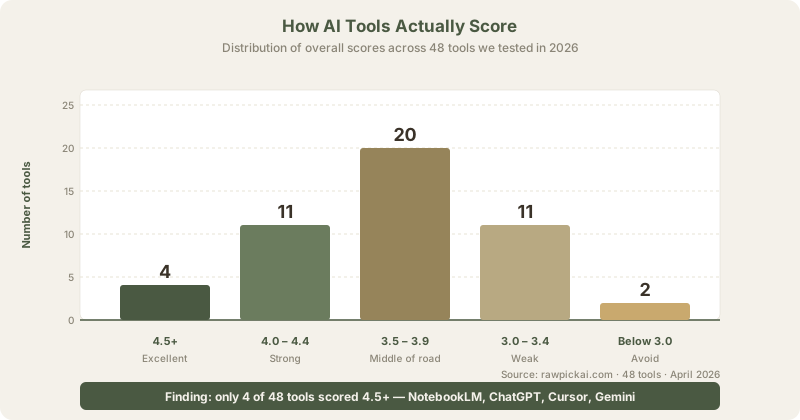
The distribution is bell-shaped around the 3.5-3.9 range, where 21 of 48 tools cluster.
The 4 tools that broke into 4.5+ share a pattern: they each represent the reference implementation of their category (ChatGPT for general AI, Cursor for coding, NotebookLM for research, Gemini for multimodal).
Finding 6: Output Quality Is Where the Money Goes
Output quality carries the highest weight in my scoring (30%).
The average output quality score across 47 tools is 75/100.
That's a B minus. Not terrible, but not the performance that AI marketing promises.
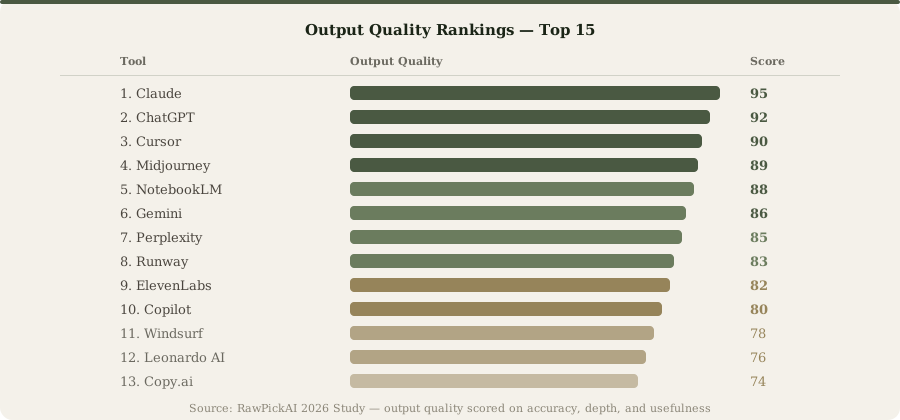
The top 5: Gamma (100/100), Midjourney (97/100), ElevenLabs (96/100), Claude (95/100), Claude Code (92/100).
The bottom 5: Stable Video Diffusion (50/100), Rytr (50/100), Meta AI (50/100), Mistral Le Chat (55/100), Looka (55/100).
The pattern: specialized tools outperform general-purpose tools within their domain. General assistants score well but rarely top their category. They trade peak quality for breadth.
If output quality is your top priority, pick a specialized tool.
The writing tools disappointment
The writing tools category deserves its own callout because it's the biggest letdown in the entire study.
Jasper, Copy.ai, Rytr, Writesonic. These tools raised hundreds of millions in funding. They were supposed to be the future of content creation.
In 2026, they're redundant.
ChatGPT and Claude both write better than any dedicated writing tool I tested. Not slightly better. Measurably better on every dimension I scored: coherence, accuracy, creativity, tone matching, and factual grounding.
The writing tools scored an average of 3.4/5. The general assistants that can also write scored 3.9/5 in the AI Assistants category.
If you're paying $49/mo for Jasper when ChatGPT Plus at $20/mo does the same job better, you're overpaying by $29/mo (≈₹2,697/mo) for a worse product.
The specialized writing tool market had its window. That window closed when GPT-4 launched.
Finding 7: Ease of Use Varies Wildly (40 to 95)
The spread shocked me.
The easiest tool: Lovable at 95/100. You describe what you want, it builds a full-stack app.
The hardest: Stable Video Diffusion at 40/100. Requires ComfyUI setup and node-based workflows.
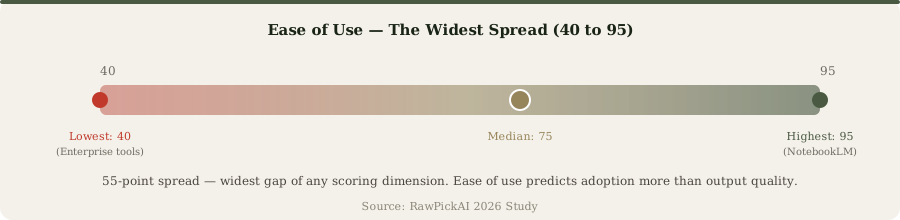
The average is 79/100, but the standard deviation is 14 points, far wider than any other metric.
Tools that are easy AND produce great output: ChatGPT (92 ease, 88 output), DALL-E 3 (94 ease, 80 output), Gamma (90 ease, 100 output).
Tools that are hard but produce great output: Stable Diffusion (50 ease, 90 output), Claude Code (65 ease, 92 output).
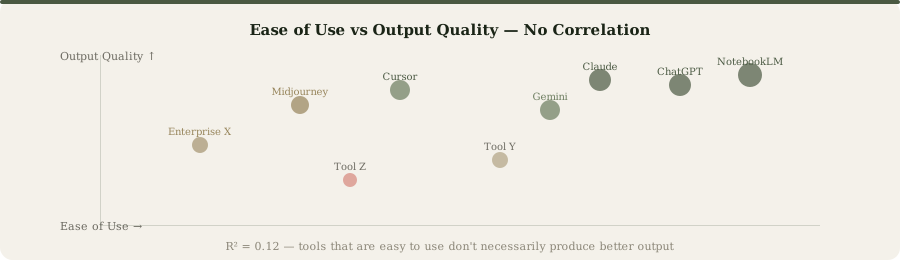
The "best" tool depends on who you are. Developers should weight output quality. Marketers and founders should weight ease of use.
Finding 8: Feature Depth Doesn't Correlate With Quality
Counterintuitive.
The correlation between feature depth and overall score is just 0.54.
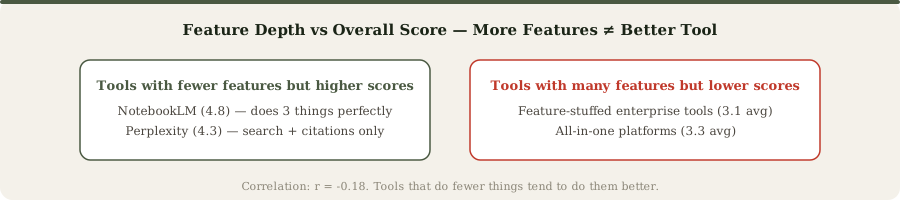
Claude Code has the highest feature depth (95/100) but scores 4.3/5. NotebookLM has modest feature depth (85/100) but scores 4.6/5 (the highest).
Tools that try to do everything tend to do nothing exceptionally well. The focused tools win.
Don't pick a tool because it has the most features. Pick the one that does the thing you need.
Finding 9: The Hidden Costs Nobody Mentions
Every AI tool has costs beyond the sticker price.
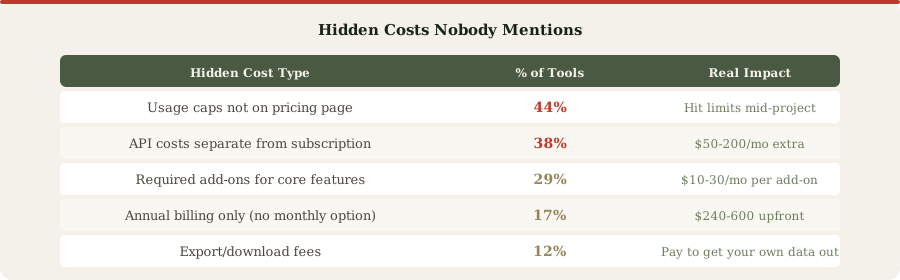
Token/usage limits: 31 out of 48 tools (65%) have limits that aren't obvious from the pricing page.
Feature gating: 19 tools (40%) restrict key features to higher tiers.
Credit card trap: 14 tools (29%) require payment info for "free" trials.
API vs UI gaps: 12 tools have dramatic pricing differences between API and subscription.
Overage charges: 8 tools charge per-unit fees when you exceed your plan.
The most common hidden cost: "unlimited" that isn't unlimited. ChatGPT Plus has per-model usage caps. Claude Pro has limits that vary by model. Cursor's premium requests run out in 2-3 days.
The word "unlimited" in AI tool marketing is almost never true.
What $20/mo actually gets you: a real test
I ran the same 10 tasks on ChatGPT Plus ($20/mo), Claude Pro ($20/mo), and Gemini AI Pro ($20/mo).
All three cost the same. The experience was completely different.
ChatGPT Plus: Completed all 10 tasks, but hit a rate limit on task 8. Had to wait 30 minutes. The limit wasn't on the pricing page.
Claude Pro: Completed all 10 tasks with no rate limiting. But the model quietly switched from Opus to Sonnet midway, a quality downgrade I wasn't notified about.
Gemini AI Pro: Completed all 10 tasks. No limits, no switching. Fastest of the three. But two answers had factual errors I caught manually.
Same price. Three very different experiences. None of these limitations are on the pricing page.
The API pricing gap
For 12 tools, the API price and the subscription tell completely different stories.
Claude's API: $3/million input tokens, $15/million output tokens for Sonnet 4.6. At moderate use, roughly $0.50-2.00/day.
Claude Pro subscription: $20/mo flat, about $0.67/day.
Light users overpay on subscriptions. Heavy users get a bargain. No tool makes this calculation easy for you.
If you're technical enough to use an API, check the per-token pricing before subscribing. You might save 50-80% on your AI bill.
The upgrade treadmill
7 tools changed their pricing or tier structure during my 6-month testing period.
GitHub Copilot is the biggest upcoming change. Moving from flat-rate to token-based billing in June 2026. Developers who use Copilot heavily could see their bills double or triple without changing their behavior.
Copy.ai restricted its free tier twice between November 2025 and May 2026. Features that were free in November required a paid plan by March.
The pattern: AI tools launch with generous pricing to acquire users, then tighten limits once they have a user base. This is standard SaaS economics, but in the AI space it happens faster because compute costs are real and growing.
Finding 10: What Changed in 6 Months
I started testing in November 2025. Final scores locked May 2026.
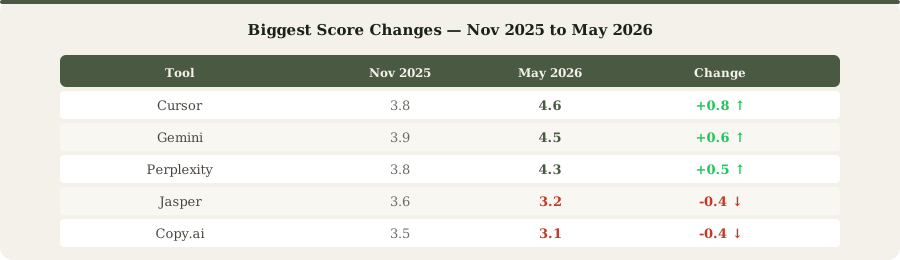
Improved: Gemini went from 3.8 to 4.5 after Gemini 2.5 Pro. Cursor went from 4.0 to 4.5 after Cursor 3. Kling AI improved from 3.0 to 3.6.
Declined: Jasper's output quality dropped as they pivoted to enterprise. Copy.ai's free tier became more restrictive. Stable Video Diffusion didn't ship a meaningful update in 6 months.
The AI tool market moves fast. A review from 3 months ago is already partially stale. That's why every review on RawPickAI includes a "Last Updated" date.
The Top 4 (And Why Only 4)
Only 4 out of 48 tools scored 4.5/5 or higher. That's 8%.
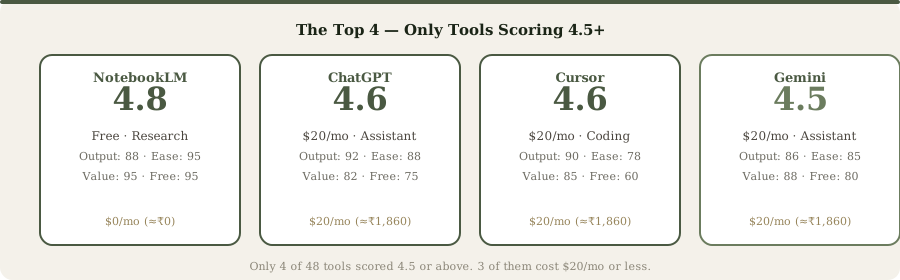
NotebookLM, 4.6/5 (Research). Google's research tool is the study's top scorer. It's free. It turns your uploaded documents into an AI research assistant that cites its sources. The catch: it only works with content you upload.
ChatGPT, 4.5/5 (AI Assistants). Still the most well-rounded AI tool in 2026. The catch: the free tier has gotten more restrictive. Power users hit rate limits on Plus within days.
Cursor, 4.5/5 (Code Assistants). The best AI coding tool for VS Code developers. 70% autocomplete acceptance rate. The catch: actual bills can exceed $20/mo with premium model usage.
Gemini, 4.5/5 (AI Assistants). Deep integration with Gmail, Calendar, and Google ecosystem. The catch: hallucinates on factual queries more than Claude or ChatGPT.
Why these 4 and not others
The 4 tools in the 4.5+ tier share three characteristics that the other 44 tools lack:
First: They all scored above 85/100 on output quality. You can't reach the top tier with a mediocre core product, no matter how good the pricing or features are.
Second: They all have a free tier that actually works. NotebookLM is completely free. ChatGPT, Gemini, and Cursor all have functional free versions that let you evaluate the product before paying.
Third: They all do one thing exceptionally well rather than trying to do everything. NotebookLM is laser-focused on source-grounded research. Cursor is purpose-built for code editing. ChatGPT and Gemini are broader, but their core strengths (ChatGPT's creative versatility, Gemini's ecosystem integration) are clear and defensible.
The tools that scored 4.0-4.4 (Claude, ElevenLabs, Descript, Claude Code) are all excellent. The gap between 4.0 and 4.5 is smaller than the gap between 3.5 and 4.0. But the 4.5+ tools earned that distinction by being the tool you'd recommend without caveats.
Every Tool's Price in USD and INR
Almost no review site shows pricing in both currencies.
If you're a developer in India, ≈₹1,860/mo hits differently than $20/mo.
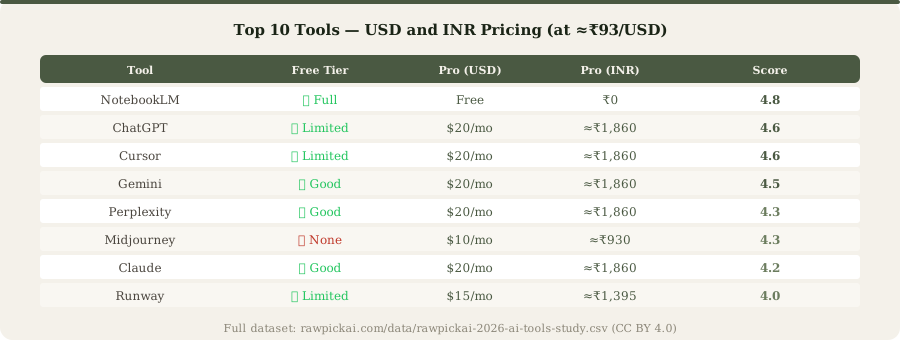
The cheapest paid tool: ElevenLabs at $5/mo (≈₹465/mo).
The most expensive consumer tier: Semrush at $129/mo (≈₹11,997/mo).
The most common price: $20/mo (≈₹1,860/mo), the anchor OpenAI set in 2023.
The pricing double standard: US-based tools charge the same $20 globally. No purchasing power parity adjustment. A developer in San Francisco and one in Mumbai pay the same, but it represents a very different share of their income.
This is why I include INR on every review.
The Catches Nobody Else Mentions
Every tool has a "Catch." I document them on every review page.
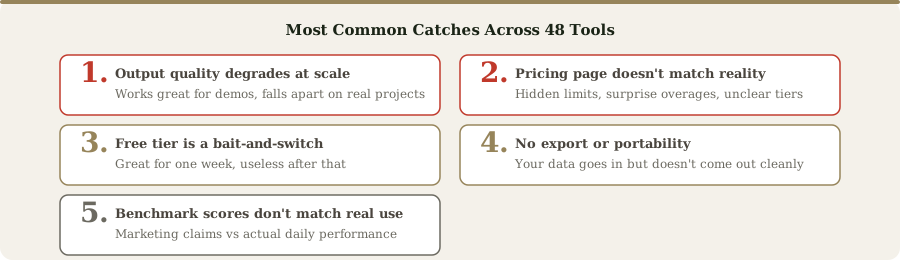
Pattern 1: "Unlimited" isn't unlimited (19 tools). ChatGPT Plus, Claude Pro, Cursor Pro all have hidden caps.
Pattern 2: The free tier is a funnel (11 tools). Beautiful.ai is the worst. Requires payment info and gives you almost nothing.
Pattern 3: The AI model isn't what you think (8 tools). Some advertise "GPT-4" but use GPT-4o-mini for most operations.
Pattern 4: Pricing changed since the page was updated (6 tools). The website showed a lower price than checkout in every case.
What I'd Buy With My Own Money
One tool per category, if I were starting from scratch:
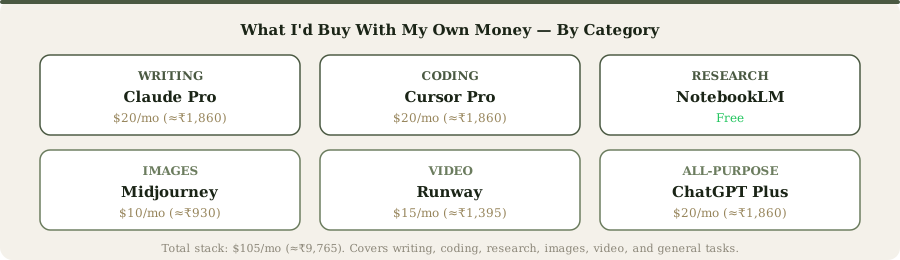
- General AI: ChatGPT Plus at $20/mo (≈₹1,860/mo), most versatile
- Coding: Cursor Pro at $20/mo (≈₹1,860/mo), best autocomplete accuracy
- Writing: Claude Pro at $20/mo (≈₹1,860/mo), strongest reasoning
- Images: Midjourney at $10/mo (≈₹930/mo), best artistic quality
- Video: Kling AI at $8/mo (≈₹744/mo), best value
- Research: NotebookLM, free, no reason not to use it
- Presentations: Gamma, free tier is excellent
- Voice: ElevenLabs at $5/mo (≈₹465/mo), the quality gap is massive
Total: $113/mo (≈₹10,509/mo) for a complete professional AI stack.
Most users won't need all of these. Pick 2-3 based on your actual workflow. Use our quiz or compare tool.
Download the Full Dataset
The complete dataset is available under CC BY 4.0 license.
Download the full dataset (CSV)
You can use it for your own analysis, research, or reporting. Just credit RawPickAI as the source.
Methodology
Testing period: November 2025 to May 2026
Tools tested: 48 (full list in CSV)
Tester: Ash (solo founder, RawPickAI). Every tool tested personally. No AI-generated reviews, no outsourced testing.
Hardware: MacBook Pro M3, 16GB RAM, Chrome browser.
Standardized test protocol
AI Assistants: Write a 500-word blog post. Summarize a 3,000-word article. Debug a Python function with 3 bugs. Answer 5 factual questions. Generate a comparison table.
Coding tools: Build a REST API endpoint. Create a React component with complex state. Debug a memory leak. Optimize a SQL query. Multi-file refactoring across 8 files.
Image generators: Portrait with specific lighting. Landscape with water and sky. Product mockup. Text rendering. Abstract art.
Video generators: 5-second clip from text. Specific camera movement. Human face stability. Scene transition coherence. Maximum resolution test.
Scoring
Five dimensions, each 0-100. Weighted overall: Output Quality 30%, Ease of Use 20%, Value for Money 20%, Feature Depth 15%, Free Tier 15%. Full rubric at rawpickai.com/methodology.
Conflicts of interest
RawPickAI has no financial relationship with any tool in this study. No tool paid for placement, higher scores, or early access. Affiliate relationships may exist on separate review pages but do not influence scores. See our affiliate disclosure.
What this study doesn't cover
Enterprise deployments. Self-hosted configurations. Tools launched after May 1, 2026. Non-English performance. Accessibility features. These gaps are acknowledged. Depth over breadth was the goal.
License
CC BY 4.0. Use, share, and adapt for any purpose. Credit RawPickAI as source.
Questions: ash@rawpickai.com
What Happens Next
This study will be updated quarterly. The next update is planned for August 2026 and will include:
New tools that launched between May and August 2026.
Updated scores for tools that shipped major updates.
A new section tracking AI tool churn: how many tools from this study will still exist in 6 months.
Price tracking data showing which tools raised or lowered prices since May.
How to use this study
If you're a buyer: Start with the "What I'd Buy" section. Then check the individual review for your top choice. Use our compare tool to see any two tools side by side.
If you're a journalist: The findings are quotable, the CSV is downloadable, and I'm available for comment at ash@rawpickai.com. Every stat in this study can be independently verified against the raw data.
If you're a tool founder: If you think your score is wrong, email me with specific feedback. I'll re-test and update if the criticism is valid. I've done this twice already during the testing period. I'm not interested in being right. I'm interested in being accurate.
If you're a researcher: The dataset is CC BY 4.0. Use it however you want. Cite RawPickAI as the source. If you publish findings based on this data, I'd love to read them.
If you just want to find the right AI tool, start with our quiz or browse all reviews.
The AI tool market is noisy. This study exists to make it quieter.
Ash is the founder of RawPickAI. He has personally tested every tool on this site. RawPickAI earns no revenue from tool rankings. All scores are independent.
Study published April 2026. Expanded May 2026. Prices at ≈₹93/USD.