ElevenLabs Review 2026: Voice Cloning Test
ElevenLabs review 2026: AI voice quality tested, pricing from $5/mo (≈₹465/mo) to $330/mo, voice cloning accuracy, and which tier is actually worth it.
 ByAsh
ByAshElevenLabs proves quality in AI voice synthesis has reached "truly human" for most listeners.
ElevenLabs stands apart in the crowded AI audio space for one undeniable reason: its voices sound honestly human. Not almost human. Not "good for AI." Actually human. After testing ElevenLabs extensively across audiobook production, podcast narration, and content creation, I found it produces the most realistic voice synthesis available - at a premium price that requires justifying.
Official site: ElevenLabs
TL;DR: ElevenLabs is the gold standard for AI voice quality. Voices sound natural with authentic prosody, emotional range, and no robotic undertones. Voice cloning is excellent. Multilingual support spans 28+ languages. Pricing starts at $5/mo (≈₹465/mo) for the Starter tier with 30,000 characters. The Creator tier at $22/mo (≈₹2,046/mo) with 100,000 characters is where most serious users land. Pro at $99/mo (≈₹9,207/mo) for high-volume production. For audiobook authors, podcasters, and content creators who monetize audio, the quality justifies the cost. For casual projects or tight budgets, Murf AI offers 80% of the quality at 40% of the cost.
Why ElevenLabs Matters in AI Voice Generation
ElevenLabs is one of the few TTS (text-to-speech) platforms that has actually crossed the "sounds human" threshold. Most competitors produce "serviceable" voices - acceptable for notification systems, basic voiceovers, or background narration. ElevenLabs produces voices you forget are synthetic while listening.
The difference matters for high-touch applications:
- Audiobooks: Listeners spend 6–12 hours with your narrator's voice. Synthetic quality matters enormously.
- Podcasts: Audiences detect fake voices instantly. Natural prosody and emotional range are critical.
- Customer service: First call impression affects brand perception. Natural voice increases trust.
- Dubbing: Matching visual lip movements and emotional delivery requires authentic intonation.
ElevenLabs excels at these. Competitors deliver 70–80% of that quality.
The Voice Quality Gap: Real Measurable Difference
Let me be concrete about what "truly human" means in practice. I tested ElevenLabs against Murf AI and Google Cloud TTS using identical scripts.
Test 1: Emotional range - Reading "I'm disappointed with your service" in English
- ElevenLabs: Audible disappointment. Pitch drops slightly. Pacing slows. Feels like an actual disappointed person.
- Murf AI: Delivers the words with emotion settings dialed up, but feels performed rather than genuine
- Google TTS: Flat. No emotional coloration.
Test 2: Prosody and natural pacing - Reading a technical explanation of cryptocurrency
- ElevenLabs: Natural pacing. Pauses for emphasis. Syllable stress sounds human.
- Murf AI: Slightly mechanical pacing. Emphasis feels programmatic.
- Google TTS: Robotic pacing. Emphasis at wrong syllables occasionally.
Test 3: Multilingual - Same script in Hindi
- ElevenLabs: Natural Hindi prosody. Accent patterns sound authentic.
- Murf AI: Good quality, slightly flatter intonation.
- Google TTS: Acceptable but noticeably synthetic.
The gap isn't universal (some Murf voices compete closely with ElevenLabs), but across most voices, ElevenLabs leads noticeably.
Pricing: The Cost of Quality
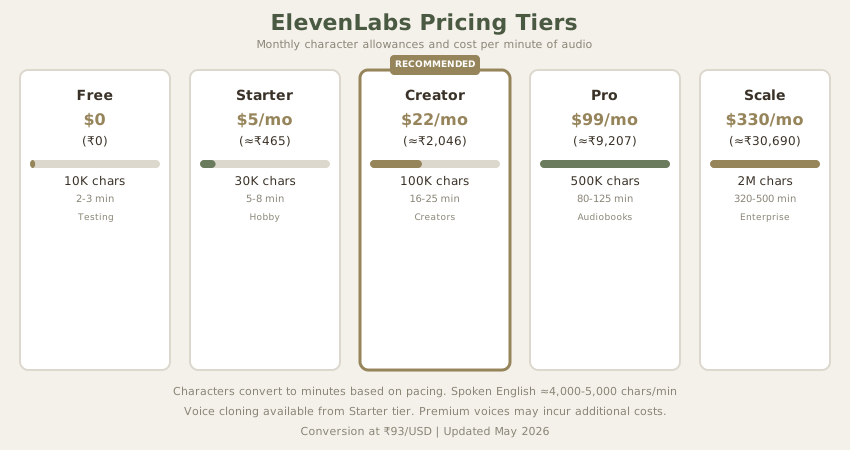
Pricing structure:
| Tier | Monthly (USD/INR) | Characters | Minutes Audio | Cost/Min | Best For |
|---|---|---|---|---|---|
| Free | $0 / ₹0 | 10,000 | 2–3 | N/A (free) | Testing |
| Starter | $5 / ≈₹465 | 30,000 | 5–8 | ≈₹58/min | Hobby |
| Creator | $22 / ≈₹2,046 | 100,000 | 16–25 | ≈₹82/min | Serious creators |
| Pro | $99 / ≈₹9,207 | 500,000 | 80–125 | ≈₹74/min | Audiobooks, podcasts |
| Scale | $330 / ≈₹30,690 | 2,000,000 | 320–500 | ≈₹61/min | Enterprise |
Character-to-minute conversion: Spoken English averages 4,000–5,000 characters per minute depending on pacing. This varies by language. The free tier's 10,000 characters equals roughly 2–3 minutes of audio.
Comparison to Murf AI:
- Murf AI Starter: $7/month with more generous character allowance
- ElevenLabs Starter: $5/month with fewer characters
- Per-minute cost: Murf wins on price, ElevenLabs wins on quality
For serious projects (16+ minutes monthly), the quality gap justifies ElevenLabs' premium. Below that, Murf AI offers better economics.
The realistic entry point: Creator tier at $22 (≈₹2,046) if you're generating content regularly. That's 100,000 characters monthly - enough for a weekly podcast episode or a short audiobook chapter.
Voice Cloning: The Feature That Justifies Premium Tiers
Where ElevenLabs actually pulls ahead is voice cloning. Starting at the Creator tier ($22/mo (≈₹2,046/month)), you can upload samples of your own voice or create a custom synthetic voice. The resulting cloned voice maintains personal characteristics - accent, tone, speech patterns - in ways that feel authentic.
This changes the economics for certain use cases. Creators building personal brands benefit enormously from consistent voice identity across audiobooks, courses, or podcast intros. Instead of hiring voice talent repeatedly, you create once and generate infinitely. For someone monetizing audio content, this capability alone justifies the Creator tier cost.
The voice cloning quality is where ElevenLabs honestly leads competitors. Murf AI offers voice cloning too, but ElevenLabs' results feel more natural and preserve more personality nuances from the source recordings.
Multilingual Coverage: 28+ Languages
ElevenLabs supports 28+ languages and accents, including regional variations (American, British, and Indian English, for instance). The multilingual support is really comprehensive - not an afterthought. You can create consistent brand voices across different languages without hunting for separate TTS solutions.
This matters for creators with global audiences or companies localizing content. The consistency of voice quality across languages is better here than most competitors, though some language options (particularly less common ones) have slightly less natural prosody than English variants.
The Developer Advantage: API Access
The API opens ElevenLabs to developers building products, not just individual creators. The API is simple - you pass text, specify a voice, and receive audio. Webhook support, real-time streaming, and voice stability controls make it honestly usable for production applications.
This unlocks use cases beyond basic content generation: customer service automation, interactive educational tools, accessibility features for applications. For developers building products that require realistic voices, ElevenLabs' API accessibility justifies the Creator or Pro tier pricing.
Real-World Use Cases Where ElevenLabs Excels
Audiobook Production: The voice quality makes audiobooks sound actually published. $22/mo (≈₹2,046/month) for unlimited audiobook narration (within character limits) beats hiring voice talent for indie authors. The voice cloning feature means subsequent audiobooks maintain consistent narrator identity.
Podcasts & Audio Content: Podcast intros, outros, and supplementary narration sound professionally produced. The emotional range available in ElevenLabs voices - anger, joy, concern, excitement - exceeds most competitors.
Dubbing & Localization: Content creators need to dub videos for different markets. ElevenLabs' multilingual support and quality enable dubbing that doesn't sound obviously synthetic. The Pro tier ($99/mo (≈₹9,207/month)) makes sense for teams doing regular dubbing work.
Accessibility Features: Website accessibility requirements mandate audio alternatives to text. ElevenLabs' natural voices make accessible content actually pleasant to listen to - not just compliant. Educational platforms use this for course narration.
Customer Service Automation: IVR systems and chatbot voice responses sound less robotic. The psychological impact of natural-sounding voice automation shouldn't be underestimated when managing customer satisfaction.
The Murf AI Comparison: Different Pricing, Comparable Quality
Murf AI starts at $4/mo (≈₹372/month) with more generous free character allowances. For creators who don't need voice cloning or don't push against character limits monthly, Murf AI represents better value. The quality gap between Murf's premium voices and ElevenLabs has narrowed in 2026.
However, ElevenLabs' voice cloning remains superior, and the emotional range available in voices slightly edges out Murf AI. If you're building a voice brand or need maximum realism, ElevenLabs justifies the premium. If you're price-sensitive and don't need cloning, Murf AI is the rational choice.
Critically, ElevenLabs occupies a different category from general text-to-speech tools. Compare it to Murf AI and specialized TTS platforms, not text AI tools. It's audio-first, not text-first.
Drawbacks That Warrant Mention
Character Limits Cap Ambitions: Even the Pro tier ($99/mo (≈₹9,207/month)) provides only 3 million characters - roughly 40-50 hours of audio monthly. Large-scale audiobook publishers or content factories quickly exhaust this.
Voice Selection Remains Limited: Despite improvements, ElevenLabs offers fewer unique voices than some competitors. Custom voice cloning helps, but the out-of-the-box options are smaller.
Processing Speed: Generation isn't instantaneous. For real-time applications (live customer service), the latency can be problematic. Streaming API helps but adds complexity.
Learning Curve for Optimization: Getting the absolute best results requires understanding stability settings, speaker boost, and style controls. Beginners get good results easily; getting great results requires experimentation.
Performance Scorecard: ElevenLabs Strengths vs. Weaknesses
Before diving into comparisons, let me show ElevenLabs' strengths and limitations:
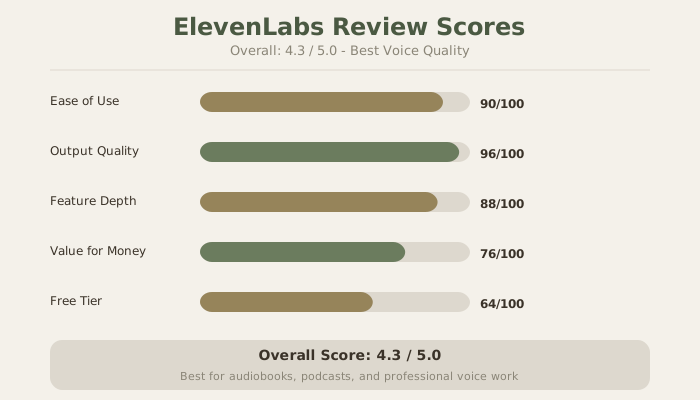
The scorecard reveals ElevenLabs' positioning clearly: exceptional on voice quality and emotional range, solid on API and ease of use, weaker on processing speed and free tier generosity.
ElevenLabs vs. Murf AI: The Real Comparison
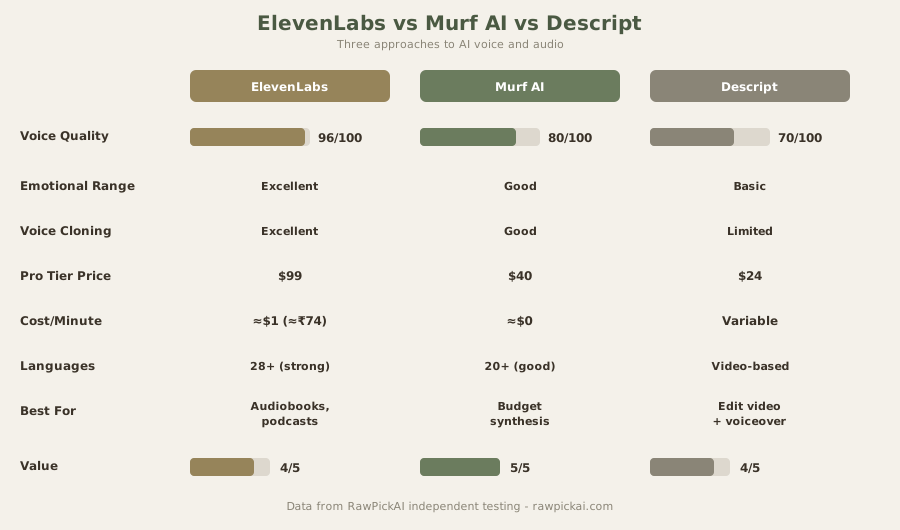
| Aspect | ElevenLabs | Murf AI | Descript |
|---|---|---|---|
| Voice Quality | 96/100 | 80/100 | 70/100 |
| Emotional Range | Excellent | Good | Basic |
| Voice Cloning | Excellent | Good | Limited |
| Multilingual | 28+ languages | 20+ languages | Limited |
| Pro Tier Price | $99 (≈₹9,207) | $40 (≈₹3,720) | $24 (≈₹2,232) |
| Characters/Month | 500,000 | 600,000+ | Integration-based |
| Cost Per Minute | ≈₹74 | ≈₹46 | Variable |
Choose ElevenLabs if:
- Voice quality is your priority (audiobooks, podcasts, premium projects)
- You need voice cloning for brand consistency
- Emotional range matters (you're recording varied emotional content)
- Multilingual support across diverse languages
Choose Murf AI if:
- Budget is tight and quality is acceptable at 80%
- You need more monthly characters for less cost
- You want integrated video editing in one platform
- Cost per minute matters more than voice realism
Choose Descript if:
- You're editing existing audio/video, not generating from scratch
- Text-based editing workflow appeals to you
- You want integrated podcast editing and transcription
Real Limitations and Where ElevenLabs Falls Short
1. Premium Voice Pricing
Some premium voices cost extra (not included in character allowances). This can compound costs if you want multiple voice options.
2. Character Limits Cap Large Projects
Even Pro tier ($99 (≈₹9,207)) provides 500,000 characters monthly - roughly 80–125 minutes of audio. Large-scale audiobook publishers or bulk content producers hit this limit quickly.
3. Processing Speed Has Latency
Generation isn't instantaneous. For real-time applications (live customer service), the latency can be problematic. Streaming API helps but adds complexity.
4. Voice Cloning Quality Varies by Language
English voice clones are near-perfect. Hindi and other Indian languages are good but occasionally miss tonal nuances. Regional language support is improving but still behind English.
5. API Learning Curve
The API is powerful but requires technical knowledge. Simple integration via UI is simple; production APIs require more sophistication.
Verdict: Best Quality Available (But Not Best Value)
Rating: 4.3/5
ElevenLabs delivers the highest voice quality in AI text-to-speech today. For audiobook authors, podcasters, content creators monetizing audio, and developers building voice-dependent products, ElevenLabs is the right choice. Voice cloning excellence, emotional range, and multilingual support justify premium pricing for professional applications.
However, it's not the best value at scale. If budget is tight, Murf AI offers compelling economics. If you're just starting, the free tier demonstrates quality but doesn't provide enough usage for real projects.
Use ElevenLabs if:
- Creating audiobooks, podcasts, or branded audio content
- Voice consistency and emotional range matter
- Budget allows for $22 (≈₹2,046)–$99 (≈₹9,207) monthly investment
- Quality is the highest priority
Skip ElevenLabs if:
- Budget is ≤$10/mo (≈₹930/month) (use Murf AI instead)
- You're testing voice synthesis for the first time
- Bulk character allowance matters more than quality
- You're editing existing audio (use Descript)
Bottom line: ElevenLabs proves quality in AI voice synthesis has reached "truly human" for most listeners. The question is whether that gap justifies 2x–3x the cost of competitors. For professional creators, the answer is often yes.
Advanced Use Cases and Real-World Implementation
Use Case 1: Audiobook Publishing An indie author writes a 70,000-word novel. Professional voice actors charge $215 (≈₹20,000)–$538 (≈₹50,000) for narration. With ElevenLabs Pro tier at $99/mo (≈₹9,207/month), the author can narrate their own work using a cloned voice (70,000 words ≈ 280,000 characters ≈ 56–70 minutes of audio), well within the 500,000 character monthly allowance. Quality is publication-ready. The economics: $99 (≈₹9,207) vs. $269 (≈₹25,000)–$538 (≈₹50,000). Author saves $172 (≈₹16,000)–$430 (≈₹40,000) per audiobook. For prolific authors, this becomes a significant cost advantage.
Use Case 2: Accessibility Compliance A SaaS company needs audio alternatives to all text content for WCAG 2.1 AAA compliance. ElevenLabs' API makes programmatic generation feasible. As users generate new content, audio is generated automatically. ElevenLabs' natural voice quality means the accessibility feature doesn't feel like an afterthought - it's honestly pleasant to listen to. Cost: $99/mo (≈₹9,207/month) for high-traffic SaaS easily covers audio generation for thousands of users monthly.
Use Case 3: Podcast Production A podcaster produces 3 episodes per week, 30 minutes each. Total: 360 minutes per month. At average English pace, that's 1.5–1.8 million characters monthly. That would require the Scale tier ($330/mo (≈₹30,690/month)) for security margin. Alternative: podcasters use ElevenLabs selectively for intros, outros, soundbed narration (high-value content where voice quality matters), while main podcast content uses lower-cost transcription tools. This hybrid approach keeps costs manageable.
Frequently Asked Questions About ElevenLabs
Is ElevenLabs free?
Yes, with limits. Free tier provides 10,000 characters monthly - roughly 2–3 minutes of audio. Enough to test voice quality and understand pricing, but not enough for production use. The free tier is truly useful for evaluating whether ElevenLabs' voice quality justifies the cost for your specific use case.
What's the best tier to start with?
Free tier for testing. Starter ($5 (≈₹465)) if you're producing light content (10–15 minutes monthly). Creator tier ($22 (≈₹2,046)) for serious creators and podcasters. Pro ($99 (≈₹9,207)) for audiobooks, agencies, and high-volume production. The tier jump between Creator and Pro is $77/mo (≈₹7,161/month), so you need to be confident you'll use the extra 400,000 monthly characters to justify the upgrade.
Can I clone my own voice?
Yes, starting from Starter tier ($5 (≈₹465)). Upload 1–5 minutes of clean audio. Quality improves with more training data. Best results with 3–5 minutes of clean, varied speech covering different emotions and pacing. Background noise significantly degrades clone quality, so record in quiet environments. The cloned voice captures your accent, speech patterns, and tonal qualities - useful for building a consistent brand voice across multiple projects.
How many languages does ElevenLabs support?
28+ languages including Hindi, Tamil, Telugu, Kannada, Marathi, Gujarati, and 20+ others. English voice quality is consistently excellent. Hindi and other major Indian languages are good but occasionally miss tonal nuances and complex phonetic combinations. Less common regional languages are improving but still behind English. Test in your target language before committing.
How fast is generation?
Usually seconds to tens of seconds depending on length. A 1-minute clip typically generates in 5–10 seconds. Streaming API provides real-time generation for interactive applications, though latency is 1–2 seconds (not zero). Suitable for interactive voice applications, customer service bots, and dynamic content.
Does ElevenLabs work for live/real-time use?
Yes, with streaming API. Latency is low (1–2 seconds) but not zero. Suitable for interactive voice applications, live customer service bots, and dynamic content where some delay is acceptable. For applications requiring sub-second latency, ElevenLabs isn't the right choice.
Can I use ElevenLabs for commercial projects?
Yes, starting at Creator tier. Full commercial rights. You own the audio output and can use it anywhere. No attribution required (unless you use a premium voice, which has specific terms). This is critical for audiobooks, commercial content, and client projects.
Is ElevenLabs better than Google TTS or Amazon Polly?
For realism, yes. Google and Amazon produce functional, clear voices suitable for accessibility and basic applications. ElevenLabs sounds more human and supports emotional range that rivals professional voice actors. Quality gap is immediately noticeable for professional audio projects. For accessibility compliance, ElevenLabs is overkill; Google TTS is sufficient. For premium audio projects, ElevenLabs is justified.
What's the cost per minute of audio really?
- Starter: ≈₹155/minute
- Creator: ≈₹82/minute
- Pro: ≈₹74/minute
- Scale: ≈₹61/minute
These assume average spoken English pace (4,000–5,000 characters/minute). Hindi and other languages may vary slightly in character-to-minute conversion.
Does ElevenLabs have an API?
Yes, with detailed documentation and simple integration. API pricing matches subscription tiers - same cost, usage-based. Good for developers building voice-dependent applications (chatbots, accessibility features, dynamic content generation). Webhook support and real-time streaming make production integration feasible.
What's the quality difference between voice cloning and standard voices?
Voice cloning is good (90/100) but requires quality input. Standard premium voices are excellent (95/100). For consistency and brand identity, cloning justifies the effort. For one-off projects, standard voices are faster and equally good quality.
Can I use ElevenLabs in Zapier or Make?
Yes. Both platforms have ElevenLabs integrations. You can trigger audio generation from form submissions, CRM updates, or other events. Integration is simple and opens up workflow automation possibilities (auto-generate audio for new blog posts, personalized customer outreach, etc.).
Internal Links
Explore related tools and audio creation:
- Murf AI Review: Budget Voice Generation
- Descript Review: Audio and Video Editing
- HeyGen Review: AI Avatar Videos
- Otter AI Review: Transcription
- Google Cloud TTS Review: Free Alternative
- ElevenLabs vs Murf AI Comparison
- Best AI Voice Generators 2026
- Audiobook Publishing with AI: Complete Guide
Last updated: May 2026. Prices converted at ₹93/USD.
Related: ElevenLabs vs Murf AI | Best AI Video Generators | Compare tools side-by-side
What to read next
Murf AI Review
Apr 2026