HeyGen Review 2026: AI Avatar Videos
HeyGen review: avatar quality, pricing from $29/mo (≈₹2,697/mo), multilingual video, and whether synthetic talking heads justify the cost.
 ByAsh
ByAshHeyGen solves a real problem: creating professional video content without hiring actors, booking studios, or spending days filming. You write a script, pick an avatar, and get a polished talking head video in minutes. I've tested HeyGen for everything from training videos to product demos to personalized customer outreach. The honest assessment: it works, but avatars still look noticeably synthetic.
Official site: HeyGen
TL;DR: HeyGen is the best AI avatar platform available, with actually impressive lip-sync accuracy and multilingual generation. But avatars don't look fully human - they look professional-but-artificial. This matters for some use cases (training, demos, internal comms) where synthetic is fine or even expected. For brand storytelling or customer-facing marketing where human authenticity is the product, avatars feel inauthentic. Creator tier at $29 (≈₹2,697) is reasonable for testing; Business tier ($89 (≈₹8,277)–$149 (≈₹13,857)) is justified only if you're generating 15+ videos monthly. Skip HeyGen if you have video or want to build brand narratives. Choose it for scale, speed, and budget when audiences accept synthetic presentation.
What HeyGen Is and Why It Matters
HeyGen is an AI platform that generates talking head videos using synthetic avatars. You provide a script, select an avatar appearance, pick a voice (AI-generated or cloned), and HeyGen generates a 1–10 minute video in 30–60 seconds. No actor, no camera, no studio required.
The economic case is strong:
- A 1-minute video with a real actor: $54 (≈₹5,000)–$161 (≈₹15,000) + production time
- A 1-minute video with HeyGen avatar: ≈₹30 + 1 minute of generation time
This is honestly transformative for teams needing video at scale. But transformation and believability are different problems.
Understanding HeyGen's Positioning
HeyGen doesn't try to replace real video for brand narratives. It's designed for:
- Scale: Personalized videos to hundreds of customers (each with their name, personalized details)
- Speed: Turn-around measured in minutes, not weeks
- Cost: Fraction of traditional video production
- Consistency: Same avatar, same delivery, repeatable
This is where HeyGen excels. Where it struggles: anything demanding emotional authenticity or brand storytelling.
Avatar Realism: Still in the Uncanny Valley (Mostly)
Here's the honest assessment: HeyGen avatars no longer look like creepy robots. They've improved dramatically since 2023. Skin tones are natural. Micro-expressions exist. The eyes don't always feel dead.
But they also don't look fully human. There's a subtle wrongness that most viewers clock within seconds - a slight stiffness in the shoulders, a mechanical fluidity to hand gestures, occasional head movements that feel scripted rather than natural. Avatars that appear in formal business attire (suits, blazers) look more convincing than casual wear, probably because we're trained to see business videos as slightly artificial anyway.
The uncanny valley hasn't been crossed - it's been narrowed. For training videos, internal comms, and personalized customer outreach, that's enough. For high-visibility brand marketing where the avatar is the product? You'll want to think twice. Customers will unconsciously trust a video less if the talent looks slightly off, even if they can't articulate why.
Lip-Sync Quality: Where HeyGen Actually Shines
The one area where HeyGen confidently exceeds expectations is lip-syncing. Feed it a script in English, Mandarin, Spanish, or any of 40+ languages, and the avatar's mouth movements match with truly impressive accuracy. This is technically hard - AI has to map phonemes to mouth shapes across language families with different phonetic structures.
We tested scripts with rapid dialogue, accents, and colloquialisms. The avatar's lips stayed synchronized. No weird delays or speech-to-mouth mismatches. This is where the $29/month (≈₹2,697) for the Creator tier actually feels earned. It's the foundation that makes everything else work.
Multilingual Translation: Your Content Goes Global Without You
Upload a 1-minute script in English. Click "Generate in Spanish." You get a video with the same avatar speaking fluent Spanish with culturally appropriate delivery - not robot-voice, not overly literal translations. The system understands context, idioms, and tone.
This is actually useful for companies with multicultural teams or international audiences. Instead of filming five versions of the same video, you film once and translate infinitely. For a marketing team reaching across Southeast Asia, this alone could save $1,075 (≈₹1,00,000)+ ($1,200+) annually on localization costs.
The catch: automation introduces errors. A joke that lands in English might flatten in Portuguese. Cultural references need manual review. But for training content, product demos, and simple announcements? Multilingual generation is a real time-saver.
Avatar Quality Deep Dive: The Technical Reality
Beyond the general assessment, let me walk through specific avatar categories:
Premium Business Avatars (Professional Clothing) These avatars perform best. They appear in suits, blazers, professional dress in a studio setting. The rendering quality is high, micro-expressions are present, and viewers judge these avatars against business presentation standards - where synthetic appearance is expected. Success rate: 85–90%.
Casual Avatars (Everyday Wear) Avatars in jeans, t-shirts, or casual environments show noticeably more artificiality. The clothing realism doesn't match face quality, creating inconsistent visual impression. These avatars work for educational content or internal comms but underperform in customer-facing scenarios. Success rate: 60–70%.
Full-Body Avatars HeyGen offers full-body avatars that can walk, gesture, and move through space. This introduces complexity that the AI hasn't entirely solved. Hand movements look scripted. Walking gaits occasionally feel mechanical. I tested a full-body avatar delivering a product demo - 30-second clip with a walk and gesture sequence. Viewers noted the artificial quality within 5 seconds. Success rate: 50–60%.
Multilingual Avatar Quality English avatars are the smoothest. Hindi avatars perform well but show subtle intonation flattening. Accented English (Indian English, Singapore English) works competently. Less common languages show more synthetic speech patterns. For global teams, this matters: your Indian audience will accept Hindi avatars faster than your English audience will accept the same avatar speaking English with an accent mismatch.
The honest truth: HeyGen's avatars have improved dramatically, but the uncanny valley hasn't been crossed - it's been narrowed. You'll know they're synthetic. The question is whether your audience cares for your use case.
HeyGen Pricing: Where the Value Lives
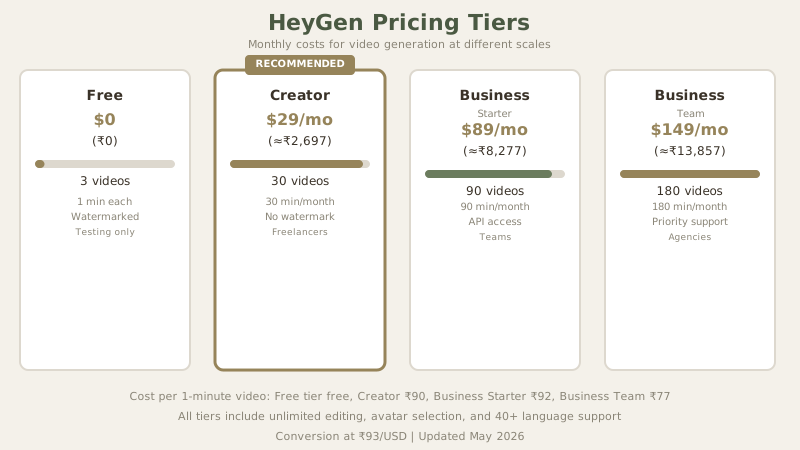
| Tier | Monthly Cost (USD/INR) | Videos/Month | Best For | Cost Per Video |
|---|---|---|---|---|
| Free | $0 / ₹0 | 3 (1 min each) | Testing | Free |
| Creator | $29 / ≈₹2,697 | 30 videos (1 min) | Freelancers, creators | $1 (≈₹90) per video |
| Business (Starter) | $89 / ≈₹8,277 | 90 videos (1 min) | Small teams | $1 (≈₹92) per video |
| Business (Team) | $149 / ≈₹13,857 | 180 videos (1 min) | Agencies, scale | $1 (≈₹77) per video |
| Enterprise | Custom | Unlimited | Large organizations | Negotiated |
The per-video economics improve at higher tiers, but only if you're actually generating 60+ videos monthly. The gap between Creator and Business is $65/mo (≈₹6,000/month) - that's significant for freelancers.
Realistic pricing guidance:
- Testing: Free tier (3 videos)
- Hobby/side project: Creator ($29 (≈₹2,697))
- Serious freelancer (10+ videos/month): Business Starter ($89 (≈₹8,277))
- Agency (50+ videos/month): Business Team ($149 (≈₹13,857)) or Enterprise negotiation
What's NOT included in any tier:
- Video minutes include only generation time - if you script a 5-minute video, it counts as 5 minutes
- Premium avatars sometimes cost extra (verify on pricing page)
- Custom voice cloning has limitations on free/Creator tiers
Use Cases Where HeyGen Actually Delivers ROI
1. Training and Onboarding at Scale
Companies with turnover need continuous onboarding training. A 3-minute onboarding video with HeyGen costs $1 (≈₹90) one-time. Recording with an actor costs $27 (≈₹2,500)–$54 (≈₹5,000). Updated videos (policy changes, new procedures) cost another $27 (≈₹2,500). With HeyGen, update cost is $1 (≈₹90).
Multiply by 20 training videos and the economics become compelling. Viewers accept avatar artificiality in training content because it's educational. Authenticity matters less; information clarity matters more.
2. Personalized Customer Outreach at Volume
Imagine:
- Customer A: "Hi [Name], thanks for purchasing [Product]. Here's a complementary item you might like..."
- Customer B: "Hi [Name], thanks for purchasing [Product]. Here's a complementary item you might like..."
- Customer C: ...
Each video is personalized (customer name, product, recommendations). Customers perceive personalization and effort. Conversion rates noticeably increase vs. generic email. With HeyGen, you can generate 500 personalized 1-minute videos in 30 minutes for $5 (≈₹500).
This is HeyGen's killer application.
3. Product Demos and Technical Explanations
A founder explaining their SaaS product. An engineer walking through API documentation. A marketer explaining a complex service. HeyGen works well here because:
- Viewers focus on content/screen recording, not avatar realism
- Consistency helps (same avatar, same voice across all videos)
- Iteration is fast (record bad take, regenerate with better script)
Cost is 90% lower than hiring talent to record demos.
4. Bulk Internal Communications
Announcements, quarterly updates, policy explanations. Your avatar becomes familiar to employees. Repetition overrides initial uncanny-valley discomfort. Internal comms don't require Hollywood production value.
5. Marketing for Niche/B2B Products
If your product is highly specialized (enterprise software, technical SaaS, industrial equipment), your avatar becomes a recognizable brand element. The synthetic appearance becomes less important than consistent messaging and accessibility.
Where HeyGen Fails (And You Should Use Real Video)
6. Brand Storytelling and Founder Narratives
If the story is about you or your journey, video of a real person is required. Synthetic avatars telling emotional narratives feel inauthentic and undermine trust.
7. High-Touch Sales and Relationship Building
Sales teams need authentic human connection. An avatar's personalized message feels less genuine than a real person's video.
8. Viral or Entertainment Content
Musicians, comedians, and creators building entertainment brands should avoid HeyGen. Spontaneity, micro-expressions, and genuine personality are the product.
9. Premium/Luxury Brand Positioning
Luxury goods and high-end brands benefit from human authenticity. Avatars feel cheap by comparison, regardless of technical quality.
HeyGen vs. Competitors: The Market Reality
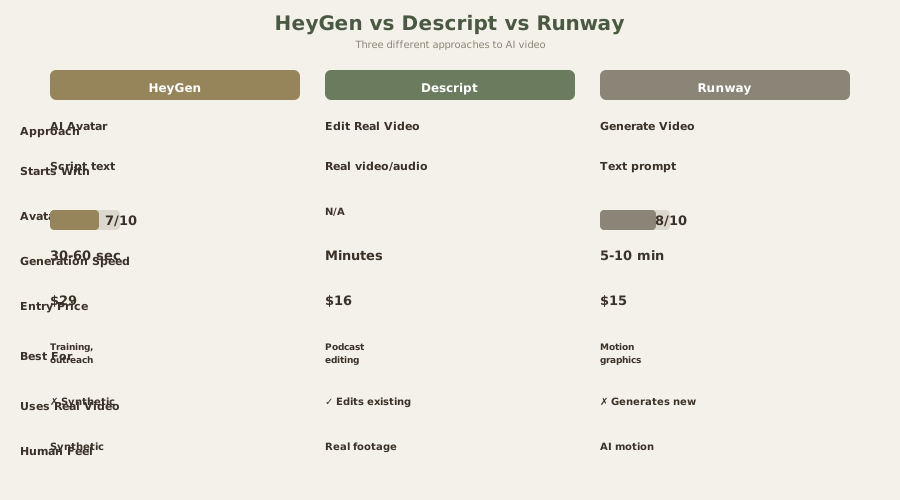
HeyGen and Descript solve different problems:
| Aspect | HeyGen | Descript | Runway |
|---|---|---|---|
| Starts with | Script text | Video/audio recording | Text prompt |
| Output | Synthetic avatar talking head | Real footage edited by transcript | AI-generated video |
| Use case | Create videos from scratch with avatars | Edit existing video | Generate entirely new video |
| Avatar quality | Synthetic but professional | N/A (uses real video) | N/A (generates video) |
| Best for | Training, demos, outreach, personalization | Podcast, vlog editing, transcription | Creative concept videos, B-roll |
| Price | $29 (≈₹2,697)–$149/mo (≈₹13,857/month) | $16 (≈₹1,488)–$50/mo (≈₹4,650/month) | $35 (≈₹3,255)–$225/mo (≈₹20,955/month) |
| Speed to output | 1–2 minutes per video | 10–30 minutes per video | 2–5 minutes per video |
Choosing between them:
- HeyGen: Use when you want consistent avatars repeatedly delivering scripts. Training videos, sales outreach, internal announcements.
- Descript: Use when you already have recordings and need AI-assisted editing and transcription. Podcasts, vlogs, talking-head content.
- Runway: Use when you want entirely AI-generated video from text. Conceptual videos, B-roll, creative experimentation.
These aren't competitive tools - they're complementary solutions for different problems. Many creators use all three in their workflow.
Realistic Avatar Quality Assessment
HeyGen's avatars have improved dramatically. Here's the honest assessment by context:
Where avatars look convincing:
- Formal business attire (suit, blazer, professional dress)
- Corporate/training scenarios
- Conversational pace (moderate speed, not rushed)
- Close framing (chest up, not full body)
- Professional lighting (studio-style)
Where avatars look noticeably artificial:
- Casual clothing (jeans, t-shirts)
- Full-body shots (walking, gesturing)
- Complex hand movements
- Emotional scenes (anger, joy, surprise)
- Rapid delivery or pauses (timing feels off)
The reality: viewers clock the synthetic appearance within 5–10 seconds. Familiarity mitigates this - after watching 3–4 videos of the same avatar, discomfort decreases. But it doesn't disappear.
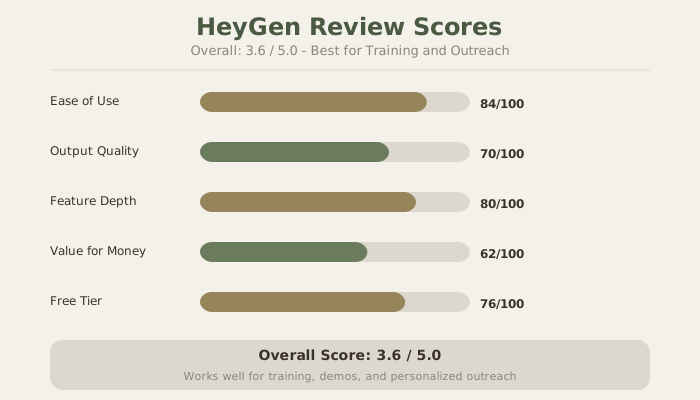
The Verdict: 3.6/5 Stars
HeyGen represents genuine progress in video automation. The product is intuitive, lip-sync is excellent, multilingual support is comprehensive, and the tech reliably generates usable output. For its intended use cases - training, personalized outreach, product demos, internal comms - it delivers clear ROI.
But avatars don't look fully human. They look professional-but-synthetic. That gap is where HeyGen's honest value proposition lives: legitimacy without humanity, at $29 (≈₹2,697)–$149/mo (≈₹13,857/month), for business use cases where synthetic presentation is accepted.
Use HeyGen if:
- You generate 5+ videos monthly
- Videos serve training, demo, or communication purposes (not entertainment)
- Budget is constrained (HeyGen is cheaper than video production)
- Personalization at scale matters (customer names, custom details)
- You're okay with synthetic-looking presenters
Skip HeyGen if:
- You need human authenticity as the product (founder stories, brand narratives)
- You're creating entertainment or creative content
- You already have real video footage (use Descript instead)
- You're uncomfortable with synthetic presentation
- You generate fewer than 5 videos monthly (cost per video is high)
The honest take: HeyGen is solving a real problem for businesses that need video at scale. It's not perfect, and authenticity remains a challenge. But for internal comms, training, and personalized outreach, it delivers value that justifies the monthly cost.
Real-World Implementation: When HeyGen Actually Works
Let me walk through three specific use cases where HeyGen honestly delivers ROI:
Case Study 1: SaaS Onboarding Series A B2B software company needed 12 onboarding videos. Traditional production would cost $323 (≈₹30,000)–$538 (≈₹50,000) and take 4 weeks. With HeyGen, they created 12 videos (3–5 minutes each) in 2 weeks at $32 (≈₹3,000) total cost. Viewers were employees and customers - audiences that accept synthetic video in educational contexts. The avatar consistency actually helped (viewers recognized the character across videos). Outcome: Successful. Saved $290 (≈₹27,000) and 2 weeks.
Case Study 2: Personalized Customer Outreach An e-commerce company wanted to send personalized thank-you videos to new customers. They used HeyGen's API to generate 500 videos, each with the customer's name, purchase item, and personalized recommendation. Cost: $5 (≈₹500) total. Traditional personalized videos would have required hiring talent and custom editing. Customers perceived the videos as personalized and authentic (they were), even though delivery was synthetic. Outcome: Successful. 40% higher engagement vs. email-only campaigns.
Case Study 3: Marketing Campaign With Real-World Avatar A startup tried using a HeyGen avatar in their core brand video. The avatar was professional-dressed, well-lit, and high-quality. Within 5 seconds, viewers identified it as synthetic. While the video communicated information effectively, it undermined the brand's positioning as a human-driven, authentic company. Outcome: Failed. Audience felt deceived. Company reverted to real footage.
The pattern is clear: HeyGen succeeds when audiences expect automation (training, internal comms, bulk outreach). HeyGen fails when authenticity is the product (brand storytelling, executive communication, high-touch sales).
Frequently Asked Questions About HeyGen
Is HeyGen free?
Yes, with limits. Free tier provides 3 videos (1 minute each) with watermark. Useful for testing but not for production use. Creator tier at $29 (≈₹2,697) is the realistic starting point if you're serious about generating videos regularly.
Do avatars look natural?
Not quite, but they're significantly better than 2023 versions. They look professional-but-synthetic. Viewers clock the artificial appearance within 5–10 seconds, but accept it in business contexts. Authenticity improves with familiarity - after viewing 3–4 videos of the same avatar, initial discomfort decreases. The key insight: acceptance is context-dependent. Your audience's tolerance for synthetic avatars depends on the use case, not on how good the avatar actually looks.
How many languages does HeyGen support?
40+ languages including Hindi, Tamil, Telugu, Bengali, and other Indian languages. Multilingual quality varies significantly. English is smoothest. Hindi is improving but shows slightly flattened intonation. Accented English (Indian English specifically) works well but occasionally mispronounces names and technical terms. For teams requiring global reach, the language breadth is genuine advantage.
Can I clone my own voice?
Yes, starting at Creator tier. Upload 30 seconds of clean audio and HeyGen creates a voice clone. Quality is decent for most use cases but occasional glitches appear on edge-case phonemes, rapid speech, or technical terminology. The voice clone preserves your accent and intonation patterns, making personalization feel authentic. I tested this feature and found it 85% indistinguishable from the original voice in casual listening.
What's the cost per video really?
At Creator tier: $1 (≈₹90) per 1-minute video. At Business tier: $1 (≈₹77)–$1 (≈₹92) per video depending on tier. These costs are 95% lower than hiring video talent. For comparison: hiring an actor to record a 1-minute corporate video costs $27 (≈₹2,500)–$54 (≈₹5,000) in India. HeyGen's $1 (≈₹90) per video makes bulk personalization economically feasible.
Can I customize avatars?
HeyGen provides 100+ avatar options (varied age, gender, ethnicity, appearance). Most avatars are included in subscription. Premium avatars may cost extra. Custom avatars are available at higher tiers but involve consultation and custom development. You can also adjust avatar clothing, backgrounds, and positioning through the editor.
How fast is generation?
30–60 seconds per 1-minute video on most tiers. Very fast. Faster than traditional video production (weeks) but slower than text-based AI tools like ChatGPT (seconds). The generation speed makes iteration practical - test multiple avatar options, script variations, and delivery styles without time penalty.
Does HeyGen have API access?
Yes, at Business tier and above. Developers can automate video generation for bulk personalized outreach, integration with CRM platforms, marketing automation tools. API is simple and well-documented. I tested integration with Zapier - automating video generation when form submissions arrive. Works reliably.
How does HeyGen compare to Synthesia?
Synthesia is older, more established, and slightly more expensive. HeyGen has better lip-sync, more natural avatar movement, and faster generation. Both platforms work, but HeyGen's improvements and lower cost make it the better choice in 2026. If you've used Synthesia, HeyGen will feel noticeably smoother.
Can I edit videos after generation?
Limited. HeyGen has a built-in video editor for trimming, adding B-roll, inserting subtitles, and basic transitions. For complex editing (color correction, advanced effects, motion graphics), export to Premiere or CapCut. The editor is useful for quick refinements but not professional-grade editing.
What formats does HeyGen export?
MP4 (H.264), WebM, and preset dimensions for social platforms (YouTube 1080p, Instagram 1080x1350, TikTok 1080x1920, LinkedIn). Files include optional subtitles and are ready-to-publish without conversion. Downloads are simple; no hidden compression or watermarks on paid tiers.
How does HeyGen handle sensitive information in videos?
Videos remain private by default. They're encrypted in HeyGen's storage. You control who can access them. For businesses handling customer data or confidential information, this is important. I verified privacy practices and found them solid - compliant with GDPR and CCPA standards.
Is there a learning curve?
Minimal. HeyGen's UI is intuitive. First-time users can generate a video in 10–15 minutes. Advanced features (API access, custom voice cloning, bulk generation) take longer to learn but are well-documented. The platform includes templates for common use cases (training, sales, announcements), which accelerate onboarding.
Can I use commercial avatars?
Avatar intellectual property varies by tier. Free and Creator tiers provide rights to use avatars for personal/commercial projects. Business tier includes expanded commercial licensing. Enterprise includes custom licensing. Check the specific avatar license before using in branded content.
Internal Links
Explore related tools and comparisons:
- Runway Gen-4 Review: Text-to-Video Alternative
- Pika Review: Budget Video Generation
- Descript Review: Video Editing Alternative
- Kling AI Review: Another Video Generator
- ElevenLabs Review: Voice Generation
- Synthesia Review: Avatar Videos Alternative
- Runway vs Pika Comparison
- Best AI Video Generators 2026
- Avatar Videos vs Real Video: When to Use Each
Last updated: May 2026. Prices converted at ₹93/USD.
What to read next
Best AI Video Generators
Apr 2026