Meta Tracked Employees to Train AI, Then Laid Off 8,000 the Same Day
Leaked audio reveals Meta tracked keystrokes and code to train AI. 8,000 layoffs followed. OpenAI model disproves 80-year math conjecture.
 ByAsh·5 min read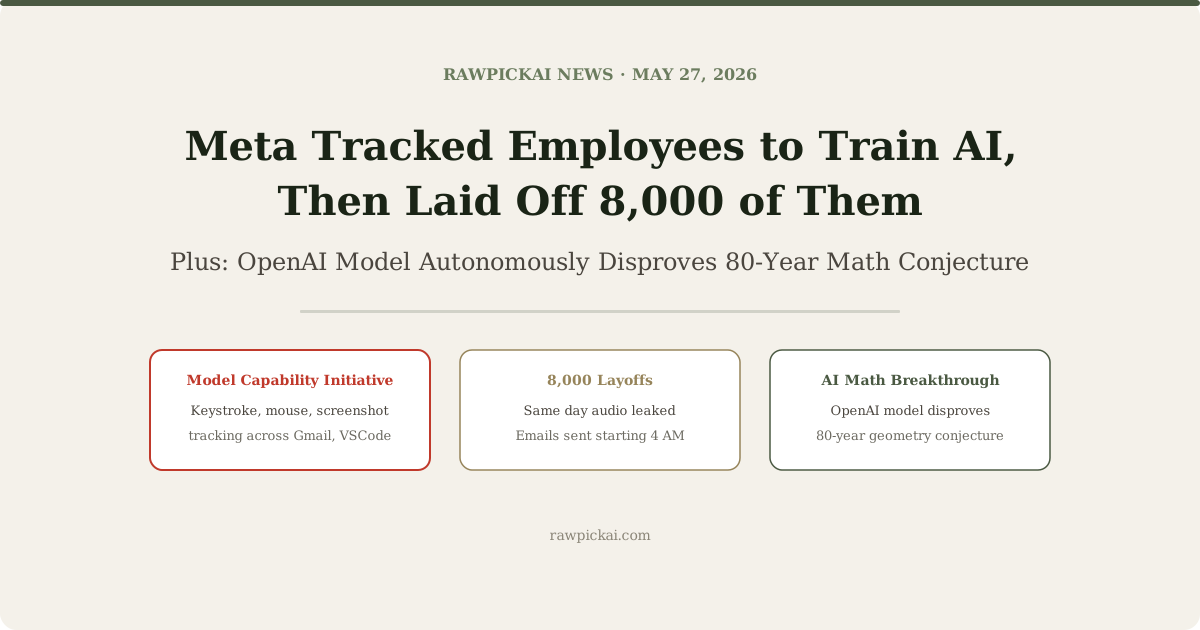
Leaked audio from a Meta all-hands meeting captures Mark Zuckerberg explaining that Meta has been monitoring employee keystrokes, mouse movements, screenshots, and coding activity across Gmail, GChat, VSCode, and Meta's internal AI assistant Metamate to train its AI models. The same week the audio surfaced, Meta laid off approximately 8,000 employees. In separate news, an internal OpenAI model autonomously disproved a geometry conjecture that had stumped mathematicians for 80 years.
What Meta actually did
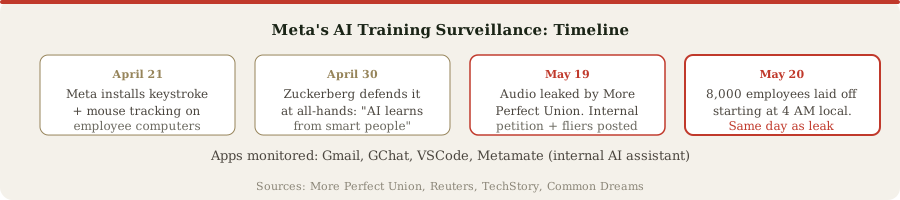
The program is called the Model Capability Initiative (MCI). Reuters first reported its existence in April, but the leaked audio from Zuckerberg's April 30 all-hands meeting, obtained by More Perfect Union and published May 19, provided the first direct confirmation from the CEO.
Zuckerberg's defense: "The AI models learn from watching really smart people do things." He argued that Meta's own engineers produce higher-quality training data than outside contractors, which is why the company chose to monitor its own workforce rather than hire external annotators.
His assurance to employees: "None of the data has been used for looking at what people are doing or surveillance or performance tracking or anything like that. It's purely just like we are using this to feed a very large amount of content into the AI model."
The problem with that assurance: the tracking software and the performance review system exist inside the same corporate infrastructure. Employees have no independent way to verify that keystroke data used for AI training isn't also accessible to managers making layoff decisions. And the timing destroyed whatever trust remained. The audio leaked on May 19. On May 20, 8,000 employees received termination emails starting at 4 AM local time.
Internal response was immediate. Employees posted fliers in meeting rooms and offices urging colleagues to sign a petition against the surveillance program. Meta's CISO responded by saying "we take leaks seriously and will take action," effectively threatening to fire anyone who spoke about the program publicly.
Why this matters for AI tool users
This isn't just a workplace story. It's a data sourcing story. Every AI model you use was trained on data from somewhere. The question is whether that data was collected ethically.
Meta AI is free and scores 3.0/5 on our reviews. It's built on Llama models that are now partially trained on employee activity data. ChatGPT and Claude are trained on publicly available internet data and licensed datasets. The training data sources matter because they reflect the company's values, and those values eventually show up in product decisions.

The contrast with Anthropic this same week is striking. While Meta was surveilling employees and laying them off, Anthropic hired Karpathy to build a team that uses Claude to improve Claude, released African language data publicly through the Gates Foundation partnership, and presented an AI ethics encyclical with the Vatican. Two very different approaches to building AI, from two companies competing for the same users.
OpenAI model autonomously solves 80-year math problem

In a development that got overshadowed by the Meta story, an internal OpenAI model autonomously disproved a geometry conjecture that mathematicians had worked on since the 1940s. Fields medalist Tim Gowers described the result as "a milestone in AI mathematics."
What makes this different from previous AI math achievements: the model was not specifically trained for this problem, did not retrieve an existing solution, and was not guided step-by-step by a human researcher. It received the problem statement and produced the disproof independently.
This is the kind of capability advance that supports ChatGPT's position as a reasoning tool, not just a text generator. For developers and researchers using AI for complex problem-solving, it signals that reasoning models are entering territory where they can contribute original insights, not just recombine existing knowledge.
Anthropic co-founder Jack Clark predicted at Oxford this same week that AI would deliver a Nobel-worthy breakthrough within 12 months, while acknowledging "a non-zero chance it could kill everyone on the planet." The math proof suggests the first half of that prediction is on track.
Quick hits
Zuckerberg held another internal meeting where he told employees to "buckle up" and complained about leaks. The audio from that meeting was also promptly leaked.
Meta's median employee compensation dropped from $417,400 to $388,200 last year, meaning employees took a pay cut while simultaneously being monitored to train their replacements.
The Trump White House officially dropped its AI safety executive order after Zuckerberg, Musk, and David Sacks called the president directly, according to multiple reports.
My take

The Meta story isn't about AI training methods. It's about trust. When the company building your tools is willing to surveil its own engineers and fire them the next day, it tells you something about how they view the people who use those tools.
This is exactly why we built the Transparency Index. Meta AI scores 96/100 on transparency because its pricing is clear (it's free). But transparency on pricing and transparency on values are different things. A tool can be free and still be built on practices you wouldn't endorse.
For users choosing between AI assistants: the products are converging on quality. ChatGPT, Claude, and Gemini all score 4.4+ on our reviews. The differentiator increasingly isn't which model writes better code. It's which company you trust to handle data responsibly. This week made that distinction very clear.
Sources: More Perfect Union, TechStory, Common Dreams, eWeek, BuildFastWithAI
Related: Meta AI Review · ChatGPT Review · Claude Review · Transparency Index · 2026 AI Tools Reality Check · Karpathy Joins Anthropic · Anthropic $10.9B Revenue