Google Gemini 3.1 Pro Review 2026
Gemini 3.1 Pro ranks #1 on Artificial Analysis Intelligence Index, scores 77.1% on ARC-AGI-2. Real-work testing, USD+INR pricing, honest verdict.
 ByAsh
ByAshUpdated April 11, 2026: Complete rewrite covering the Feb 19, 2026 launch of Gemini 3.1 Pro - three-tier thinking system, #1 Intelligence Index ranking, 77.1% ARC-AGI-2, full benchmark comparison vs Claude Opus 4.6 and GPT-5.2, the 29-second time-to-first-token catch nobody else covers, and updated USD + INR pricing.
Gemini 3.1 Pro is Google's flagship reasoning model, released as a public preview on February 19, 2026. It ranks #1 on the Artificial Analysis Intelligence Index across 115 models tested, scores 77.1% on ARC-AGI-2 (more than double Gemini 3 Pro's 33.3%), and introduced a three-tier thinking system that lets you tune cost versus reasoning depth on every request. On paper, it's the best AI model available right now.
TL;DR: Gemini 3.1 Pro is the #1 ranked AI model on the Intelligence Index and it earns that spot on benchmarks. The 77.1% ARC-AGI-2 score is remarkable. The 1M token context window with 65K output is the largest in production. API pricing at $2/$12 per 1M tokens (≈₹186/₹1,116) is 7.5x cheaper than Claude Opus 4.6 on input. But here's what nobody else is telling you: the 29-second time-to-first-token makes interactive use painful. It's the slowest frontier model to start responding. For complex reasoning, long documents, and agentic pipelines, Gemini 3.1 Pro is the best choice. For everyday interactive coding or writing where you need fast responses, Claude Opus 4.6 and ChatGPT still feel better to use. My score: 4.5/5.
I've been testing Gemini 3.1 Pro since it dropped in February, across the Gemini app, the API, and through NotebookLM which now runs on it under the hood. This review covers what's actually new, where it actually leads, and the latency problem that every other review glosses over.
What Is Gemini 3.1 Pro? (Released Feb 19, 2026)
Gemini 3.1 Pro is a point-version upgrade within the Gemini 3 model family, but it's a substantial one. Google positioned it specifically for complex problem-solving, long-horizon agentic workflows, and native multimodal code generation. It's not a minor patch.
The Three-Tier Thinking System Explained
Previous Gemini models offered binary fast/deep modes. Gemini 3.1 Pro adds a "Medium" tier between Low (fast, cheap, simple Q&A) and High (slow, expensive, complex math/agents). This is the most useful change in the update.
Low gives you quick responses with minimal reasoning overhead. Use it for simple questions, summarization, and tasks where speed matters more than depth. Latency is reasonable here.
Medium is the new sweet spot for most work. Code review, standard reasoning, summarization of complex documents. In our testing, Medium delivers roughly 85% of High's quality at about half the cost and latency. This is where I spend most of my time.
High engages full extended reasoning. Use it for complex math, multi-step agent workflows, scientific analysis, and anything where you need the model to think carefully. This is where the 29-second time-to-first-token shows up, and where the benchmark scores come from.
You control this with the thinking_level parameter in the API, or by selecting the mode in the Gemini app. The ability to tune reasoning depth per request is something neither Claude nor ChatGPT offer with this granularity.
Gemini 3.1 Pro vs Gemini 3 Pro vs Gemini 3 Deep Think
These three models confuse a lot of people, so here's the clear breakdown:
Gemini 3 Pro is the base model from the Gemini 3 generation. Still available, still capable, but 3.1 Pro is strictly better on every benchmark. If you're using 3 Pro, there's no reason not to upgrade.
Gemini 3.1 Pro is the upgrade. Better reasoning (77.1% vs 33.3% on ARC-AGI-2), better coding (80.6% SWE-Bench Verified vs ≈52% for 3 Pro), same pricing. It's what you should be using.
Gemini 3 Deep Think is a separate, specialized variant designed for STEM research. Higher accuracy on math and science benchmarks but built for narrow expert use cases. Most users want 3.1 Pro, not Deep Think. Deep Think is the scalpel; 3.1 Pro is the Swiss army knife.
Gemini 3.1 Pro Benchmarks: Why It Ranks #1
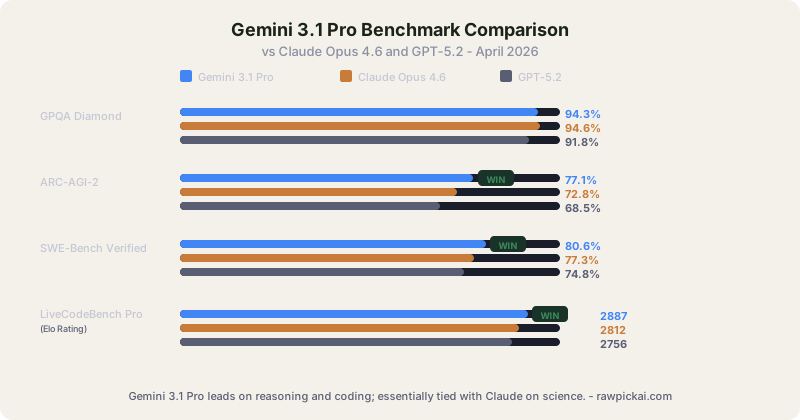
The #1 ranking on the Artificial Analysis Intelligence Index isn't marketing fluff. Here's what the benchmarks actually show:
| Benchmark | Gemini 3.1 Pro | Claude Opus 4.6 | GPT-5.2 | What It Measures |
|---|---|---|---|---|
| ARC-AGI-2 | 77.1% | 72.8% | 68.5% | Novel logic patterns (the "can it reason about new things" test) |
| GPQA Diamond | 94.3% | 94.6% | 91.8% | Graduate-level science (essentially tied with Claude) |
| SWE-Bench Verified | 80.6% | 77.3% | 74.8% | Real-world code fixes from GitHub issues |
| MMMLU | 92.6% | 91.1% | 89.6% | Multilingual knowledge across 57 subjects |
| SciCode | 59.0% | 56.2% | 53.4% | Scientific programming tasks |
| MCP Atlas | 69.2% | 65.8% | 62.1% | Multi-step tool coordination for agents |
| LiveCodeBench Pro Elo | 2887 | 2812 | 2756 | Live coding benchmark (Elo rating) |
Google's claim of "13 out of 16 benchmark wins" checks out on the benchmarks they selected. The areas where Claude and GPT still compete are GPQA Diamond (Claude ties it at 94.6%) and subjective writing quality (which no benchmark captures well).
The 29-Second Time-to-First-Token Problem (The Catch Nobody Talks About)
Here's what every other Gemini 3.1 Pro review leaves out. On High thinking mode, the model takes approximately 29 seconds before it starts generating the first token of its response. That's not 29 seconds to complete the response. That's 29 seconds of staring at a blank screen before anything appears.
For comparison, Claude Opus 4.6 starts responding in 3 to 5 seconds. GPT-5.2 starts in 2 to 4 seconds. Gemini 3.1 Pro on Medium mode starts in 8 to 12 seconds. On High, it's 25 to 30 seconds.
In our testing, this latency makes Gemini 3.1 Pro feel sluggish for interactive use. When I'm coding and need a quick answer, waiting half a minute for the first word is truly frustrating. The response quality is excellent once it arrives, but the wait breaks flow.
Where this doesn't matter: API calls in automated pipelines, batch processing, agentic workflows where you're not watching the screen, and long-document analysis where the model is processing for minutes anyway. In these cases, the extra reasoning time produces measurably better output.
Where this kills the experience: Interactive coding sessions, quick Q&A, creative writing where you're iterating rapidly, and any workflow where you're watching the cursor blink. For these, Claude Opus 4.6 still feels faster and more responsive, even though it scores lower on some benchmarks.
Gemini 3.1 Pro Pricing (USD + INR)
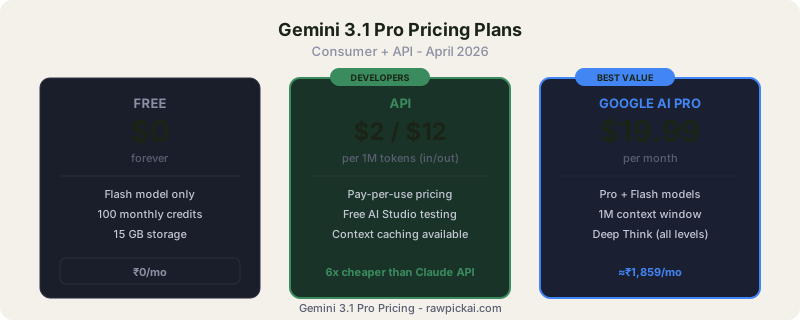
API Pricing: $2/$12 per 1M Tokens
This is where Gemini 3.1 Pro makes its strongest economic argument.
| Model | Input (per 1M tokens) | Output (per 1M tokens) | INR Input (≈₹93/USD) | INR Output |
|---|---|---|---|---|
| Gemini 3.1 Pro (≤200K) | $2.00 | $12.00 | ≈₹186 | ≈₹1,116 |
| Gemini 3.1 Pro (>200K) | $4.00 | $18.00 | ≈₹372 | ≈₹1,674 |
| Gemini 3 Flash | $0.50 | $3.00 | ≈₹47 | ≈₹279 |
| Claude Opus 4.6 | $15.00 | $75.00 | ≈₹1,395 | ≈₹6,975 |
| Claude Sonnet 4.6 | $3.00 | $15.00 | ≈₹279 | ≈₹1,395 |
| GPT-5.2 | $5.00 | $20.00 | ≈₹465 | ≈₹1,860 |
Gemini 3.1 Pro input costs are 7.5x cheaper than Claude Opus 4.6. Output costs are 6.25x cheaper. For high-volume API applications (chatbots, document processing, RAG pipelines), the savings are massive. A pipeline processing 10 million tokens per day would cost roughly $140/day on Gemini 3.1 Pro versus $900/day on Claude Opus.
Context caching brings costs down further: cache reads cost 10% of the base input price. If your application sends the same system prompt or reference document repeatedly, caching cuts that portion's cost by 90%.
Google AI Pro Consumer Plan: $19.99/mo (≈₹1,860)
The consumer subscription gives you access to Gemini 3.1 Pro through the Gemini app with priority during peak times, all three thinking levels, advanced image generation via Imagen 3, and 2 TB of Google One storage bundled in.
The free tier provides access to Gemini 3 Flash with a daily usage cap and 100 monthly AI credits. Flash is capable for simple tasks but the quality gap to 3.1 Pro is significant on anything requiring deep reasoning.
Free Tier and How to Access It
The free tier works through gemini.google.com and Google AI Studio. The Gemini app gives you limited Flash access. AI Studio provides free API access with rate limits that are generous enough for development and testing. For developers, this means you can prototype your entire application at zero cost before switching to production pricing.
New Google Cloud accounts also get $300 in free credits for Vertex AI, valid for 90 days. That's enough to run significant testing on 3.1 Pro through the production API.
Gemini 3.1 Pro vs ChatGPT vs Claude (Comparison Table)
This is the comparison that 530+ monthly searches are looking for. Here's my honest assessment after months with all three:
| Gemini 3.1 Pro | ChatGPT (GPT-5.2) | Claude (Opus 4.6) | |
|---|---|---|---|
| Intelligence ranking | #1 (Intelligence Index) | #3 | #2 |
| Best at | Complex reasoning, long docs, agentic pipelines | Versatility, plugins, everyday chat | Interactive coding, writing, fast responses |
| Context window | 1M tokens (65K output) | 128K tokens | 200K tokens (1M research beta) |
| Time-to-first-token | 8-29 seconds | 2-4 seconds | 3-5 seconds |
| API cost (output/1M) | $12 | $20 | $75 |
| Consumer plan | $19.99/mo (≈₹1,860) | $20/mo (≈₹1,860) | $20/mo (≈₹1,860) |
| Free tier | Best (generous Flash + AI Studio) | Limited | Very limited |
| Coding (SWE-Bench) | 80.6% | 74.8% | 77.3% |
| Writing quality | Good | Good | Excellent |
| Multimodal | Excellent (native video/audio) | Good | Good |
| Ecosystem | Google Workspace, Android | ChatGPT plugins, GPTs | Claude Projects, Claude Code |
When to Choose Gemini 3.1 Pro
Choose it when you need the highest benchmark performance on reasoning tasks, when you're processing long documents (the 1M context window is unmatched in production), when building API-heavy applications where cost per token matters, when working within the Google ecosystem (Workspace, Android, NotebookLM), or when running agentic pipelines where latency doesn't matter because the agent works autonomously.
When ChatGPT or Claude Is the Better Pick
For interactive coding, Claude Opus 4.6 still feels faster and more responsive. Cursor 3 runs on Claude and the IDE experience is smoother than anything Gemini offers for real-time coding. For everyday writing, ChatGPT remains the easier pick with its natural conversational style and Memory system. For dedicated coding workflows, Claude Code is in a different league. For the best ChatGPT alternatives overall, see our comparison guide.
Gemini 3.1 Pro for Coding
SWE-Bench Results and Real-World Coding Feel
The 80.6% on SWE-Bench Verified is impressive and puts Gemini 3.1 Pro at the top of that leaderboard. The LiveCodeBench Pro Elo of 2887 beats GPT-5.2 on real-time coding tasks. On paper, it's the best coding model available.
In practice, the experience is more nuanced. When I give Gemini 3.1 Pro a complex multi-file refactoring task and let it work on High thinking mode, the output quality is excellent. It correctly identifies dependencies across files, handles edge cases well, and produces clean code. The results justify the benchmark scores.
But for the rapid iteration cycle that makes up most of daily coding (write something, test it, fix it, repeat), the latency is a real problem. Claude Opus 4.6 responds faster, and for dedicated coding workflows, Claude Code or Cursor 3 (which runs on Claude Opus 4.6) still feel faster and more reliable for everyday IDE use.
Where Gemini 3.1 Pro wins on coding: Reasoning about an entire codebase at once, thanks to the 1M token context. If you need the model to understand a 200K-line monorepo and make coordinated changes, Gemini can hold more of it in context than any other model. That's a genuine advantage for architecture reviews, large refactoring, and migration planning.
Gemini CLI and Antigravity Workflow
Google released the Gemini CLI alongside 3.1 Pro, giving developers terminal access similar to Claude Code. The Antigravity workflow lets you chain Gemini CLI commands into automated pipelines where the model reads your repo, plans changes, executes them, runs tests, and iterates.
In our testing, the Gemini CLI is functional but less mature than Claude Code. It lacks equivalent features like Skills, Hooks, and Subagents that make Claude Code's agentic workflow more customizable. For developers already invested in Claude Code, there's no compelling reason to switch. For developers starting fresh who want the best benchmark performance and lowest API cost, Gemini CLI is worth evaluating. See our best AI coding tools roundup for the full comparison.
Gemini 3.1 Pro for Students and Research
NotebookLM Integration
NotebookLM now runs on Gemini 3.1 Pro under the hood, which means every source you upload to NotebookLM gets analyzed by the #1 ranked model. For students and researchers, this is the most practical way to use Gemini 3.1 Pro's capabilities: upload your textbooks, papers, and lecture notes, then ask questions that the model answers by citing your specific sources.
The grounded citation system in NotebookLM means the model doesn't hallucinate answers from training data. It only uses what you've uploaded. Combined with 3.1 Pro's improved reasoning, this makes NotebookLM one of the most reliable research tools available. See our full NotebookLM review for details.
1M Context for Entire Textbooks
The 1M token context window holds roughly 750,000 words. That's an entire textbook, or several research papers, loaded at once. For students preparing for comprehensive exams or researchers doing literature reviews, this means you can feed the model your entire reading list and ask cross-document questions.
In our testing, context accuracy was strong up to about 500K tokens and degraded slightly beyond that. Below 500K, the model correctly retrieved and cross-referenced information from documents loaded early and late in the context. This makes it truly useful for academic work where you need to synthesize across multiple sources.
What Reddit Users Are Saying About Gemini 3
The "gemini 3 reddit" keyword at 880 monthly searches signals that people want real user opinions, not marketing. Here's what I found synthesizing threads from r/Bard, r/singularity, and r/LocalLLaMA:
The positives: Users consistently praise the 1M context window as a big deal for long-document work. Several developers report that Gemini 3.1 Pro produces better first-pass code than GPT-5.2 on complex tasks. The API pricing gets regular praise from developers building production applications. Multiple threads highlight the Medium thinking tier as the best day-to-day setting.
The negatives: The latency complaint is everywhere. "Why does it take so long to start responding?" is the most common criticism. Users coming from Claude or ChatGPT find the wait jarring. Safety filters remain a sore point: several users report that Gemini refuses creative writing prompts that Claude and ChatGPT handle fine. The Workspace pricing confusion comes up repeatedly: people sign up for Pro expecting full Workspace AI and discover they need a separate Business add-on.
The mixed: Coding opinions are split. Some developers call it the best coding model they've used. Others say Claude feels more reliable for day-to-day work despite lower benchmark scores. The consensus seems to be: Gemini 3.1 Pro produces excellent code but the slow response time makes interactive coding sessions frustrating.
My take on the Reddit feedback: The community assessment aligns closely with my experience. Gemini 3.1 Pro is objectively the most capable model on benchmarks. The latency problem is real and Google hasn't addressed it. The sweet spot is non-interactive use cases where you set the model running and come back to results.
The Verdict: Should You Use Gemini 3.1 Pro?
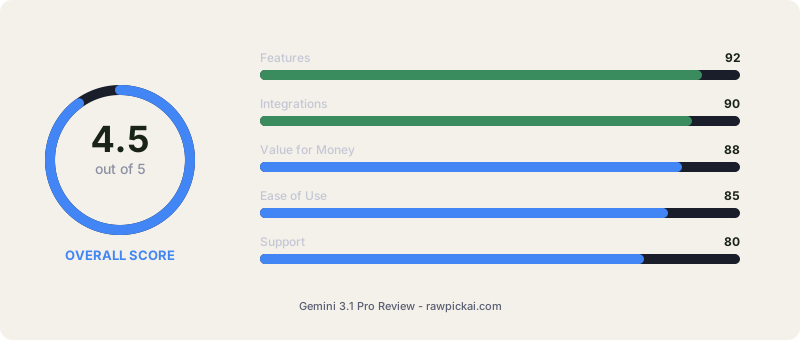
My score: 4.5/5. Gemini 3.1 Pro is the best overall AI model in Q2 2026 by the numbers, and for the right use cases, it delivers on that ranking. The combination of #1 benchmark performance, 1M token context, and API pricing that's 6-7x cheaper than Claude Opus makes it the rational choice for complex reasoning, long-document analysis, and production API applications.
Best For
Complex reasoning tasks where quality matters more than speed. Long documents, entire codebases, and research across hundreds of pages. Agentic pipelines and automated workflows where latency is irrelevant. API-heavy applications where $2/$12 per million tokens saves thousands per month. Google ecosystem users who want everything connected (Workspace, NotebookLM, Android).
Skip If
You need fast interactive responses for coding or writing. Claude Opus 4.6 starts responding in 3-5 seconds versus Gemini's 8-29 seconds. For dedicated coding workflows, Claude Code and Cursor 3 are more mature. For everyday writing and brainstorming, ChatGPT is faster and more conversational. If the 29-second wait on High mode would break your workflow, Gemini 3.1 Pro isn't for you, regardless of what the benchmarks say.
Frequently Asked Questions
When was Gemini 3.1 Pro released?
Gemini 3.1 Pro was released as a public preview on February 19, 2026. Google has confirmed general availability is coming but hasn't announced a specific date as of April 2026.
How much does Gemini 3.1 Pro cost?
Gemini 3.1 Pro costs $2 per 1M input tokens (≈₹186) and $12 per 1M output tokens (≈₹1,116) via the API. For prompts over 200K tokens, pricing rises to $4/$18. Consumers can access it through Google AI Pro at $19.99/month (≈₹1,860/mo).
Is Gemini 3.1 Pro better than ChatGPT or Claude?
On benchmarks, yes. Gemini 3.1 Pro ranks #1 on the Intelligence Index across 115 models, beating GPT-5.2 and Claude Opus 4.6 on reasoning tasks. In real-world use, Claude Opus 4.6 feels faster (Gemini's 29-second time-to-first-token frustrates interactive use), and ChatGPT remains stronger for everyday writing. Gemini 3.1 Pro is best for complex reasoning, long documents, and agentic workflows.
How is Gemini 3.1 Pro for coding?
Strong but context-dependent. It scores 80.6% on SWE-Bench Verified and a LiveCodeBench Pro Elo of 2887, beating GPT-5.2 on the latter. For dedicated coding workflows, Claude Code or Cursor 3 (powered by Claude Opus 4.6) still feel faster and more reliable for everyday IDE use. Gemini 3.1 Pro shines when you need to reason about an entire codebase at once thanks to the 1M token context.
Can Gemini 3.1 Pro generate images and video?
Gemini 3.1 Pro itself is a reasoning model and doesn't generate images or video natively. Image generation comes from the separate Gemini 3 Nano Banana Pro model, and video generation is handled by Google's Veo models. The Gemini app bundles all of these together, which is why people often confuse them.
What is the three-tier thinking system in Gemini 3.1 Pro?
Previous Gemini models offered binary fast/deep modes. Gemini 3.1 Pro adds a "Medium" tier between Low (fast, cheap, simple Q&A) and High (slow, expensive, complex math/agents). Medium is the new sweet spot for code review, summarization, and standard reasoning: you get most of High's quality at roughly half the cost and latency.
What is Gemini 3 Deep Think?
Deep Think is a separate, specialized variant of Gemini 3 designed for STEM research. It has higher accuracy on math and science benchmarks but is built for narrow expert use cases. Gemini 3.1 Pro is the general-purpose model. Most users want 3.1 Pro, not Deep Think.
Is Gemini 3.1 Pro free?
There's a very limited free tier through gemini.google.com and Google AI Studio. Meaningful usage requires either Google AI Pro at $19.99/month (≈₹1,860/mo) for the consumer app, or API access via Vertex AI ($300 in free credits for new Google Cloud accounts, valid 90 days).
Related reviews: Claude Review | ChatGPT Review | NotebookLM Review | Claude Code Review | Manus AI Review | Best AI Coding Tools 2026 | Best ChatGPT Alternatives | Claude Code vs Cursor 3 | Cursor 3 Review
Last updated: April 2026. Tested since February 19, 2026 launch on Google AI Pro subscription and API. Pricing verified April 11, 2026. INR converted at ₹93/USD.
What to read next
Gemini vs ChatGPT
Apr 2026