Claude vs Perplexity 2026: Writing vs Research
Complete comparison of Claude and Perplexity for different use cases. We tested writing quality, research accuracy, citations, and pricing to help you.
 ByAsh
ByAshTL;DR: Claude is a writing partner; Perplexity is a research librarian. Choose Claude for blog posts, emails, reports, and any output where quality prose matters. Choose Perplexity for fact-finding, current information, and research with citations. Both cost $20/mo (≈₹1,860/mo) for Pro. Most users benefit from Claude Pro + Perplexity Free ($20/mo (≈₹1,860/mo)) rather than paying for both. See ChatGPT vs Claude if you want a full AI assistant comparison, or Perplexity vs ChatGPT to compare research-first to feature-rich.
Comparing Claude and Perplexity is like comparing a writing partner with a research librarian. Both are AI tools. Both answer questions. But they're built for fundamentally different workflows and excel in different contexts. I've used both daily for eight months across content creation, research, analysis, and decision-making. Here's the honest breakdown of when each one is the right choice.
The Core Difference in One Sentence
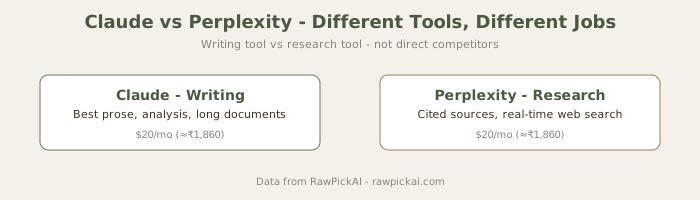
Claude is optimized to compose. Perplexity is optimized to search.
Official sites: Claude · Perplexity
That distinction cascades through everything else: how they handle information, what outputs they produce, how they cite sources, and ultimately whether they're the right tool for your specific task. Understanding this difference is the key to knowing which tool to reach for.
Head-to-Head Feature Comparison
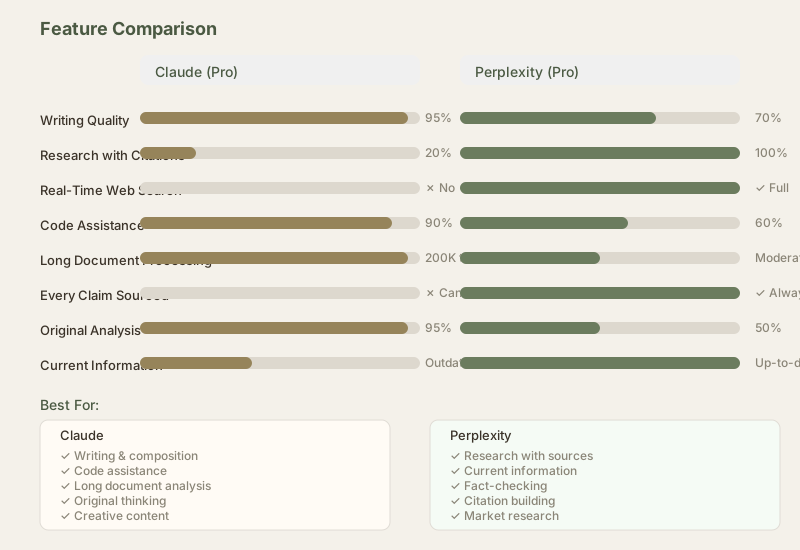
| Feature | Claude | Perplexity |
|---|---|---|
| Writing Quality | Excellent, natural tone | Good, Wikipedia-like structure |
| Research & Citations | No internet access, knowledge cutoff | Full web search, numbered citations |
| Code Assistance | Strong reasoning, handles complex logic | Finds solutions, less iterative |
| Long Document Analysis | Excellent, 200K context window | Good, but optimized for search results |
| Long-Form Content | Exceptional, engaging prose | Functional, fact-heavy |
| Real-Time Information | Not available, uses training data | Full real-time web search |
| Source Verification | Can't verify, potential hallucination | Every fact has clickable source |
| Pro Search/Deep Thinking | Built-in reasoning mode | Pro Search for complex queries |
| Monthly Cost (Pro) | $20/mo (≈₹1,860) | $20/mo (≈₹1,860) |
| Free Tier Strength | Rate-limited access to Sonnet 4.6 | Unlimited search + 5 Pro searches |
Pricing Comparison
| Claude | Perplexity | |
|---|---|---|
| Free tier | Sonnet 4.6, rate-limited | Unlimited search + 5 Pro searches/day |
| Pro plan | $20/mo (≈₹1,860/mo) | $20/mo (≈₹1,860/mo) |
| Best free feature | Highest quality writing | Cited research answers |
| Best value combo | Pro + Perplexity Free | Claude Free + Pro |
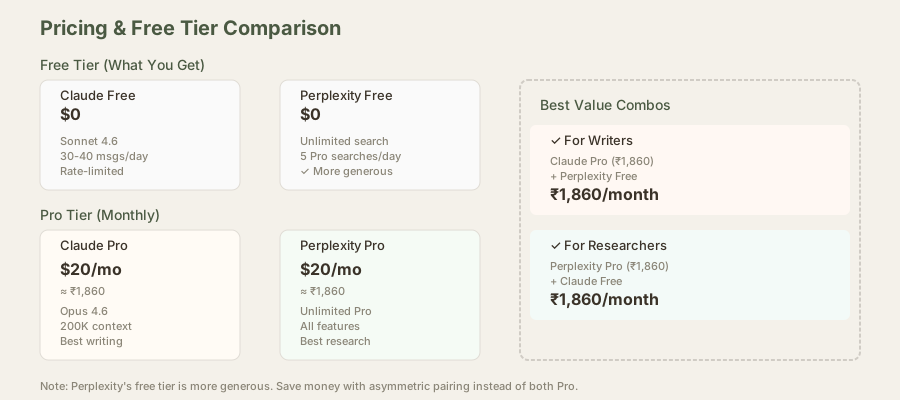
Both cost $20/mo (≈₹1,860/month) for Pro subscriptions. The real difference is in free tiers: Claude's free tier is rate-limited but gives you access to Sonnet 4.6 (excellent for writing). Perplexity's free tier is unlimited search with 5 daily Pro searches, making it generous for research workflows. Most users save money with Claude Pro + Perplexity Free ($20/mo (≈₹1,860/mo) total) rather than paying for both Pro subscriptions.
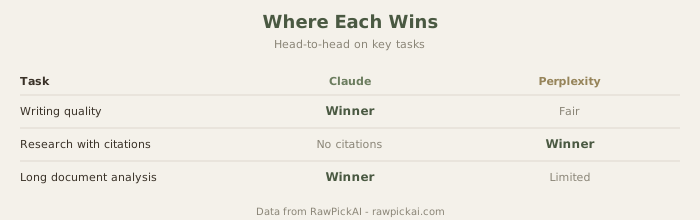
Writing Quality: Claude Wins by a Large Margin
I tested both tools with identical prompts across blog posts, emails, product descriptions, essays, and creative writing.
Claude produces prose that reads naturally: varied sentence rhythms, genuine reasoning embedded in the text, appropriate tone shifts that feel intentional. A 1,000-word blog post from Claude needs minimal editing. The writing has personality without feeling forced or artificial.
Perplexity generates text that reads like a well-researched Wikipedia summary. Factually solid, properly cited, but structurally flat. It's optimized to retrieve and synthesize information, not to create compelling, engaging prose. The writing is functional - it conveys facts clearly - but lacks the rhythm and voice that makes people want to read something.
Real test: "Write a 500-word blog introduction about the future of remote work in India"
Claude's output:
- Opened with a personal observation about Indian tech workers and burnout culture
- Included nuanced context about Indian work culture, migration patterns, and family expectations
- Shifted tone midway from reflective to practical
- Ended with a surprising insight about India's competitive advantage in remote-first work
- Reads like thoughtful journalism, not template-based writing
Perplexity's output:
- Opened with a definition and statistics
- Cited 8 sources (all correct and useful)
- Covered the topic comprehensively and accurately
- Read like a research brief or the summary section of a Wikipedia article
- No original perspective or voice
The difference compounds over length. For a 2,000-word essay, Claude's variable tone and vocabulary rhythm feel natural to read. Perplexity's output starts to feel like a concatenation of search results (because it partially is).
When Claude's writing advantage matters:
- Blog posts, thought leadership, and content marketing (where voice and personality drive engagement)
- Marketing emails and sales copy (where tone and persuasion matter)
- Creative writing, storytelling, and narrative content
- Reports and proposals that need to persuade, not just inform
- Any client-facing work where you want the output to feel thoughtfully written
- Social media and community building (where personality is the differentiator)
Where the difference doesn't matter:
- Technical documentation and how-to guides (structure matters more than prose)
- Data summaries and research briefs (facts and citations are primary)
- Quick reference material and FAQs (utility over readability)

Research & Fact-Finding: Perplexity Wins Decisively
Perplexity was built specifically for research. Every claim in a Perplexity answer includes a numbered citation you can click to verify. Pro Search (the premium feature) breaks complex questions into sub-queries, searches multiple sources in parallel, and synthesizes a comprehensive, sourced answer.
Claude has no internet access by default. Its knowledge has a cutoff date (varies by version, typically ≈6 months). For anything time-sensitive - recent news, current pricing, latest tool updates, market trends - Claude cannot help effectively. It will sometimes generate plausible-sounding but outdated information with absolute confidence (a problem I call "confident hallucination").
Real test: "What are the current Midjourney pricing plans as of May 2026, and how do they compare to DALL-E 3?"
Perplexity:
- Returned all 4 Midjourney plans with exact current pricing
- Linked directly to Midjourney's official pricing page and DALL-E 3's pricing page
- Provided side-by-side comparison with current feature differences
- Cited when information was updated (within the last week)
- Total time: 12 seconds
Claude:
- Returned pricing that was 6+ months old
- Couldn't verify against current sources
- Made reasonable guesses about updates but couldn't confirm
- Acknowledged its knowledge cutoff date
- Reasonable output but not useful for decision-making
For any task where recency and source verification matter, Perplexity is the clear winner.
When Perplexity's research advantage matters:
- Current events and breaking news analysis
- Market research and competitive intelligence
- Fact-checking and verification (every claim is traceable)
- Price comparisons and product research (needs current data)
- Trend analysis and industry updates
- Academic research (you get sources to build your citations)
- Investment and financial decisions (needs current data)
Where Perplexity falls short:
- Historical analysis and context (works fine, but unnecessary source-heavy)
- Creative brainstorming (it retrieves existing ideas rather than generating new ones)
- Complex reasoning on established concepts (Claude reasons better)
Coding Assistance: Claude Wins for Interactive Development
Claude is the better coding assistant, especially for complex work. Claude Sonnet 4.6 handles complex debugging, refactoring, code generation, and architecture decisions with strong contextual understanding. It can reason through multi-step problems, understand the implications of changes, and suggest improvements beyond the bare requirements.
Perplexity can answer coding questions and find Stack Overflow solutions effectively, but it's not built for interactive coding sessions. Perplexity retrieves answers; Claude reasons through your specific problem. If you paste a Stack Overflow link, Perplexity can summarize it. If you need help understanding why your code is broken, Claude is better.
Real comparison:
- Claude: You describe your problem, Claude asks clarifying questions, understands your codebase constraints, and proposes a solution with alternatives
- Perplexity: You describe your problem, Perplexity finds similar problems on Stack Overflow and shows you how others solved it
Both approaches are useful, but they serve different development stages.
When to use Claude for coding:
- Debugging complex issues (why is this happening?)
- Architecture decisions (what approach is better?)
- Refactoring and code quality improvements
- Understanding implementation tradeoffs
- Teaching yourself a language or framework
- Iterative development within a single session
When to use Perplexity for coding:
- Quick reference questions (how do I use this library?)
- Finding existing solutions to common problems
- API documentation lookups
- Learning from Stack Overflow patterns
- Understanding how others solved similar problems
For serious development work: Use Claude Code, Cursor, or GitHub Copilot instead. These tools integrate into your IDE, understand your codebase, and provide inline assistance that matters far more than raw reasoning quality.
Long-Form Analysis: Different Approaches, Both Useful
Here's where the tools overlap most. Both can analyze documents and produce summaries and insights. But the approach differs fundamentally:
Claude reads your document, understands its argument structure, and produces original analysis. It identifies weak points, suggests improvements, and reframes ideas. It reasons about your content.
Perplexity cross-references your topic against current sources and tells you what the latest research says about that topic. It adds external context you didn't have, rather than analyzing the structure of what you already have.
Practical difference:
- Student writing a thesis: Use Claude to strengthen your argument and improve your writing. Use Perplexity to find peer-reviewed sources to cite.
- Business analysis: Use Claude to understand a client's problem deeply. Use Perplexity to research what competitors and industry leaders are doing.
- Research paper: Use Claude to synthesize and critique different viewpoints. Use Perplexity to find those viewpoints and verify them.
Both are valuable, and most people benefit from using them sequentially: research with Perplexity first, then synthesize and write with Claude.
Pricing Comparison
Who Should Pick Claude
- Writers, content creators, marketers - anyone whose primary output is text
- Developers who need a thinking partner for complex code and architecture
- Professionals who need to draft documents, emails, proposals, and reports
- Anyone who prioritizes writing quality and natural tone over citations
- Teams where most work is composition, not research
- Users building long-form content that needs personality and voice
Who Should Pick Perplexity
- Researchers, journalists, students doing fact-based work
- Anyone who needs current, verified information with immediate sources
- Professionals making decisions based on market data or trends
- Users who distrust AI and want every single claim traceable to an original source
- Teams where most work is research, analysis, and decision support
- Anyone who needs to stay current with rapidly changing information
The Optimal Strategy: Combine Them Asymmetrically
This isn't a cop-out - it's practical. Paying for both Pro tiers costs $40/mo (≈₹3,720/mo). But most users don't need both at Pro level.
The best value combinations:
Option 1: Claude Pro + Perplexity Free ($20/mo (≈₹1,860/mo))
- Best if your primary work is writing, drafting, and composition
- Perplexity's free tier gives unlimited search + 5 Pro searches/day, which is surprisingly generous
- Use Perplexity free for background research, then write with Claude Pro
- Recommended for: writers, marketers, managers, consultants
Option 2: Claude Free + Perplexity Pro ($20/mo (≈₹1,860/mo))
- Best if your primary work is research, analysis, and decision-making
- Claude's free tier is rate-limited but sufficient for casual writing
- Use Perplexity Pro for deep research, then use Claude Free for refinement
- Recommended for: researchers, journalists, analysts, students
Option 3: Both Pro ($40/mo (≈₹3,720/mo))
- Only necessary if you do both writing and research equally, at professional scale
- Many agencies and consulting firms find this justified
- Gives you best-in-class for every task
Option 4: Both Free (₹0)
- Honestly usable for casual users
- Claude Free is rate-limited (30-40 messages per day)
- Perplexity Free is generous (unlimited search, 5 Pro searches)
- Try both before paying
Frequently Asked Questions
Can Perplexity write blog posts like Claude?
Technically yes, it can generate text. But the quality is noticeably below Claude for creative or persuasive writing. Perplexity is optimized for information retrieval and synthesis, not prose composition. If writing quality is important to your audience, use Claude.
Does Claude have internet access?
Not by default. Claude's knowledge comes from training data with a cutoff date (typically 6 months old). It cannot search the web, check current prices, or access recent news. For anything time-sensitive, Perplexity is required.
Which is better for students in India?
Both free tiers are useful. Use Perplexity for research papers (you get verified sources to cite) and Claude for essay writing and exam preparation (better explanations and clearer structure).
Can I use both tools together in a workflow?
Yes, and this is how power users actually work. Typical workflow:
- Research with Perplexity (get current info + sources)
- Paste findings into Claude (refine writing and analysis)
- Use sources from Perplexity in your final output
This combination is more powerful than either tool alone.
Which handles Indian context better?
Both have reasonable understanding of India. Claude has knowledge up to its training cutoff, which may be outdated. Perplexity searches the web, so it can find current Indian news, pricing, and context. For anything India-specific and current, Perplexity is better.
Is one tool better for competitive analysis?
Perplexity, clearly. You need current information about competitors. Claude's knowledge is outdated for this use case.
Can I automate either tool?
Both have APIs, but neither is built for heavy automation. Claude Code (a separate product) is better for automation. For integrating Perplexity into workflows, it has limited API access. For most automation needs, consider other tools.
Related Comparisons
- ChatGPT vs Claude for broader AI assistant comparison
- Perplexity vs ChatGPT if you want Perplexity's research focus compared to ChatGPT's features
- Claude Code Review if you're interested in Claude's agentic coding tool
Last updated: May 2026. Prices converted at ₹93/USD.
What to read next
Gemini vs ChatGPT
Apr 2026