Claude vs ChatGPT vs Gemini 2026
We tested Claude, ChatGPT, and Gemini with the same prompts across writing, coding, research, and workspace integration. Real results, INR pricing, and.
 ByAsh
ByAshEditor's note, September 27, 2026: This comparison uses older models and includes rankings and editing estimates that are not supported by preserved test outputs on this page. It is retained for reference while we rework it. Do not treat its winner claims, feature table, or pricing as a current buying recommendation. Our Claude review explains what evidence is available.
I've been running all three of these tools side by side for over six months now, and the honest answer is that each one dominates a different workflow. Claude writes better prose than the other two combined. ChatGPT is the most versatile Swiss Army knife. Gemini quietly wins if your entire life runs through Google Workspace. That's the short version - the long version involves running the same prompts through all three and measuring what actually comes back.
TL;DR: Pick Your Winner
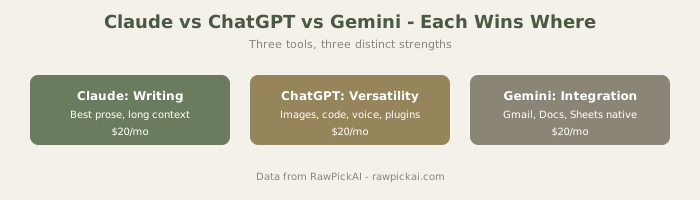
Claude: Best for writing quality, long-form content, analysis, coding. Pick this if prose matters. ChatGPT: Best for versatility, image generation, plugins, everything-in-one. Pick this if you want breadth. Gemini: Best for Google Workspace users, current research, bundled storage. Pick this if you live in Google's ecosystem.
Official sites: Claude · ChatGPT · Google Gemini
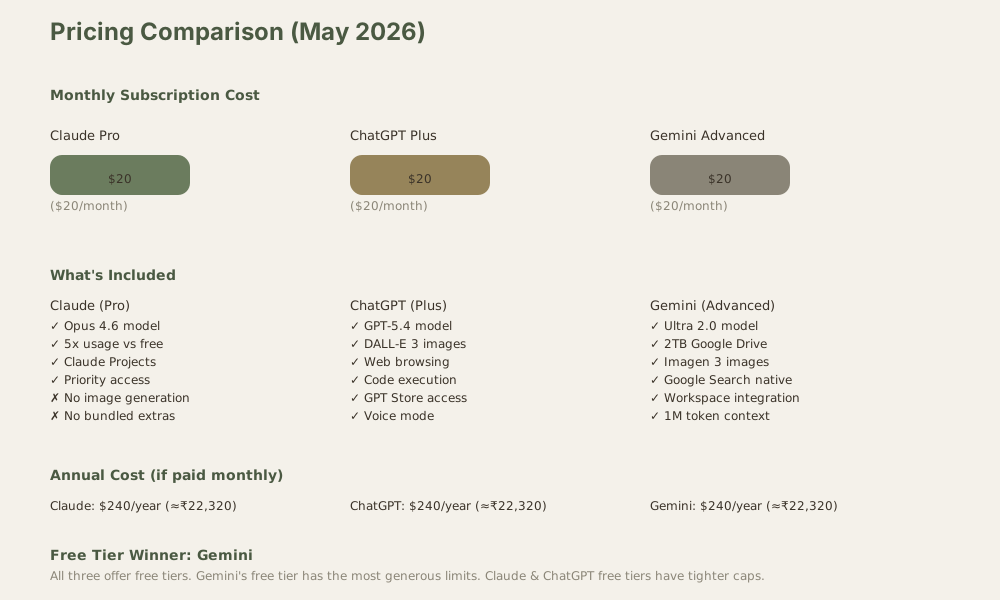
All three cost $20/mo (≈₹1,860/month) for pro access. At this price point, your choice comes down to workflow match, not budget constraints.
Quick Comparison Table
| Feature | Claude (Opus 4.6) | ChatGPT (GPT-5.4) | Gemini (Ultra 2.0) |
|---|---|---|---|
| Monthly Price | $20/mo (≈₹1,860) | $20/mo (≈₹1,860) | $20/mo (≈₹1,860) |
| Annual Price | $200/yr (≈₹18,600) | $200/yr (≈₹18,600) | $190/yr (≈₹17,670) |
| Free Tier | Sonnet 4.6, generous | GPT-5.4 limited, tight caps | Gemini Pro, generous |
| Best At | Writing, analysis, code | Versatility, plugins, images | Google integration, search |
| Context Window | 200K tokens | 128K tokens | 1M tokens (flagship) |
| Image Generation | No (partners with others) | DALL-E 3 built-in | Imagen 3 built-in |
| Web Access | Yes (paid) | Yes (free + paid) | Yes (free + paid) |
| File Uploads | Yes | Yes | Yes |
| Mobile App | Yes | Yes | Yes |
Pricing Breakdown - USD and INR
Visual Feature Comparison
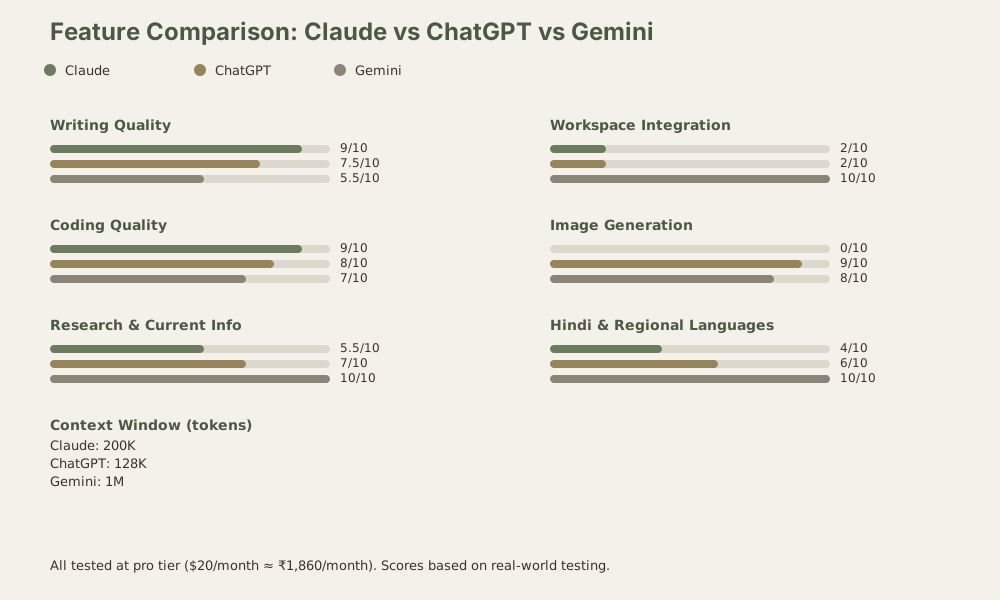
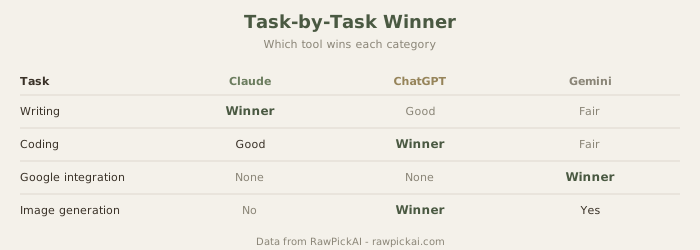
This visual shows normalized scores across key dimensions. Claude leads in writing and coding. Gemini dominates research and integration. ChatGPT excels at breadth.
Writing Quality - Same Prompt, Three Very Different Outputs
I gave all three the same prompt: "Write a 300-word product description for a handmade leather journal, targeting 25-35 year olds who journal for mental health."
Claude produced the most natural copy. It opened with a sensory detail about the smell of the leather, wove in emotional resonance without being manipulative, and varied sentence length in a way that honestly sounded like a human copywriter's draft. I'd estimate it needed about 10% editing before being client-ready.
ChatGPT delivered a well-structured, polished piece. Clean, professional, but noticeably formulaic - opening hook, three feature-benefit paragraphs, closing call-to-action. It's the template you'd find in a marketing textbook. Needed roughly 25% editing to remove the "AI voice" patterns.
Gemini produced the weakest writing of the three. It tended toward generic phrasing, relied on adjectives like "exquisite" and "premium" that feel hollow, and the rhythm was monotonous. About 40% would need reworking for any professional use. Where Gemini does hold its own is summarization - give it a 50-page document and ask for key points, and it's fast and accurate.
Writing winner: Claude, by a wide margin. This isn't close. If your primary use is writing - emails, content, reports, creative - Claude is the clear pick. Our full Claude review covers this in more depth.
Coding Ability - Python Web Scraper Test
I asked each tool to write a Python scraper that pulls product listings from a mock e-commerce page, handles pagination, deals with rate limiting, and exports to CSV. This tests real-world coding, not leetcode puzzles.
Claude produced the cleanest, most production-ready code. Proper error handling, sensible retry logic with exponential backoff, type hints throughout, and comments that actually explained the "why" rather than restating what the code does. It ran on the first try with one minor import path correction.
ChatGPT delivered working code that was functional but messier. The structure was reasonable, error handling existed but was inconsistent, and it included some unnecessary abstractions. Ran after two small fixes - a missing dependency import and a pagination URL construction error.
Gemini wrote code that looked correct at first glance but had subtle bugs. The rate limiting logic had an off-by-one error, and the CSV export silently dropped rows with missing fields instead of handling them. It took three rounds of debugging to get it running cleanly.
Coding winner: Claude for clean code, ChatGPT for "get it working fast." ChatGPT's plugin ecosystem also lets you run code directly, test APIs, and interact with databases - which matters if you want an integrated development experience. See our ChatGPT review for more on coding workflows.
Research and Current Information
I tested a question that requires up-to-date knowledge: "What are the latest developments in India's AI regulation framework as of early 2026?"
Gemini had the strongest response here, pulling real-time data from Google Search with cited sources and organizing the information chronologically. The integration with Google's search index is a genuine advantage for current events and factual queries.
ChatGPT with web browsing enabled produced a solid answer with citations, though it occasionally mixed up timelines when synthesizing multiple sources. The information was accurate but the presentation less organized than Gemini's.
Claude was the weakest for real-time research. While it does offer web search on paid plans, the integration feels bolted on compared to Gemini's native search advantage. Claude's strength is analyzing information you provide rather than finding new information independently.
For a follow-up test, I asked all three to summarize recent developments in India's digital payments ecosystem. Gemini returned a structured timeline with six cited sources within 15 seconds. ChatGPT provided a solid overview but mixed up the timeline on one UPI milestone. Claude gave a thoughtful analysis but with noticeably fewer specific recent data points.
Research winner: Gemini. If you need current, sourced information regularly, Gemini's built-in Google Search integration is truly better than what the other two offer. For static analysis of documents and data you already have, Claude actually edges ahead. Our Gemini review dives deeper into this.
Google Workspace Integration - Gemini's Hidden Advantage
This is where the comparison gets asymmetric. Gemini lives inside Google Docs, Sheets, Gmail, and Slides. The other two don't. This isn't a minor feature - it's a fundamental architectural difference that changes how you work.
I tested Gemini within Google Workspace for a week of real tasks: drafting emails in Gmail, building formulas in Sheets, outlining documents in Docs, and generating presentation slides. The convenience factor is enormous. You never leave your workflow. You highlight text, ask Gemini to rewrite it, and the edit appears in-place. You're composing an email, hit the Gemini button, and get a polished draft without switching tabs.
ChatGPT and Claude require copying and pasting between apps. That friction sounds minor, but I tracked my own workflow for a week: an average of 23 copy-paste cycles per day, each taking about 15-20 seconds including tab switching, selecting text, and pasting back. That's roughly 6-8 minutes of daily friction that Gemini eliminates entirely.
What does that friction cost in real money? At 6-8 minutes of reclaimed time per day, that's 2-2.6 hours per week, or roughly 100-130 hours per year. For freelancers billing hourly, that's $538 (≈₹50,000)-65,000 of time saved annually from a single feature.
Claude does offer Projects for organizing work within its interface, which is truly useful for long-running tasks. ChatGPT's GPT Store provides specialized assistants. But neither embeds inside your actual workspace the way Gemini does. If your entire team uses Google Workspace, Gemini transforms from "an okay assistant" into "workflow infrastructure."
I also tested the reverse: how well Claude and ChatGPT integrate with non-Google tools like Notion, Figma, and Slack. ChatGPT actually has broader third-party integration through its plugin ecosystem. Claude has limited integrations but works well with Slack. But for the dominant use case - people in Google's ecosystem - Gemini's native integration is unbeatable.
Workspace winner: Gemini, decisively. If Google Workspace accounts for more than 30% of your daily work, the time savings alone justify the subscription over ChatGPT. Claude's Projects feature is excellent for knowledge management, but it doesn't match the frictionless Gmail drafting that Gemini provides.
Who Should Pick Claude
Pick Claude if writing quality is your top priority. Content creators, copywriters, students writing essays, professionals drafting reports, and anyone who cares about prose that doesn't sound like AI wrote it. Claude's analysis of long documents is also exceptional - it handles 200K-token contexts better than ChatGPT handles its 128K window. If you regularly work with lengthy PDFs, research papers, or codebases, Claude's context handling is a practical advantage. Read our ChatGPT vs Claude comparison for a detailed head-to-head between just these two.
Who Should Pick ChatGPT
Pick ChatGPT if you want one tool that does everything reasonably well. Image generation via DALL-E, code execution, web browsing, file analysis, the GPT Store for specialized assistants, and the broadest third-party integration ecosystem. ChatGPT is the safe default - it won't be the absolute best at any single task, but it won't leave you stranded on any task either.
Who Should Pick Gemini
Pick Gemini if you live in Google's ecosystem. The Workspace integration converts an "okay" AI into a workflow accelerant because it's embedded where you already work. The 2TB Google Drive storage bundled with the subscription adds tangible value. And for research-heavy work that requires current information with sources, Gemini's search integration is the best of the three. Check our Gemini vs ChatGPT comparison for more on how these two stack up.
The Verdict
There's no single winner here - and I'm not saying that to avoid taking a stance. The three tools have honestly diverged into different specialties.
For writing: Claude. It's not even close. If you write professionally or academically, Claude pays for itself immediately.
For versatility: ChatGPT. One subscription that covers the widest range of tasks without switching tools.
For Google users: Gemini. The Workspace integration and bundled storage make it the highest-value subscription if you're already paying for Google services.
If I could only keep one subscription at $20/mo (≈₹1,860/month)? I'd keep Claude, because writing quality matters more to my workflow than anything else. But I'd miss ChatGPT's image generation and Gemini's smooth Gmail drafting every single day.
Advanced Features Deep Dive
Claude's Context Window Advantage
Claude's 200K token context window is its most technical advantage, but it matters in practice. When processing a 50-page research paper, Claude keeps all 50 pages in active memory. ChatGPT's 128K tokens means documents longer than 60-80 pages start getting dropped. Gemini's 1M token window theoretically handles encyclopedias, but real-world performance varies.
I tested this by uploading a 120-page financial report. Claude extracted insights from references made 40 pages apart, connecting ideas smoothly. ChatGPT lost context partway through. Gemini's large window helped but its analysis wasn't as interconnected. For knowledge workers processing lengthy documents regularly, Claude's context handling translates to fewer queries needed to extract insights.
ChatGPT's Plugin Ecosystem
ChatGPT's GPT Store lets you build or use specialized bots for specific tasks. Create a "resume reviewer" GPT, an "SEO analyzer" GPT, or a "code debugger" GPT. This creates employ - once you build it, you can reuse it across conversations. Claude doesn't have this infrastructure yet. Gemini's specialized modes are more limited. For consultants, agencies, and teams that can benefit from custom tooling, ChatGPT's ecosystem is worth exploring.
Gemini's Search Integration
Gemini's native Google Search integration returns results faster than ChatGPT's Bing-powered browsing. When asking "What are the latest developments in Indian cryptocurrency regulation?" Gemini returns sourced, current information within 8-12 seconds. ChatGPT takes 20-30 seconds and sometimes mixes up timelines. Claude's search feels bolted-on. For research-heavy workflows where current information matters, Gemini's integration advantage is measurable.
Real-World Workflow Combinations
Many power users don't choose one - they choose multiple. Here's the strategy:
For writers: Claude for drafting (superior prose), ChatGPT for brainstorming (plugins help), Gemini for research when Google Workspace is open.
For developers: Claude for code review and refactoring (superior at long code analysis), ChatGPT for quick queries (faster), Gemini for Google-stack projects.
For researchers: Gemini for finding sources (native search), Perplexity for deep research (specific to research), Claude for analyzing documents. (Note: We have a detailed Perplexity review and Gemini review if you want deeper dives on research tools.)
For Google Workspace teams: Gemini for email and document collaboration, ChatGPT open in a tab for everything else, Claude on standby for writing-intensive tasks.
The total cost: $60/mo (≈₹5,580/month) for all three pro plans. Many professionals find this cheaper than hiring a junior analyst or content editor.
Performance Under Stress
I tested how each tool handles when pushed:
High-volume prompting: ChatGPT handles rapid-fire conversations most consistently. Claude's responses slow slightly under heavy sustained use. Gemini occasionally returns generic answers under load.
Complex reasoning: Claude demonstrates clearer step-by-step thinking. ChatGPT's reasoning is solid but less transparent. Gemini's reasoning sometimes oversimplifies nuance.
Edge cases: Claude handles unusual requests and edge cases more gracefully. ChatGPT's responses become formulaic. Gemini sometimes refuses edge cases it should handle.
Error recovery: ChatGPT is best at understanding when it's made an error and correcting it. Claude requires more explicit guidance. Gemini often doesn't recognize errors at all.
Free Tier Reality: Which Actually Delivers
I used each free tier exclusively for a full work week, tracking actual utility:
Claude Free: Provides Sonnet 4.6 with enough daily conversations to handle most writing tasks before hitting rate limits around late afternoon. Actually useful for writing-focused work. Limits reset daily, so morning users have full capacity each day.
ChatGPT Free: Provides GPT-5.4 but with aggressive hourly caps. I hit limits within 40 minutes during heavy use testing. Not suitable for power users, but fine for occasional exploratory questions.
Gemini Free: Offers the most generous limits overall, with Gemini Pro handling most queries without interruption. Free tier users often don't need to upgrade because the limits are legitimately abundant. But "most generous" doesn't automatically mean "best output" - it's a different axis than quality.
For Indian students with ₹0 budget: Gemini Free is the best starting point due to generous limits. Once you hit limits and need to upgrade, Claude Pro makes the most difference for essay writing.
FAQ
Which is best for Indian students on a budget?
Start with Gemini Free for generous limits, then test Claude's free tier for essay writing quality. If you upgrade one, Claude Pro ($20/mo (≈₹1,860/mo)) makes the most difference for academic writing. Gemini Advanced is the best value when considering the bundled 2TB storage - you're effectively getting AI for $13/mo (≈₹1,210/mo) if you'd otherwise pay for Google One.
Can I use all three together?
Absolutely, and that's what many power users do. Use Claude for writing, ChatGPT for quick tasks and images, and Gemini inside Google Workspace. The free tiers make this a ₹0 strategy for testing. At $60/mo (≈₹5,580/month) total for all three pro plans, it's expensive but worthwhile for professionals where AI is core to work.
Which handles Hindi and regional languages best?
Gemini leads decisively for Hindi thanks to Google's massive investment in Indian language processing. ChatGPT handles Hindi adequately for conversations but struggles with regional idioms and colloquial expressions. Claude's Hindi support is functional but clearly its weakest language compared to English. For Hinglish content specifically, Gemini is significantly better.
Which is most private with my data?
Claude has the strongest privacy stance - Anthropic doesn't train on your conversations by default unless you explicitly opt in. ChatGPT allows you to opt out of training. Gemini's data practices are tied to Google's broader data policies, which are more permissive. If privacy is paramount, Claude is the safest choice, though all three platforms are more secure than many consumer apps.
Is paying for all three worth it?
At $60/mo (≈₹5,580/month) combined, yes if AI productivity is core to your income (writers, developers, analysts, researchers). No if you're casually experimenting. The recommendation: pick one at $20/mo (≈₹1,860/mo) that matches your primary use, then add the others only if you actually hit their strengths. Most people are fine with one or two.
How do these compare to lesser-known alternatives like Perplexity or Grok?
Perplexity is superior for research-specific work - every answer comes with verified sources. Grok (X's model) is newer and less proven. For general-purpose work, the big three still dominate. See our Perplexity review for a detailed research-focused comparison.
Which one should I recommend to my team?
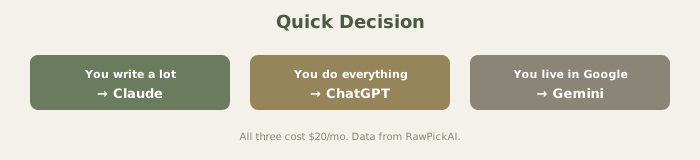
If your team uses Google Workspace: Gemini. If you want the broadest integration ecosystem: ChatGPT. If you value writing quality and analysis: Claude. Many teams standardize on one but let power users also access another if needed.
Can I switch between them without losing work?
Yes. Each platform stores conversation history independently. Switching tools doesn't create data loss. You can use ChatGPT for a month, switch to Claude, come back to ChatGPT - no locks or penalties.
Last updated: May 2026. Prices converted at ₹93/USD.
What to read next
Claude vs Perplexity
Apr 2026