Manus AI Review 2026: Autonomous Agent
Manus AI is an autonomous agent that browses the web and writes code. Tested on real tasks. Pricing (USD + INR), Meta acquisition context, verdict.
 ByAsh
ByAshTry the free tier on a real task you'd normally spend 2+ hours on.
Manus AI is not a chatbot. It's an autonomous AI agent that takes a task, breaks it into steps, and executes the entire thing: browsing the web, writing code, creating files, analyzing data, and delivering finished results. You describe what you want, and Manus goes and does it. No prompting each step. No copy-pasting between tools.
TL;DR: Manus AI is the most capable general-purpose autonomous agent I've tested. It handles multi-step research, web app building, and data analysis better than anything in the "just do it for me" category. The sandboxed VM approach (real browser, real terminal) makes it really more capable than plugin-based agents. After Meta's $2 billion acquisition in late 2025, Manus restructured pricing - the entry tier is now $20/mo. But credit consumption is still unpredictable, the free tier runs dry fast, and the Meta ownership raises legitimate questions about where the product is headed. If you need an AI that executes tasks end-to-end rather than just answering questions, Manus is worth trying. If you need a daily coding assistant, Claude Code or Cursor will serve you better.
I spent about 10 hours with Manus over two weeks, testing it on research tasks, data analysis, web app generation, and general productivity work. This review covers what it actually does well, where it breaks down, what it costs, and whether the Meta ownership changes anything.
What Is Manus AI and How Is It Different
The simplest way to understand Manus: ChatGPT and Claude are conversational. You ask, they answer. Manus is autonomous. You assign, it executes.
When you give Manus a task like "research the top 10 project management tools, compare their pricing, and create a spreadsheet," it doesn't ask you clarifying questions. It spins up a sandboxed virtual machine, opens a real web browser, visits actual websites, reads pricing pages, compiles the data, creates a real spreadsheet file, and hands you the finished result. You can watch it work in real-time through a screen-share view.
This is fundamentally different from how ChatGPT, Claude, or Gemini work. Those tools generate text responses. Manus generates outcomes.
The technical architecture behind this is a multi-agent system. At minimum, there's a Planner agent that breaks your task into sub-steps, an Execution agent that carries them out using real tools (browser, terminal, file system), and a verification layer that checks results. Per chief scientist Yichao Ji's own statements, Manus runs on top of multiple LLMs including Anthropic's Claude and fine-tuned versions of Alibaba's open-source Qwen, choosing whichever fits the sub-task best.
Who Built Manus (and Who Owns It Now)
Manus was created by Butterfly Effect (also known as Monica.im), a startup founded in 2022 by CEO Xiao Hong (nicknamed "Red"), with co-founders Yichao "Peak" Ji as chief scientist and Zhang Tao leading product. The company was originally based in Beijing and Wuhan before relocating headquarters to Singapore in mid-2025 after raising a $75 million Series B led by Benchmark at a roughly $500 million valuation. Ji - named to MIT Technology Review's 2025 Innovators Under 35 list - was the public face of the launch video that went viral in March 2025, but Xiao is the CEO and the company's organizational lead.
Within eight months of its public launch in early 2025, Manus hit $100 million in annual recurring revenue, making it one of the fastest-growing AI startups in history. The company also drew political attention: in May 2025, US Senator John Cornyn publicly questioned Benchmark's investment, raising concerns about American venture capital backing a Chinese-founded AI company. Microsoft began testing Manus inside Windows 11 in October 2025.
Then Meta bought it. On December 30, 2025, Meta announced its acquisition of Butterfly Effect in a deal valued at over $2 billion, finalized in roughly ten days. Manus continues to operate as a standalone product under its own brand, but Xiao Hong now reports to Meta COO Javier Olivan as a Vice President. Meta has said it plans to integrate Manus capabilities into Facebook, Instagram, and WhatsApp over the coming months, though no specific timeline or product details have been announced publicly.
I'll address what the acquisition means for users later in this review. For now, the product functions the same way it did before the deal.
Key Features I Actually Tested
Autonomous Research
This is Manus's strongest feature. I gave it: "Research the top 8 AI coding tools launched or majorly updated in 2025-2026. For each, find pricing, key features, user sentiment, and any notable limitations. Compile into a structured report."
Manus spent about 12 minutes on this. It opened multiple browser tabs, visited official sites and review aggregators, cross-referenced pricing data, and produced a formatted report with a comparison table. The output was roughly 80% accurate. It got pricing right for 6 of 8 tools, missed a recent plan change for one, and slightly mischaracterized features for another. That's better than any chatbot would do, because chatbots are limited to training data while Manus browses live websites.
For well-defined research tasks with objective answers, Manus is actually useful. In our testing, it saved roughly 60-70% of the time I'd spend doing the research manually.
Web App Builder
Manus can generate full-stack web applications from a text description. I tested it with: "Build a simple expense tracker with categories, date filtering, and a monthly summary chart. Use React and make it deployable."
It produced a working React app with a clean UI, category tagging, date range filters, and a Chart.js bar graph for monthly totals. The code was functional but not production-quality: no error handling, no input validation, hardcoded demo data. It took about 8 minutes and generated deployable files.
For prototyping and MVPs, this is impressive. For production code, you'd still need significant cleanup. Claude Code produces higher-quality code on individual components, but it doesn't build and deploy an entire app end-to-end in one shot like Manus does.
Data Analysis
I uploaded a CSV with 2,000 rows of sales data and asked Manus to "identify trends, find the top-performing products by region, and create visualizations."
Manus loaded the file into its sandboxed environment, ran Python analysis, generated matplotlib charts, and produced a summary report. The statistical analysis was sound: it correctly identified seasonal patterns and regional outliers. The visualizations were functional but basic.
For quick analysis of structured data, Manus works well. For anything requiring domain expertise or nuanced interpretation, you'll want to review the output carefully.
Wide Research (Parallel Multi-Agent)
Manus's "Wide Research" mode processes hundreds of data points simultaneously by orchestrating multiple agents in parallel. I tested this with a competitive analysis across 15 companies. The parallel execution noticeably reduced wait time compared to sequential research, and the output was more comprehensive than single-agent approaches.
This is where Manus's multi-agent architecture shines. The parallel orchestration bypasses the context-window limitations that degrade quality in standard chatbots when you feed them too much information.
Photo Style Analysis
The keyword data shows "manus ai color analysis" at 390 monthly searches, so people are looking for this. Manus has a PhotoStyle Insight Scanner that analyzes your photographs for composition, lighting, color patterns, and mood. You upload photos and it returns a detailed report on your stylistic tendencies, strengths, and suggestions for improvement.
I tested it with 10 photos from a recent trip. The analysis was surprisingly detailed: it identified my tendency toward warm tones and center-weighted composition, and suggested experimenting with negative space. It's not replacing a photography mentor, but for self-directed learning it's a useful tool.
Pricing: The Credit Math That Matters
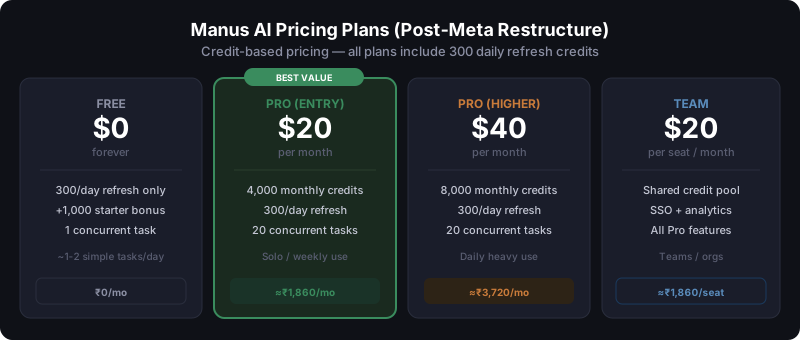
Manus uses credit-based pricing. Every task consumes credits, and the amount varies based on complexity. This is the part that frustrates most users: you can't predict what a task will cost before you run it.
Heads-up on the pricing structure: Manus restructured pricing around the Meta acquisition. Per Manus's own help center, "the original Basic and Plus plans have both been renamed to Pro" and the credit allocations were adjusted. The current tiers are below; older third-party reviews on the web still cite the legacy Basic ($19) / Plus ($39) / Pro ($199) naming with 1,900 / 3,900 / 19,900 credits - those plans still exist for grandfathered subscribers but are no longer offered to new signups.
| Plan | Monthly Cost | INR (≈₹93/USD) | Monthly Credits | Daily Refresh | Concurrent Tasks |
|---|---|---|---|---|---|
| Free | $0 | ₹0 | 300/day refresh only | 300/day | 1 |
| Pro (entry) | $20/mo | ≈₹1,860 | 4,000 + daily refresh | 300/day | 20 |
| Pro (higher) | $40/mo | ≈₹3,720 | 8,000 + daily refresh | 300/day | 20 |
| Team | $20/seat/mo | ≈₹1,860 | Shared pool + Pro features | 300/day | 20 |
Annual billing saves 17% across all paid plans. New signups also typically receive a one-time 1,000-credit starter bonus on top of the daily refresh. Verify current pricing at manus.im/pricing.
How credits actually burn:
In our testing, credit consumption per task broke down roughly like this:
- Simple web lookup or quick question: 10-20 credits
- Content generation with light research: 50-100 credits
- Multi-step research with report generation: 100-300 credits
- Complex research across many sources: 500-900 credits
- Full web app generation: 200-500 credits
The daily refresh saves you. Every plan, including free, gets 300 credits refreshed daily. That's separate from your monthly pool. If you use Manus for one or two simple tasks per day, the daily refresh alone might be enough. It's when you run complex multi-step tasks that you start burning through monthly credits fast.
The free tier reality: 300 daily credits sounds reasonable until you run a single complex research task and the entire day's allocation vanishes. Manus typically grants a 1,000-credit starter bonus to new signups, which buys you a couple of substantial test tasks before you're back to the daily refresh limit. Enough to evaluate the product, not enough for regular use.
The honest cost picture: Pro at $20/mo (≈₹1,860) is the realistic entry point for anyone who wants to use Manus weekly. The $40/mo Pro tier makes sense if you regularly run 2-3 substantial tasks per day or need Wide Research at scale. For comparison, Claude Code Max costs $100/mo (≈₹9,300) and Cursor Pro costs $20/mo (≈₹1,860), but they're coding-specific tools, not general autonomous agents.
Manus AI vs ChatGPT vs Claude
This comparison comes up constantly (140 monthly searches for "manus ai vs chatgpt"), so let me be clear about what you're comparing.
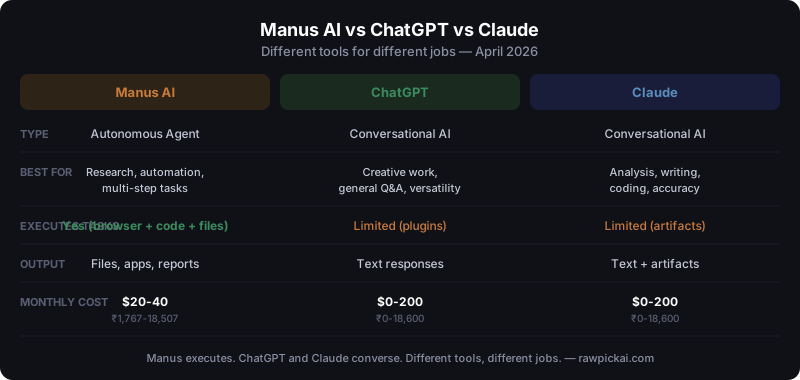
| Manus AI | ChatGPT | Claude | |
|---|---|---|---|
| Type | Autonomous agent | Conversational AI | Conversational AI |
| Executes tasks | Yes (browser, code, files) | Limited (plugins/GPTs) | Limited (Artifacts) |
| Best for | Multi-step research, automation | Creative work, general Q&A | Analysis, writing, coding |
| Output | Finished deliverables (files, apps, reports) | Text responses | Text responses + artifacts |
| Pricing | $20-40/mo (≈₹1,860-3,720) | $0-200/mo | $0-200/mo |
| Learning curve | Low (describe task, wait) | Very low | Very low |
| Reliability | ≈80% on first try | High for chat tasks | High for chat tasks |
The fundamental difference: ChatGPT and Claude help you think. Manus helps you do. If you need to write an email, brainstorm ideas, or get answers, use ChatGPT or Claude. If you need someone to go research 20 websites, compile findings into a spreadsheet, and email it to your team, that's what Manus is for.
They're not competitors. I use Claude for writing and analysis, Claude Code for coding, and Manus for research and automation tasks that would otherwise take me hours of tab-switching. Different tools, different jobs.
The Meta Acquisition: What It Means for Users
Meta acquired Manus for over $2 billion in late December 2025. Here's what's changed and what hasn't.
What hasn't changed: The product still works the same way. Same interface, same features, same credit system. Existing subscriptions remain unchanged - grandfathered users still see legacy plan names. The team still operates from Singapore.
What has changed: Meta restructured pricing, simplified plan naming, and the company's corporate structure shifted dramatically. Per a Meta spokesperson statement to Business Insider and Nikkei Asia, "there will be no continuing Chinese ownership interests in Manus AI following the transaction, and Manus AI will discontinue its services and operations in China." That includes shutting down the Chinese-market Monica assistant and relocating the relevant employees. Whatever the technology's provenance, the corporate structure as of January 2026 is unambiguously US-owned.
What I think this means long-term: Meta didn't pay $2 billion for a $40/mo consumer product. They bought the execution engine. Expect the standalone Manus product to eventually become a funnel for Meta's business tools across WhatsApp Business, Instagram Direct, and Facebook. Whether that means the consumer product gets better (more resources, faster development) or worse (attention shifts to Meta integration) is the open question. The acquisition is less than four months old at time of writing, so we don't have a clear answer yet.
The data question: Manus already processes your tasks on cloud servers. Under Meta's ownership, your task data is subject to Meta's privacy policies, not just Manus's original ones. Meta has said Manus employees joining Meta will not have access to existing customer data, and that Manus will continue to geo-block Meta's AI models from certain markets. If you're running sensitive research through Manus, review Meta's data handling practices first. This matters more for business users than casual ones.
The China Question
The keyword data shows real search interest: "manus ai china," "manus ai chinese," "manus ai is from which country." People want to know.
Here's the simple answer: Manus was founded by a Chinese team (Butterfly Effect, Beijing/Wuhan, 2022). The company relocated to Singapore in mid-2025 and raised US venture funding from Benchmark. The product uses multiple AI models including Alibaba's Qwen (Chinese, fine-tuned) and Anthropic's Claude (US).
Post-acquisition, Meta has been explicit about severing Chinese ties. Per Meta's spokesperson statements: no continuing Chinese ownership, services discontinued in China, Monica (the Chinese-market assistant) being shut down. China's Ministry of Commerce launched its own export control compliance review of the deal in January 2026, which is its own indication of how seriously both governments treat the change in ownership. As of early 2026, Manus is owned and operated by Meta, a US company, with development based in Singapore.
For most users, the country of origin is irrelevant to the product experience. If you work in a sector with specific compliance requirements around Chinese-developed software, that's a conversation for your legal team - but the Meta acquisition has materially changed the compliance picture compared to where Manus stood six months ago.
What I Don't Like About Manus
Credit unpredictability. A task I expect to cost 50 credits might cost 200. The variable consumption makes budgeting difficult, especially for teams. Unlike Claude Code where you get a plan with clear capacity, Manus's credit system feels like metered electricity where the rate changes based on weather.
Reliability on complex tasks. In our testing, Manus completed about 80% of tasks correctly on the first attempt. The other 20% either partially failed (missing data, incomplete outputs) or required a retry. For simple tasks, reliability was higher (≈90%). For complex multi-step tasks, it dropped to around 70%. That's the reality of autonomous agents in 2026: they're impressive when they work, frustrating when they don't.
No real coding depth. Manus can generate web apps and run Python scripts, but it doesn't have the codebase awareness or multi-file editing depth of Claude Code or the real-time IDE integration of Cursor 3. If your primary need is coding, Manus isn't the right tool.
Slow on complex tasks. A multi-step research task can take 8-15 minutes. You're watching an agent browse websites in real-time, which is cool the first time and tedious the tenth. ChatGPT or Claude give you answers in seconds because they're pulling from training data, not live-browsing.
The Meta uncertainty. The acquisition is less than four months old. We don't know yet whether Meta will invest heavily in the standalone product or slowly redirect resources toward WhatsApp/Instagram integration. Signing up for an annual plan right now carries more risk than it did six months ago.
The Verdict
Manus AI is the most capable general-purpose autonomous agent available right now. The sandboxed VM approach, where it uses a real browser and real terminal rather than simulated plugins, gives it genuine task-execution capability that conversational AIs can't match. For research tasks, data analysis, and prototype generation, it delivers real time savings.
But it's not a daily driver for most people. The credit system makes costs unpredictable. Reliability hovers around 80%, which means one in five tasks needs manual intervention. And for coding specifically, dedicated tools like Claude Code and Cursor are significantly better.
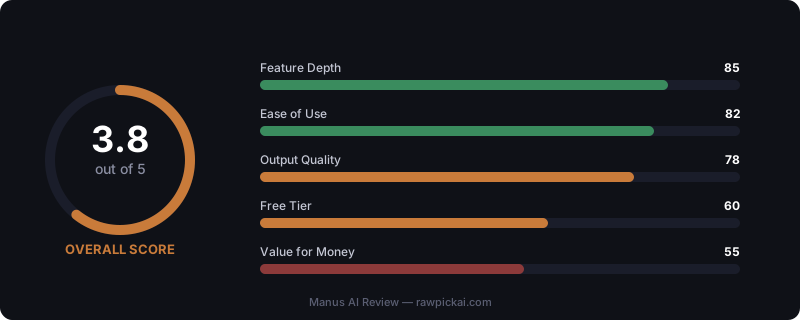
My score: 3.8/5. Strong technology held back by pricing unpredictability, reliability gaps, and acquisition uncertainty. If credit pricing were transparent and reliability hit 90%+, this would be a 4.3.
Bottom line: Try the free tier on a real task you'd normally spend 2+ hours on. If Manus saves you that time, Pro at $20/mo (≈₹1,860) is reasonable. Don't commit to the $40/mo tier until you've used it for at least a month and know your actual credit consumption patterns.
Frequently Asked Questions
What is Manus AI?
Manus AI is an autonomous AI agent that executes multi-step tasks independently. Unlike chatbots that generate text, Manus browses the web, writes and runs code, creates files, and delivers finished results. It's owned by Meta since January 2026.
Is Manus AI free?
Manus has a free tier with 300 daily refresh credits (and a one-time 1,000-credit starter bonus for new signups). That's enough for one or two simple tasks per day. For regular use, paid plans start at $20/mo (≈₹1,860) for the Pro tier.
How much does Manus AI cost?
The current pricing tiers are: Free ($0, 300 daily credits), Pro entry ($20/mo with 4,000 monthly credits + daily refresh), Pro higher ($40/mo with 8,000 credits), and Team ($20/seat/mo with shared credit pool). All paid plans get 300 daily refresh credits. Credit consumption per task varies from 10 to 900+ depending on complexity. Manus restructured pricing after the Meta acquisition; older reviews may cite the legacy Basic ($19) / Plus ($39) / Pro ($199) naming.
Is Manus AI Chinese?
Manus was founded by a Chinese team (Butterfly Effect, Beijing/Wuhan) in 2022. The company relocated to Singapore in mid-2025 and was acquired by Meta (US) for over $2 billion in December 2025. Per Meta's own statements, there are no continuing Chinese ownership interests post-acquisition, and Manus has discontinued operations in China entirely. The product uses both Chinese (Qwen) and US (Claude) AI models.
Is Manus AI open source?
Manus itself is not open source. However, OpenManus is a community-built open-source alternative on GitHub with around 55,000 stars that replicates much of Manus's core functionality. It was built by the MetaGPT research community in roughly three hours after Manus's launch and now has its own active development. A Go SDK for the Manus API also exists for developers.
How does Manus AI compare to ChatGPT?
Manus executes tasks autonomously (browsing, coding, file creation). ChatGPT is conversational and generates text responses. Use ChatGPT for quick answers, creative writing, and analysis. Use Manus when you need a task fully completed without step-by-step prompting.
What happened with Manus AI and Meta?
Meta acquired Butterfly Effect (Manus's parent company) for over $2 billion in late December 2025. The deal was finalized in roughly ten days. CEO Xiao Hong now reports to Meta COO Javier Olivan as a Vice President. The product continues as a standalone service. Meta has said it plans to integrate Manus capabilities into Facebook, Instagram, and WhatsApp over the coming months.
Is Manus AI worth it?
For regular multi-step research and automation tasks, Pro at $20/mo is good value if the time savings justify the cost. For coding specifically, Claude Code or Cursor are better tools. The free tier is worth trying before committing.
Related reviews: Best AI Agents 2026 | Claude Code Review | ChatGPT Review | Cursor 3 Review | Devin Review | AI Agents vs Agentic AI
Last updated: April 2026. Tested over 10 hours across two weeks. Pricing verified April 10, 2026 against Manus's official help center. INR converted at ₹93/USD.
What to read next
Claude vs ChatGPT vs Gemini
Apr 2026