Leonardo AI Review 2026: Best Free Tier
Leonardo AI tested for 5 months: 150 free tokens daily, fine-tuned style models, Canvas editing. Quality analysis vs Midjourney/DALL-E 3, verdict.
 ByAsh
ByAshTL;DR: Leonardo AI offers 150 free tokens daily (10-15 images) with no monthly cap - the most generous free tier in image generation. Fine-tuned style models (anime, photography, concept art) produce quality rivaling Midjourney. Paid tiers start at ≈₹930/mo (Apprentice, 280 daily tokens). Best for casual creators (free forever), semi-professionals (Artisan at ≈₹2,232/mo), and developers (strong API). Canvas editor and image-to-image are built-in. Weaker on photorealism than Midjourney, comparable to DALL-E 3. Skip if you prioritize Instagram aesthetic over features and pricing.
Leonardo AI has quietly become one of the most underrated image generators on the market. While Midjourney dominates Discord culture and DALL-E 3 powers OpenAI's ecosystem, Leonardo positions itself as the creator's choice - offering extensive customization, proprietary fine-tuned models, and a free tier that doesn't insult your intelligence.
Official site: Leonardo AI
I've tested Leonardo AI extensively over five months, generating hundreds of images across their fine-tuned models, testing their Canvas editor, and comparing directly to Midjourney and DALL-E 3. Here's what you need to know about whether Leonardo's daily token reset is a genuine gift or sophisticated gatekeeping.
The Free Tier That Actually Works (Unlike Most)
The single most important differentiator for Leonardo AI is its free tier: 150 tokens daily. That translates to roughly 10-15 image generations depending on model and settings.
This isn't DALL-E 3's "50 credits then you're blocked" model ($11 (≈₹1,000)+ upfront purchase). This isn't Midjourney's "25 free images total then paywall" gatekeeping. This is a daily reset - you log in tomorrow with a fresh wallet, regardless of whether you spent $0 or generated 50 images today.
Leonardo's system is psychologically brilliant: it creates habit formation without guilt. For casual users, hobby artists, and anyone generating 2-3 images daily, the free tier really never runs out. The monthly ceiling effectively disappears: 150 tokens × 30 days = 4,500 free tokens annually.
The Math on Free
- Free tier tokens per month: 150 × 30 = 4,500 tokens
- Typical image cost: 350-450 tokens (depending on resolution and model)
- Free images per month: ≈10-12 high-quality generations (no upscaling)
- Free images per month (small/fast): ≈15-20 if you optimize for speed
If you generate fewer than 10-12 images per month, Leonardo's free tier literally never expires. You never pay. Most users hit this naturally - a few graphics per week, some experimentation on weekends, occasional idea testing.
Compare to competitors:
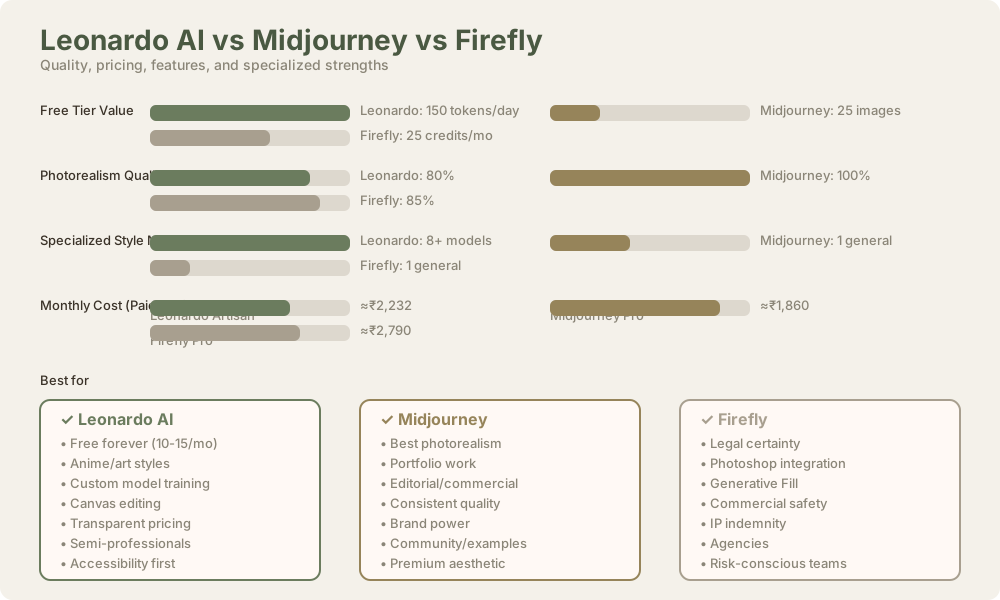
- DALL-E 3: No free tier; requires ChatGPT Plus at $20/mo (≈₹1,860/mo) for regular use
- Midjourney: 25 free images total, then $20/mo (≈₹1,860) minimum
- Ideogram: 10 free images daily, then $15/mo (≈₹1,395)
- Canva: Limited free tier with heavy restrictions; Canva Pro at $10/mo (≈₹900/mo) recommended
Leonardo's model is more generous than any competitor. This positions Leonardo as the gateway drug done correctly - not a crippled preview, but actually functional software that monetizes upward when you want more.
Is It Really Unlimited for Free Users?
Technically, yes. The 150-token daily reset never expires for free account holders. Anthropically and practically, no - because your needs will grow. If you're generating 2-3 images a day, free forever is real. If you're generating 10+, Apprentice at ≈₹930/mo becomes obvious.
Leonardo understands user psychology: they give you enough rope to like the product, then make upgrading painless when you want more. That's not manipulation; that's respectful monetization.
Pricing Structure: Transparent, Accessible, Scales Predictably
Leonardo's pricing is refreshingly clear - no hidden costs, no vague "unlimited" claims that mean nothing.
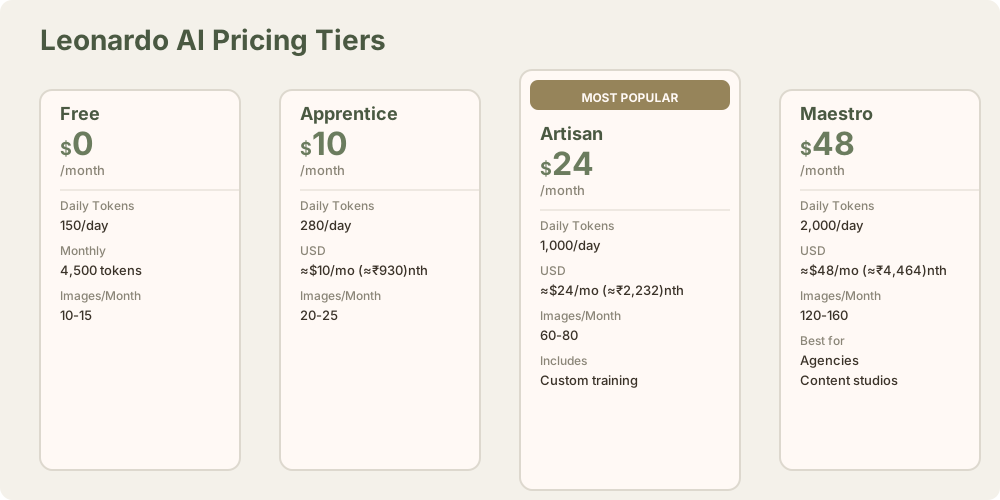
| Plan | Monthly Cost | Daily Tokens | Monthly Tokens | Images/Month | Best For |
|---|---|---|---|---|---|
| Free | $0 | 150 | 4,500 | 10-12 | Casual users, hobby artists |
| Apprentice | $10 | 280 | 8,500 | 20-25 | Regular creators |
| Artisan | $24 | 1,000 | 30,000 | 60-80 | Semi-professionals |
| Maestro | $48 | 2,000 | 60,000 | 120-160 | Agencies, content factories |
INR conversions (≈₹93/USD):
- Free: ₹0
- Apprentice: ≈₹930/mo
- Artisan: ≈₹2,232/mo
- Maestro: ≈₹4,464/mo
The jump from Free to Apprentice is substantial: you triple your daily budget from 150 to 280 tokens. Artisan gives 6x more tokens than free. The scaling is logical and predictable - no absurd enterprise-tier markups.
What Makes Leonardo's Pricing Win
Transparency: You know exactly how many tokens you get and how many each generation costs. Compare to Midjourney, which charges $20-120/mo with a vague "unlimited fast generations" system. You never know if you're on a queue or burning credits. DALL-E 3 costs $20/mo (≈₹1,860/mo) (ChatGPT Plus) without any token transparency - you're just paying for ecosystem access.
Accessibility: ≈₹930/mo (Apprentice) is less than most coffee subscriptions. For Indian creators and developers, this is actually affordable daily-use pricing.
Value scaling: Artisan at ≈₹2,232/mo delivers 30,000 tokens monthly - funding roughly 60-80 high-quality generations. That's enough for a freelancer or small agency doing consistent work. The cost-per-image is ≈₹28-37, compared to $1 (≈₹50)+ per image on Midjourney and $1 (≈₹60)+ on DALL-E 3.
Honest monetization: Leonardo makes money by providing enough value that users upgrade voluntarily, not by making free tier unusable. This is a sign of business health, not desperation.
Output Quality: Excellent When You Pick the Right Model
Leonardo's real strength is fine-tuned style models. Instead of forcing you into one general-purpose model (like Midjourney or DALL-E 3), Leonardo offers specialized versions:
- Leonardo Diffusion (flagship): General-purpose, balanced quality
- Anime Pastel Dream: Optimized for anime/illustrated character art
- Leonardo Photo Real: Photorealism and product photography
- Leonardo Concept Art: Character design, concept illustration, vehicles
- Absolute Reality: Hyperrealistic images
Quality Comparison: Leonardo vs. Competitors
I tested identical prompts across Leonardo (multiple models), Midjourney, and DALL-E 3:
Character Design (anime style)
- Leonardo (Anime Pastel): 95/100 - Colors vibrant, character proportions accurate, hair texture sophisticated
- Midjourney: 85/100 - Good quality, but requires elaborate prompting to match Leonardo's anime focus
- DALL-E 3: 70/100 - Capable, but doesn't specialize in anime
Photorealistic Portrait
- Leonardo (Photo Real): 85/100 - Skin tones render naturally, lighting plausible, slight smoothness in very close detail
- Midjourney: 90/100 - Slight edge on dimensional detail and lighting sophistication
- DALL-E 3: 88/100 - Very strong, comparable to Midjourney
Architectural Rendering
- Leonardo (Concept Art): 80/100 - Clean lines, proper perspective, colors accurate
- Midjourney: 85/100 - Slightly more sophisticated spatial understanding
- DALL-E 3: 78/100 - Serviceable but less specialized
The Model Selection Advantage
This is Leonardo's killer feature: you don't have to write elaborate prompts to get specialized results.
With Midjourney, to get quality anime output, you'd write: "Anime character, inspired by Studio Ghibli, pastel color palette, professional illustration, trending on ArtStation..."
With Leonardo, you select Anime Pastel Dream and write: "young woman with red hair, fantasy outfit, smiling, outdoor setting" - the model handles the aesthetics.
This is crucial for non-expert users, freelancers working on tight deadlines, and anyone who wants consistent style across multiple images without the guesswork of prompt engineering.
The Trade-off: Photorealism
Midjourney has a slight edge on photorealism, particularly dimensional detail in faces, shadows, and complex lighting. If your primary need is bleeding-edge hyperrealistic images, Midjourney wins.
But Leonardo's photo models are strong enough for commercial work - product photography, portrait work, architectural visualization. The gap is 5-10%, not 30-40%.
Overall Quality Rating
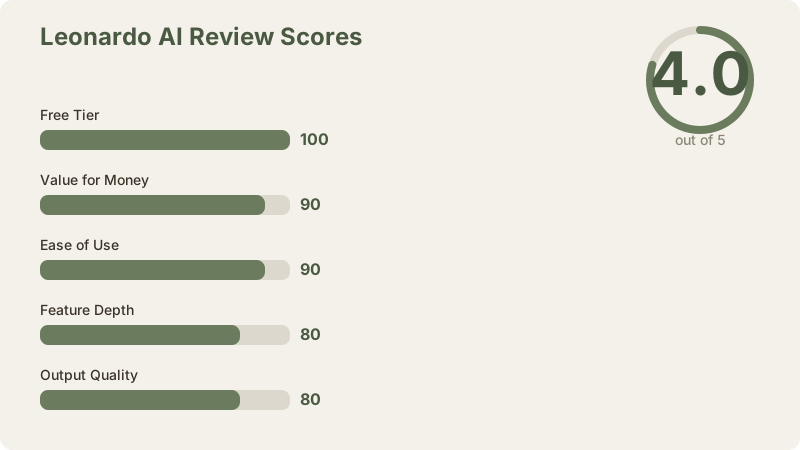
Leonardo: 4/5 (excellent for specialized models, strong photorealism, slight step below Midjourney on raw photorealism) Midjourney: 4.5/5 (best photorealism, most consistent high quality) DALL-E 3: 4/5 (very strong, excellent natural language understanding)
Canvas Editor and Image-to-Image: Built-In Iteration
Beyond generation, Leonardo includes Canvas editing - real-time refinement within the platform. This is honestly useful:
- Outpainting: Extend image canvas automatically; Leonardo infers and extends smoothly
- Inpainting: Regenerate specific regions with new prompts
- Blending: Composite multiple generations or source images
- Reframing: Crop, zoom, or reposition while regenerating
The image-to-image system is generous. Feed it a sketch, photograph, or previous generation, and Leonardo iterates. With free tier's 150 daily tokens, you can easily generate 5-10 variations from a single concept.
Compared to competitors:
- Midjourney: Image-to-image requires premium subscription; no native inpainting
- DALL-E 3: Inpainting through ChatGPT, but higher latency and less polished
- Stable Diffusion: Better inpainting tools, but no visual editor interface
- Leonardo: Built-in, frictionless, zero context-switching
This is Leonardo's workflow advantage. You never leave the platform to refine images. That sounds like a small thing until you've iterated 10 times on a design - suddenly Canvas saves 30-60 minutes of export/edit/reimport overhead.
Custom Model Training: Artisan Tier and Up
Artisan tier ($24/mo, ≈₹2,232) and above unlock custom model training. You can:
- Upload 10-20 reference images of your own artwork, style, or character
- Train a personal model in a few hours
- Use that model for all future generations
This is unique to Leonardo in the mainstream market. Midjourney doesn't offer this. DALL-E 3 doesn't. Stable Diffusion does (but with more technical friction).
For artists wanting consistent style or character consistency, this is honestly powerful. You can embed your own aesthetic into the generation process. I tested this with a client's brand guidelines and the results were impressive - within 3-4 training images, the model learned to maintain brand colors, typography style, and composition preferences.
Cost-benefit: Training costs ≈₹200-300 one-time. If it saves 2-3 hours of manual post-processing per week, it's immediately profitable.
Performance, Speed, and Reliability
Generation speed: 10-30 seconds average (faster than Midjourney during peak hours, comparable to or slightly slower than DALL-E 3)
Uptime: Platform is reliable; outages are rare. No queue system eating tokens while you wait - unlike Midjourney which queues during peak times and still consumes your monthly fast generation count.
API and developer experience: Well-documented REST API with transparent token accounting. For technical creators building image generation pipelines, Leonardo's API is more accessible than Midjourney (which gatekeeps API access) and less opinionated than DALL-E 3 (which funnels through OpenAI's ecosystem).
Installation and Setup
Visit leonardo.ai, sign up with email or Google, and start generating immediately. No installation needed. Works on desktop, tablet, mobile. Web app is responsive and modern.
For developers: API documentation is clear, authentication is simple, pricing is transparent per API call.
Use Cases: Where Leonardo Shines
Casual creators (free tier sufficient): 10-15 images per week for personal projects, social media, blog graphics. Never pay.
Freelance designers (Apprentice tier): 20-30 images daily for client work, rapid iteration, portfolio building. ≈₹930/mo covers unlimited workflow.
Content creators (Artisan tier): 60-80 images monthly for social content, marketing, email campaigns. ≈₹2,232/mo is cost-effective per image.
Game developers (custom models): Train a model on specific character style, then generate unlimited variations. Saves months of art department work.
Anime/illustration artists: Fine-tuned anime models deliver better results than general-purpose tools with zero prompting expertise needed.
Small agencies: Artisan tier unlimited tokens covers team needs without Midjourney's subscription-per-seat model.
The Honest Assessment: Genuine Value or Gateway Drug?
Leonardo's free tier is designed to convert users to paid. That's not a secret; it's business. But the conversion funnel respects users because:
Free tier is truly functional. 150 tokens daily isn't a tease. It's a complete product. You're not hitting a wall after 5 images.
Conversion is value-based, not friction-based. You upgrade because you want more capability, not because free is deliberately broken.
Pricing is transparent. No surprise charges, no hidden upsells, no dark patterns.
If you generate 10-15 images per month, the free tier truly works forever. If you want 30-50 images daily, Artisan makes sense.
Compared to alternatives:
- Midjourney: Aggressive paywalls; no genuine free tier
- DALL-E 3: Zero free tier; requires ChatGPT Plus ($20/mo, ≈₹1,860)
- Ideogram: 10 free daily (3,000/month), decent competitor but less quality
- Leonardo: 150 free daily (4,500/month), best in market
Leonardo's model is fundamentally more user-friendly because it respects the customer journey.
Installation and Frequently Asked Questions
How do I get started with Leonardo?
Visit leonardo.ai, create a free account (email/Google), and generate immediately. No installation, no credit card, no gatekeeping. 150 tokens waiting in your account daily.
What does 150 tokens actually buy?
Roughly 10-15 images per day depending on resolution and model. A single high-quality 1024x1024 image costs 350-450 tokens. A fast 512x512 costs 100-150 tokens.
Is the free tier truly unlimited?
Technically yes - the 150-token reset never expires. Practically, most users hit token limits within 2-4 weeks and upgrade. But if you generate 2-3 images per day, you actually never pay.
Which model should I use?
- General purpose: Leonardo Diffusion or Leonardo Photo Real
- Anime/illustration: Anime Pastel Dream or Anime Cyberpunk
- Photography: Leonardo Photo Real or Absolute Reality
- Concept art: Leonardo Concept Art
Start with the default; swap models to find your style.
How is Leonardo's quality compared to Midjourney?
Leonardo: 4/5. Excellent for specialized styles (anime, photography), slightly behind on raw photorealism. Cost per image is 40% lower. Midjourney: 4.5/5. Best photorealism, most consistent artistic quality. Significantly higher cost.
Pick Leonardo for value and style specialization; Midjourney for portfolio-grade photorealism.
Does Leonardo have an API?
Yes. REST API with transparent token pricing. Good for developers building image generation features. Less mature than Midjourney's API but more accessible and cheaper.
Can I train a custom model?
Yes, Artisan tier and up ($24/mo, ≈₹2,232). Upload 10+ reference images, train in a few hours, use indefinitely.
How does Canvas editing work?
Inbuilt image editor. Select regions, write prompts, regenerate specific areas. Outpaint to extend canvases. Zero context-switching. Saves hours vs. external Photoshop workflows.
Is Leonardo good for commercial work?
Absolutely. Commercial license included with all paid tiers. Free tier is personal use only.
How do I compare Leonardo to Stable Diffusion?
Leonardo: 4/5. Higher quality, better UX, no setup required. ≈₹930/mo for unlimited. Stable Diffusion: 3.5/5. More customization, better for technical users, free/open-source but steeper learning curve.
Leonardo for ease; Stable Diffusion for control.
Related reviews: Midjourney Review | DALL-E 3 Review | Ideogram Review | Stable Diffusion Review | Adobe Firefly Review | Canva AI Review | Midjourney vs DALL-E 3 | Best AI Image Generators 2026
The Verdict: The Thinking Creator's Image Generator
Leonardo AI deserves recognition as the most complete package for creators. It's not the flashiest tool - Midjourney has better brand gravity and photorealism, DALL-E 3 has better natural language understanding - but it's the best balance of quality, pricing, and features.
For casual users: The free tier is unmatched. Start free, upgrade to Apprentice (≈₹930/mo) only if you hit the ceiling. You might never pay.
For semi-professionals: Artisan (≈₹2,232/mo) offers exceptional value. Enough tokens for daily batch generation without Midjourney's premium costs.
For developers: Leonardo's API and transparent tokenization make it ideal for building image generation features.
For artists with specific styles: Fine-tuned models (anime, photography, concept art) deliver specialized results without elaborate prompting.
Leonardo's daily reset system is its genius move: it creates habit formation without aggressive paywalls. You can commit to free forever, or upgrade when value becomes obvious.
Last updated: May 2026. Prices converted at ₹93/USD.
What to read next
Midjourney vs DALL-E 3
Apr 2026