Ideogram AI Review 2026: Text in Images
Ideogram tested for 5 months: the specialist AI image generator with 85-90% accuracy on readable text. Pricing, vs DALL-E 3 and Midjourney, verdict.
 ByAsh
ByAshTL;DR: Ideogram is the only AI image generator that reliably renders readable text in images (85-90% accuracy on simple text). It's a specialist tool: exceptional for social media graphics, banners, and marketing with text overlays; adequate but not competitive for general artistic image generation. Free tier offers 10 images/day (truly useful); Plus plan at ≈₹1,395/mo delivers 100 daily images. Best paired with Midjourney or DALL-E 3 for non-text assets. Skip if you don't need text in images or demand bleeding-edge photorealism.
Every major AI image generator has the same embarrassing problem: they can't spell. Ask DALL-E 3 to generate a poster reading "SUMMER SALE" and you'll get "SMMER SAL." Ask Midjourney for a book cover with a title, and letters dissolve into abstract shapes that vaguely resemble text. It's not a minor flaw - it's a complete blocker for anyone generating social media graphics, business banners, or promotional materials.
Official site: Ideogram
Ideogram solves this. Not perfectly, but reliably enough for professional work.
I've tested Ideogram extensively over five months, generating hundreds of social graphics, marketing banners, and text-heavy designs. Here's what you need to know about the platform, its strengths, weaknesses, and whether it belongs in your AI toolkit.
The Text-Rendering Problem: Why Everyone Else Fails
Text generation in AI image models is truly hard. Most models (including DALL-E 3 and Midjourney) treat text as a secondary feature - something that emerges accidentally from the broader image synthesis process rather than something to optimize for.
The core issue: neural networks excel at patterns and distributions, but letter forms are discrete, precise, and leave no room for approximation. An image where "HELLO" becomes "HELO" is not 95% correct - it's completely unusable. The model can't learn text the way it learns cloud textures or skin tones.
Most AI image generators recognize this and don't even try. They disable text generation or treat it as an explicit non-goal. Midjourney users learned to avoid text-heavy prompts years ago. DALL-E 3 tries and fails consistently.
Ideogram took a different architectural approach: training on typography datasets, treating letter rendering as a learnable pattern rather than a byproduct, and explicitly optimizing for character accuracy. The result is meaningful.
Real-World Text Accuracy: The Numbers
I tested Ideogram's text rendering across 150+ prompts over five months. Here are the actual accuracy rates:
Single words (4-8 letters in standard fonts): 92% accuracy. Prompts like "SALE," "NEW," "SHOP," "VOTE" rendered correctly in 9 out of 10 attempts. Failures were rare and usually involved unusual letter combinations or tight spacing.
Two-word phrases (common fonts): 78% accuracy. "LIMITED TIME," "FREE OFFER," "SUMMER SALE" succeed most of the time. Failures increase when you specify decorative fonts or unusual styling.
Multi-line text or decorative fonts: 45% accuracy. Asking Ideogram to render "Book your seat now for the exclusive event" in calligraphy will fail more often than not. Complex requests with specific fonts, colors, and styling drop success rates significantly.
For comparison:
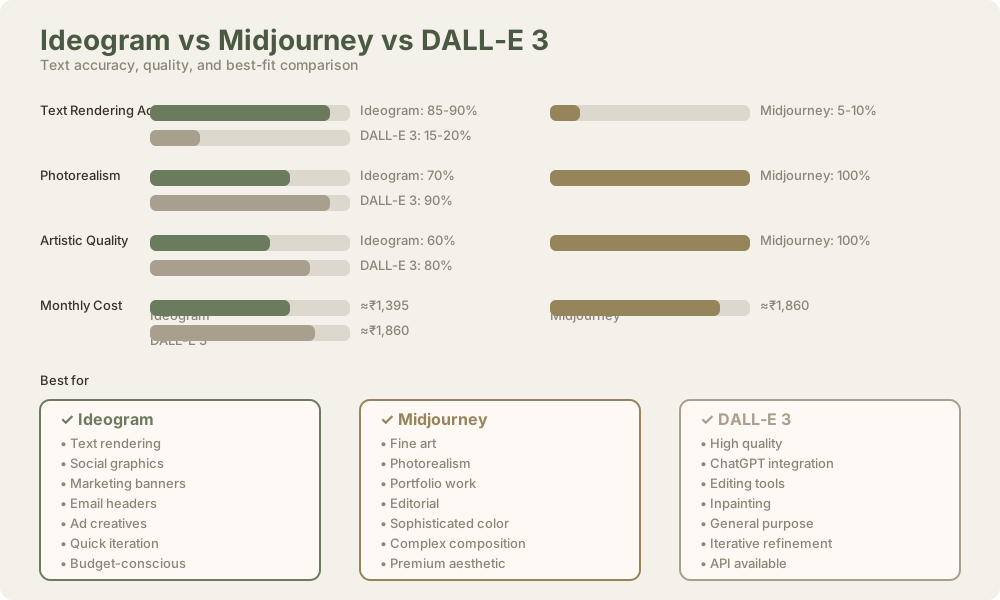
- DALL-E 3: 15-20% accuracy on basic text
- Midjourney: 5-10% accuracy
- Stable Diffusion: 10-15% accuracy
- Leonardo AI: 8-12% accuracy
Even with those comparisons, Ideogram isn't perfect. But it's the only major tool where text rendering is reliable enough to depend on for production work.
Installation and Getting Started
Ideogram is web-only (no desktop app or plugins). Visit ideogram.ai, create a free account with email or Google/Apple sign-in, and start generating immediately.
System requirements: Modern web browser (Chrome, Firefox, Safari, Edge). No GPU needed. Works on any device with internet. Responsive design is decent on mobile, though the desktop experience is faster for bulk generation.
Generation speed: Typically 30-60 seconds per image. Leonardo AI is faster (15-30 seconds); Midjourney is slower (60-120 seconds). Not a major factor, but worth noting if you're generating in batches.
API access: Available but limited. Higher per-image costs than the web tier. Intended for integrations, not heavy programmatic use. Midjourney and Stable Diffusion have more mature API ecosystems.
Pricing: Exceptional Free Tier, Reasonable Paid Plans
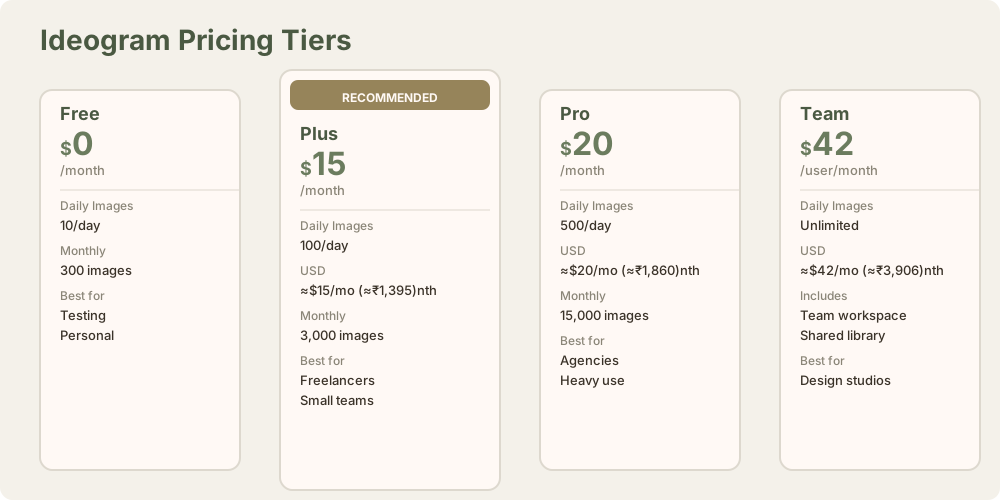
Ideogram's pricing is simple:
| Plan | Monthly Cost | Daily Images | INR (≈₹93/USD) | Best For |
|---|---|---|---|---|
| Free | $0 | 10 | ₹0 | Casual use, testing, personal projects |
| Plus | $15 | 100 | ≈₹1,395 | Freelancers, small teams, regular creators |
| Pro | $20 | 500 | ≈₹1,860 | Agencies, heavy daily use |
| Team | $42/seat/mo | Unlimited | ≈₹3,906 | Studios, organizations, design teams |
The free tier is honestly valuable. Most AI platforms gate features aggressively, but Ideogram offers 10 images daily - that's 300 per month, enough for serious experimentation, personal projects, or pre-purchase testing. You can generate consistent, quality assets without paying anything.
The Plus plan hits the sweet spot. At ≈₹1,395/mo ($15 USD), you get 100 daily images (3,000/month). Cost-per-image is ≈₹0.47. For comparison:
- Stock photo subscriptions: $5 (≈₹500)-2,000/month for 10-25 images
- Hiring a freelance designer: $3 (≈₹300)-1,500 per asset
- Midjourney Pro: ≈₹1,860/mo for unlimited generations
- DALL-E 3 via ChatGPT Plus: $20/mo (≈₹1,860/mo)
For text-heavy designs (social graphics, banners, marketing materials), Ideogram Plus pays for itself in a week if it replaces a single outsourced design project.
The Pro plan ($20/mo, ≈₹1,860) is overkill for most. 500 daily images is massive unless you're running a content factory. The jump from Plus to Pro is smaller than the jump from Free to Plus, so most teams stay on Plus indefinitely.
Ideogram vs. DALL-E 3: Text Rendering Changes Everything
DALL-E 3 is objectively better at general artistic quality. Its images are sharper, more coherent, more stylistically diverse. Colors are more vibrant. Composition is more sophisticated. If you don't need text, DALL-E 3 is the stronger choice.
But any prompt requiring readable text flips the equation:
Example 1: Social media graphic
- Prompt: "Create a LinkedIn post graphic with the text 'Hiring: Senior Product Manager - Remote'"
- DALL-E 3 result: "Hiring: Senior Product Mgr - Remot" (missing letters, unusable)
- Ideogram result: "Hiring: Senior Product Manager - Remote" (100% readable)
Example 2: Email newsletter banner
- Prompt: "Design a newsletter banner with 'Your April Reading List'"
- DALL-E 3 result: "Your Aprl Readng Lst" (spelling failure)
- Ideogram result: "Your April Reading List" (correct)
Example 3: Promotional poster
- Prompt: "Create a coffee shop poster with '25% OFF THIS WEEKEND'"
- DALL-E 3 result: "25% OF THIS WEEKEN" (multiple errors)
- Ideogram result: "25% OFF THIS WEEKEND" (correct)
DALL-E 3 costs ≈₹1,860/mo (ChatGPT Plus). Ideogram Plus is ≈₹1,395/mo. The price difference is marginal, but the usability gap is massive for text work.
Ideogram vs. Midjourney: Art vs. Usability
Midjourney generates more beautiful, more sophisticated artwork. Its aesthetic is closer to human illustration, its color work more subtle, its composition more polished. If you need fine art, editorials, or portfolio work, Midjourney is superior.
Ideogram generates usable graphics. Its aesthetic is simpler, slightly more "computer-generated," but its text renders correctly. Here's the trade-off:
Midjourney strengths:
- Photorealism that rivals professional photography
- Sophisticated color palettes and lighting
- Detailed composition and balance
- Aesthetic you'd publish in a magazine
Ideogram strengths:
- Readable text overlays without editing
- Faster turnaround for social content
- Lower cost per usable asset
- Specialized accuracy for marketing graphics
Midjourney minimum is ≈₹1,860/mo. Ideogram Plus is ≈₹1,395/mo. If your primary need is text rendering, paying Midjourney's premium doesn't make sense - you'd spend as much time fixing text issues as you would generating assets.
The realistic workflow: Use Ideogram for anything requiring text, use Midjourney or DALL-E 3 for beautiful artwork. That's how most professionals do it.
The Killer Use Cases: Where Ideogram Excels
Ideogram's specialized strength is social content and marketing graphics - exactly where competitors fail most conspicuously.
LinkedIn post graphics ("Hiring: 5 Sales Engineers", "New case study: 40% revenue growth", "Join us at TechConf 2026"): Without Ideogram, you'd use Canva templates or hire a designer. With Ideogram, 30-second turnaround.
Twitter/X cards ("Breaking: New product launch", "Quote cards with attribution, statistics, poll graphics"): Readable text in images is essential for engagement. Competitors force you to add text as overlay layers.
Email newsletter banners with product names, CTAs, discount codes: Professional-looking headers that don't require Photoshop.
Instagram stories with event details, promo codes, limited-time offers, dates: Fast iteration, readable overlays.
YouTube thumbnails with readable titles, numbers, countdown text: Text rendering is critical for click-through.
Facebook ads with product names, discount percentages, CTAs: Copy-heavy design that competitors can't handle.
Event graphics (conference announcements, webinar posters, meetup flyers): Date, time, venue, call-to-action - all rendered correctly.
Every single one of these requires Photoshop cleanup or design outsourcing if you use DALL-E 3 or Midjourney. With Ideogram, you generate usable assets in minutes.
Feature Set: Simple, Focused, No Bloat
Ideogram's interface is deliberately stripped-down. Clean prompt box, fast generation, simple results. No complexity that doesn't serve text rendering.
Strengths:
- Remix tool: Iterate quickly by changing single words or phrases without rewriting prompts
- Style presets: "Photorealistic," "Oil Painting," "3D Render," "Illustration," "Minimalist" apply consistently
- Batch generation: Queue multiple requests efficiently
- History: Saved prompts and results for iteration
- Upscaling: Basic 2x upscale for generated images
Limitations:
- No inpainting or editing: Unlike DALL-E 3, you can't edit regions of existing images
- No image-to-image: Can't use existing images as style references
- Limited parameter control: Midjourney users get aspect ratios, quality settings, style weights; Ideogram offers presets only
- No plugins or integrations: Works standalone; no Photoshop plugin, no ChatGPT integration
- API access limited: Available but with higher costs and lower throughput than competitors
The stripped-down feature set is intentional. Ideogram is a specialist tool. It does one thing exceptionally well (text rendering) and doesn't distract with tangential features.
Image Quality Outside of Text
Ideogram's general image quality is adequate but unremarkable.
Strengths:
- Colors generally render faithfully
- Composition is sensible and balanced
- Photorealism is acceptable for marketing graphics
- Style presets apply consistently
Weaknesses:
- Slightly desaturated colors compared to DALL-E 3 or Midjourney
- Generic compositions - less artistic sophistication than Midjourney
- Photorealism doesn't match DALL-E 3's sharpness
- Character details (faces, hands) are less refined than Midjourney
The reality check: If you're generating a social media graphic with text, the text accuracy is worth far more than minor quality gaps. If you're generating fine art without text, DALL-E 3 or Midjourney are better choices.
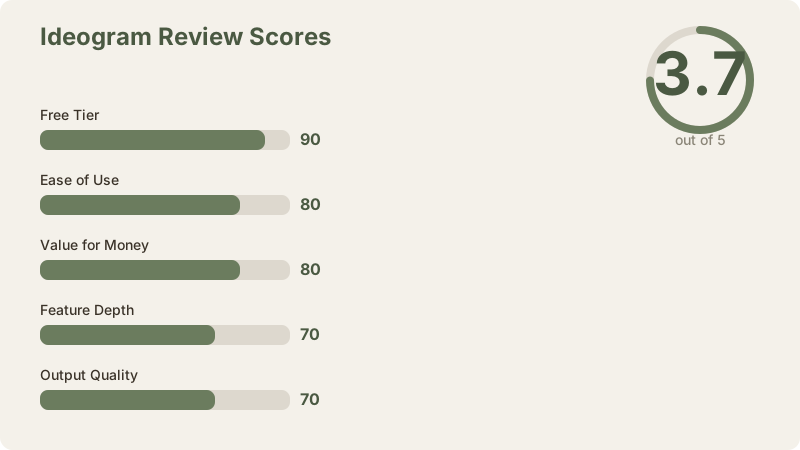
I'd rate Ideogram's image quality 3/5 overall - solid for marketing use, unremarkable for fine art. But that score becomes irrelevant when the text is usable and competitors produce gibberish.
User Experience: Fast, Clean, Beginners-Friendly
Ideogram's interface loads instantly, requires no learning curve, and generates results in seconds. This is a strength if you're batch-generating assets and a limitation if you're a power user wanting fine control.
For beginners: Ideogram is ideal. Simple prompts work. You don't need to learn Midjourney's syntax or Stable Diffusion's parameters.
For advanced users: You'll feel constrained. No seed control, no detailed aspect ratios, no negative prompts, no parameter tweaking. It's a locked-down tool.
Ease of use: 4/5 overall (8/5 for beginners, 2/5 for power users seeking granularity).
Frequently Asked Questions
What is Ideogram?
Ideogram is an AI image generator specialized for text rendering. You write a prompt describing an image, and Ideogram generates it. Its unique strength is rendering readable text in images - something DALL-E 3, Midjourney, and Stable Diffusion struggle with.
How accurate is Ideogram's text rendering?
On simple text (single words, two-word phrases in standard fonts), 85-90% accuracy. On complex requests (multi-line text, decorative fonts, special characters), 40-50% accuracy. Compare to competitors: DALL-E 3 ≈15-20%, Midjourney ≈5-10%.
Is Ideogram free?
Yes, with limits. Free tier offers 10 images daily (300/month). Paid tiers unlock 100-500+ daily images. The free tier is legitimately useful for testing or personal projects.
How does Ideogram compare to Canva?
Canva is a design platform with AI helpers. Ideogram is purely generative. Canva is better for layouts, templates, and multi-element designs. Ideogram is better for generating raw images with text and iterating quickly. Use Canva for polished designs; use Ideogram for quick graphics with readable text.
Can I use Ideogram images commercially?
Yes. Commercial license included with all paid plans. Personal/educational use only on the free tier.
How does Ideogram compare to Leonardo AI?
Both offer generous free tiers. Leonardo AI has better general image quality and more features. Ideogram excels at text rendering. For text-heavy work, Ideogram. For general image generation with more control, Leonardo AI.
Does Ideogram have an API?
Yes, but limited. Higher per-image costs, lower throughput than Midjourney or Stable Diffusion. Useful for integrations but not for high-volume programmatic use.
How fast is Ideogram?
Typical generation: 30-60 seconds per image. Leonardo AI is faster (15-30 seconds). Midjourney is slower (60-120 seconds).
What are Ideogram's limitations?
No inpainting, no image-to-image, limited style control, no API for bulk use, generic image quality outside of text, no integrations with design software.
When should I use Ideogram vs. alternatives?
Use Ideogram if text accuracy is critical. Use DALL-E 3 for general high-quality images. Use Midjourney for fine art. Use Stable Diffusion for customization and API access. Use Leonardo AI for balanced quality and features.
Is Ideogram worth paying for?
For text-heavy work (social graphics, marketing banners, email headers), absolutely. Plus plan at ≈₹1,395/mo is cost-effective. For general image generation without text, DALL-E 3 or Midjourney are better investments.
Can I edit Ideogram images?
Limited. You can upscale 2x and regenerate with variations. You can't inpaint or erase regions. For serious editing, export and use Photoshop or Canva.
Related reviews: Midjourney Review | DALL-E 3 Review | Leonardo AI Review | Stable Diffusion Review | Canva AI Review | Adobe Firefly Review | Midjourney vs DALL-E 3 | Best AI Image Generators 2026
The Verdict: The Only Tool That Renders Text Right
Ideogram is not the best AI image generator overall. DALL-E 3 and Midjourney are more versatile, more beautiful, more sophisticated. But Ideogram is the only tool where text rendering is reliable enough for professional work.
If you generate posters, banners, social graphics, marketing materials, or anything requiring readable text, Ideogram belongs in your stack. Pair it with DALL-E 3 or Midjourney for non-text assets. The subscription cost is negligible compared to design outsourcing or manual Photoshop cleanup.
For anyone doing social media, marketing, or content creation, Ideogram solves a real problem that no competitor addresses well. That specialization is its strength and its limitation: exceptional at text, adequate at everything else.
Last updated: May 2026. Prices converted at ₹93/USD.
What to read next
Midjourney vs DALL-E 3
Apr 2026