7 Best AI Writing Tools 2026 (Ranked)
We tested 15+ AI writing tools on identical prompts and ranked the 7 best. Claude leads for prose quality, ChatGPT for versatility. Full USD and INR.
 ByAsh
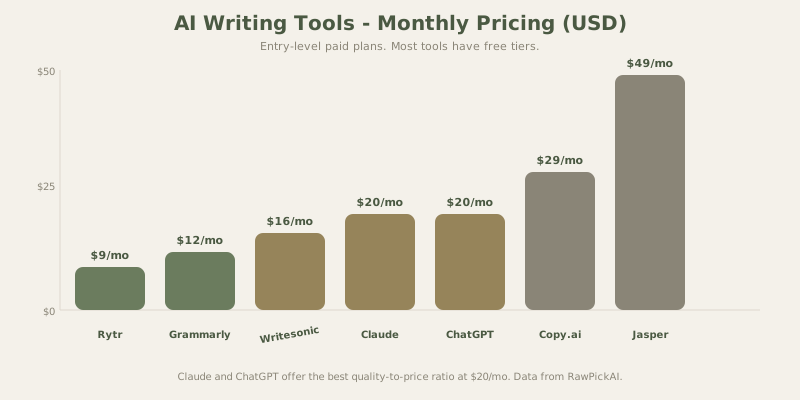
ByAshTL;DR: Claude ($20/mo) produces the most natural prose. ChatGPT ($20/mo) is most versatile. Writesonic ($16/mo) is best for SEO content. Jasper ($49/mo) works for marketing teams at scale. Rytr ($9/mo) is the budget option. Grammarly ($12/mo) is the best editing companion.
I spent three months testing every major AI writing tool on the same set of prompts - blog posts, marketing emails, ad copy, social media captions, and long-form articles. Every tool was evaluated using identical methodology with scores for output quality, ease of use, value for money, and free tier usability.
The honest conclusion: Claude and ChatGPT have made most dedicated AI writing tools redundant. At $20/mo each, they produce better output than tools charging 2-3x more. The specialized tools survive on specific workflow advantages, not writing quality.
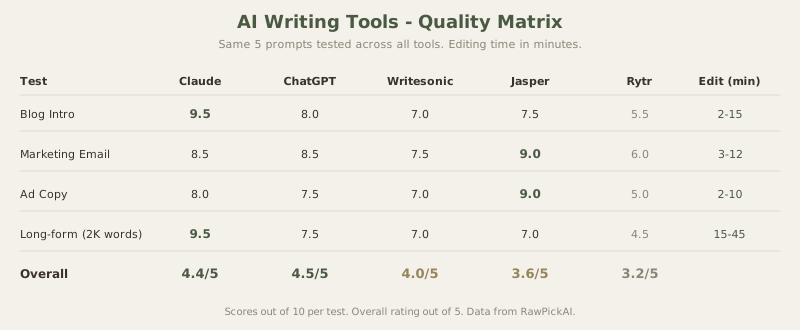
Quick Comparison Table
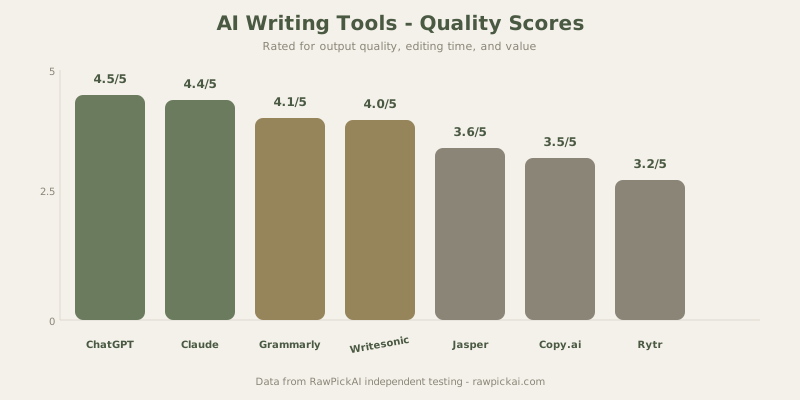
| Tool | Best For | Price | Free Tier | Our Score |
|---|---|---|---|---|
| Claude | Long-form writing, natural prose | $20/mo (≈₹1,860) | Yes (good) | 4.4/5 |
| ChatGPT | All-round writing + extras | $20/mo (≈₹1,860) | Yes (decent) | 4.5/5 |
| Writesonic | SEO-focused blog content | $16/mo (≈₹1,488) | Limited | 4.0/5 |
| Jasper | Marketing teams at scale | $49/mo (≈₹4,557) | No | 3.6/5 |
| Copy.ai | GTM teams with automation | $29/mo (≈₹2,697) | No | 3.5/5 |
| Grammarly | Editing and polishing text | $12/mo (≈₹1,116) | Yes (basic) | 4.1/5 |
| Rytr | Budget writers | $9/mo (≈₹837) | Yes (limited) | 3.2/5 |
How I Tested These Tools
Each tool received the same 5 writing prompts to make comparison fair:
Prompt 1 - Blog intro (250 words): "Write an engaging introduction about how remote work has changed team communication." Tests: hook quality, tone, readability.
Prompt 2 - Marketing email: "Write a product launch email for a project management tool targeting engineering managers." Tests: persuasive structure, CTA strength, audience understanding.
Prompt 3 - Ad copy (3 variations): "Write Facebook ad copy for a premium coffee subscription." Tests: conciseness, emotional appeal, variation quality.
Prompt 4 - Product description: "Write a product description for noise-cancelling headphones at $349." Tests: feature-to-benefit conversion, sensory language, brand tone.
Prompt 5 - Long-form article (2,000 words): "Write an article about sustainable investing for millennials." Tests: structure, argument development, coherence over length, factual accuracy.
Scoring: Output Quality (40%), Editing Required (25%), Value for Money (20%), Free Tier Usability (15%).
1. Claude - Best Overall AI Writing Tool
Best for: Long-form content, essays, reports, blog posts, creative writing, email drafting
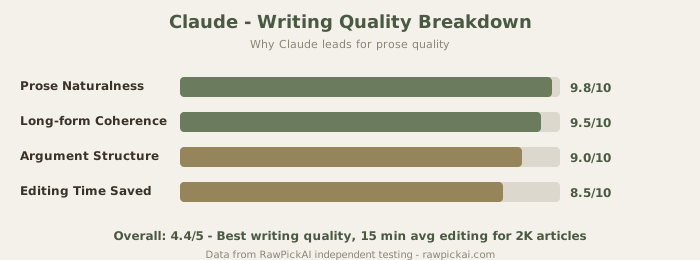
Claude tops this ranking because of one thing: output quality. Across every writing test I ran, Claude's prose read the most naturally. It varies sentence length, makes unexpected word choices, and avoids the formulaic patterns that make most AI writing detectable. For blog content, email drafting, reports, and creative writing, no other tool required less editing before the output was ready to publish.
Why Claude's Writing Is Different
The gap is especially wide for long-form content. A 2,000-word article from Claude maintains coherent argumentation and tone throughout. ChatGPT starts strong but tends to repeat its core points with different phrasing around the 1,200-word mark. Jasper maintains consistency but produces prose that reads like marketing copy regardless of the topic. Claude writes like a thoughtful human - varying rhythm, introducing counterarguments naturally, and building to conclusions rather than restating the thesis.
In the sustainable investing test, Claude produced an article that I could publish with minimal editing - two factual claims needed verification, one paragraph needed tightening, and the conclusion needed a stronger CTA. Total editing time: 15 minutes. ChatGPT's version required 35 minutes. Jasper's required 45 minutes. That editing time difference is the real value of better output quality.
Claude Pricing
Free tier is generous for occasional writing - draft outlines, get feedback, brainstorm. You'll hit rate limits during intensive sessions. Pro at $20/mo (≈₹1,860/mo) removes limits and gives access to the most capable model. For professional writers producing daily content, the Pro plan pays for itself within the first week.
Limitations: Smaller feature set than ChatGPT (no image generation, no plugins). Rate limits on free tier can frustrate heavy users.
See also: Full Claude review | Claude vs ChatGPT comparison
2. ChatGPT - Best All-Round AI (Writing + Everything Else)
Best for: Generalists who write frequently but also need AI for coding, research, image generation, and other tasks
ChatGPT earns the #2 writing spot - not because its writing is second-best, but because at the same price as Claude, you get writing plus image generation, code execution, voice mode, web browsing, and custom GPTs. If writing is 50-70% of your AI usage and you need an all-purpose tool for the rest, ChatGPT is the more practical choice.
Where ChatGPT Beats Claude
The versatility advantage is real. A freelancer who writes blog posts, generates social media images, debugs website code, and analyzes spreadsheets needs one tool, not four. ChatGPT does all of this competently. Claude writes better but does less.
The writing quality is good - well-structured, clear, and factually solid. Where it falls slightly behind Claude is in tone and personality. ChatGPT's default writing has a recognizable cadence: thesis statement, supporting points, summary. Professional and clean, but predictable after extended use.
ChatGPT Pricing
Free tier covers casual use with rate limits. Plus at $20/mo (≈₹1,860/mo) provides higher limits and faster responses. Pro at $200/mo (≈₹18,600/mo) is for power users who need maximum capability. For most writers, Plus is sufficient.
See also: Full ChatGPT review | ChatGPT vs Claude comparison
3. Writesonic - Best for SEO Blog Content
Best for: SEO-focused content creators, bloggers targeting search traffic, digital marketing agencies
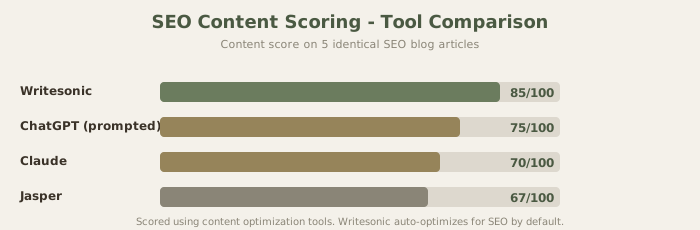
Writesonic has carved out a strong niche in SEO-optimized blog content. Its Article Writer generates full blog posts with proper heading structure, keyword integration, and a tone optimized for search rankings. The built-in SEO scoring gives real-time feedback on keyword density, readability, and meta description quality.
The SEO Advantage
I tested Writesonic against ChatGPT for 5 SEO blog articles. Writesonic's output scored consistently higher on content scoring tools, primarily because it naturally structures content with heading hierarchy, FAQ sections, and keyword distribution that search engines reward. ChatGPT can produce similar structure with detailed prompting, but Writesonic does it by default - no prompt engineering required.
For content teams publishing 10+ SEO articles per week, that saved prompting time adds up significantly. Writesonic also includes a built-in plagiarism checker and readability scorer, reducing the need for separate tools.
Writesonic Pricing
Free trial with limited words. Individual plan at $16/mo (≈₹1,488/mo) for solo creators. Team plans scale from there.
Limitations: Less versatile than ChatGPT or Claude for non-blog content. Creative quality is average - functional for SEO, but not engaging enough for brand storytelling.
See also: Full Writesonic review | Jasper vs Copy.ai comparison
4. Jasper - Best for Marketing Teams at Scale
Best for: Marketing teams of 5+, agencies managing multiple brands, enterprise content operations
Jasper's ranking might surprise you - it's the most recognized name in AI marketing tools, but in 2026, it's hard to justify the premium when ChatGPT and Claude produce comparable writing at a fraction of the cost.
When Jasper's Premium Is Justified
Where Jasper earns its place is for marketing teams with specific workflow needs: brand voice enforcement across multiple team members, campaign-based content generation (blog + social + email from one brief), and template-driven production at scale. If your team produces 50+ pieces of content monthly and needs consistency without training everyone on prompt engineering, Jasper's premium is justified.
The brand voice feature is Jasper's real differentiator. Train it on your brand guidelines, tone samples, and terminology, and every team member's output sounds consistent - regardless of their prompt engineering skill level.
Jasper Pricing
Creator at $49/mo (≈₹4,557/mo). Pro at $69/mo (≈₹6,417/mo). Business requires a sales conversation. The pricing is steep for individuals - Claude at $20/mo produces comparable or better writing quality. Jasper's value is in the workflow and team features, not the raw output.
Limitations: Expensive for individuals. Writing quality doesn't surpass Claude or ChatGPT. Value proposition has eroded as general-purpose AI tools improved.
See also: Full Jasper review | Jasper vs Copy.ai comparison
5. Copy.ai - Best for Go-to-Market Teams
Best for: Sales and marketing teams wanting AI writing bundled with GTM automation
Copy.ai has pivoted from a pure writing tool to a go-to-market automation platform. The writing capabilities are still there - ad copy, email sequences, social posts - but the standout features are now workflow automation, AI agents for prospecting, and sales enablement tools.
The per-seat value is strong: $29/mo (≈₹2,697/mo) for 5 seats works out to under $6/user. But the writing quality is less consistent than Claude, ChatGPT, or Jasper. Outputs range from sharp and usable to generic, requiring more editing passes.
See also: Full Copy.ai review | Jasper vs Copy.ai comparison
6. Grammarly - Best for Editing and Polishing
Best for: Professionals who write daily, non-native English speakers, teams wanting consistent communication quality
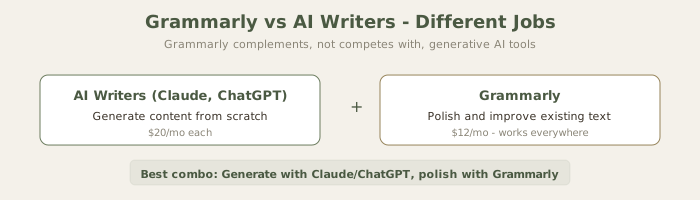
Grammarly isn't a generative AI writing tool - it doesn't write content from scratch. But its AI-powered editing makes it the best tool for polishing existing text. Tone detection, clarity suggestions, conciseness recommendations, and the newer generative features (rewriting paragraphs, expanding bullet points) make it an essential companion for regular writers.
The real value is ubiquity. The browser extension works inside Gmail, Google Docs, Slack, LinkedIn, and virtually every text field on the web. That passive quality-check catches errors everywhere, not just in a dedicated AI chat.
Grammarly Pricing
Free tier handles basic grammar and spelling. Premium at $12/mo (≈₹1,116/mo) adds advanced style suggestions, tone detection, and plagiarism checking. Business at $15/user/mo (≈₹1,395/user/mo) adds team analytics.
See also: Full Grammarly review
7. Rytr - Best Budget Option
Best for: Students, small business owners, solo creators on tight budgets
Rytr at $9/mo (≈₹837/mo) is the cheapest paid AI writing tool that still produces usable output. For quick, short-form content - social media captions, product descriptions, email drafts - Rytr delivers. For anything requiring nuance, depth, or a distinctive voice, the tools higher on this list are worth the upgrade.
See also: Full Rytr review
AI Writing Quality: What the Tests Actually Showed
The Blog Intro Test
The blog intro prompt ("Write an engaging introduction about how remote work has changed team communication") revealed the clearest quality differences. Claude produced an intro that started with a specific anecdote-style observation, built tension, and ended with a thesis that made you want to read more. ChatGPT produced a well-structured intro with a clear thesis but used the predictable "In today's rapidly evolving workplace..." opening. Jasper produced marketing-optimized copy that felt like it was selling remote work rather than exploring it. Writesonic produced SEO-friendly content with natural keyword integration but flat prose. Rytr produced a functional but generic paragraph.
The editing time comparison tells the story: Claude's intro needed 2 minutes of editing. ChatGPT needed 5. Jasper needed 8. Writesonic needed 10. Rytr needed 15.
The Long-Form Test
The 2,000-word sustainable investing article was the most revealing test. Long-form content exposes every weakness in an AI writing model. Claude maintained coherent argumentation throughout - introducing a claim, supporting it with evidence, acknowledging counterarguments, and building to a conclusion. The article read like a competent human had written it.
ChatGPT started strong but began recycling its core arguments around the 1,200-word mark. By word 1,800, three paragraphs essentially said the same thing in different words. This is ChatGPT's long-form weakness - it runs out of really new things to say and fills space with rephrased versions of earlier points.
Jasper maintained consistency but every paragraph sounded like marketing copy. The article about sustainable investing read like a Jasper-generated blog post about sustainable investing - if you've read enough AI marketing content, you recognize the cadence immediately.
The Ad Copy Test
This is where the specialized tools showed their value. Jasper produced the best Facebook ad copy - three distinct variations with different emotional hooks, each under 125 characters with strong CTAs. Copy.ai produced solid variations but with less emotional range. ChatGPT and Claude produced good ad copy but needed more specific prompting to hit the right length and tone.
For ad copy specifically, Jasper's templates and marketing-trained model produce better first-attempt results than general-purpose tools. The question is whether that advantage justifies the $49/mo price premium.
The Economics of AI Writing
The cost-per-article math changes the decision. A professional writer producing 2,000-word articles:
Without AI: 4-6 hours per article at $50/hour = $200-300 per article. With Claude ($20/mo): 1-2 hours per article (AI draft + editing) = $50-100 per article. With ChatGPT ($20/mo): 1.5-2.5 hours per article = $75-125 per article. With Jasper ($49/mo): 1.5-2 hours per article = $75-100 per article.
The ROI is clear for anyone producing 4+ articles per month. The $20/mo investment in Claude or ChatGPT saves $400-800 in writing time monthly. Jasper's higher price is harder to justify on individual economics - the same output quality at 2.5x the cost.
For teams, the math shifts. Jasper's brand voice enforcement saves review time across multiple writers. A team of 5 writers producing 10 articles each per month saves roughly 20 hours of brand-consistency review per month - worth the premium if consistency matters more than per-article cost.
The Real Decision: Claude or ChatGPT?
For most people choosing one AI writing tool today, it comes down to Claude vs ChatGPT at the same $20/mo price point.
Choose Claude if: Writing quality is your top priority. You produce long-form content (blog posts, articles, reports, essays). You want prose that sounds human without extensive editing. You don't need image generation or coding features.
Choose ChatGPT if: You need writing plus other capabilities (image generation, code, web browsing, custom GPTs). You're a freelancer juggling diverse projects. Writing is 50-70% of your AI usage, not 100%.
Choose a specialized tool if: You need team-level brand enforcement (Jasper), SEO-first content (Writesonic), GTM automation bundled with writing (Copy.ai), or the cheapest functional option (Rytr).
How Professional Writers Actually Use AI
The universal pattern across every professional writer I've spoken to: AI generates drafts, humans refine and finalize. No one publishes raw AI output professionally.
The best workflow: generate structured outlines or multiple variations, then manually write the best version using AI-generated ideas as inspiration. That workflow produces the best quality-per-hour ratio.
A writer using AI tools effectively produces 3-4x the output compared to writing manually. That matters economically for content businesses, marketing teams, and freelance writers competing on volume.
Frequently Asked Questions
What is the best AI writing tool in 2026? Claude Pro at $20/mo (≈₹1,860/mo) produces the highest-quality writing output. ChatGPT Plus at $20/mo is the best all-round option when you need writing plus image generation, coding, and web browsing. For most writers, one of these two is the right choice.
Is AI writing good enough to publish? For blog posts, marketing emails, and social media content, yes - with editing. The best AI tools (Claude, ChatGPT) produce first drafts that require 15-35 minutes of editing for a 2,000-word article. For premium content (thought leadership, brand journalism, creative writing), AI-generated drafts serve as strong starting points but still need significant human refinement.
Which AI writing tool has the best free tier? Claude's free tier is the most generous for writing quality - you get access to a capable model with reasonable usage limits. ChatGPT's free tier works for casual use. Grammarly's free tier handles basic grammar checks. Rytr offers 10,000 free characters monthly. For serious writing work, the paid tiers of Claude or ChatGPT ($20/mo each) are worth the investment.
Is Jasper worth the price vs ChatGPT? For individual writers, no. ChatGPT at $20/mo (≈₹1,860/mo) produces comparable writing to Jasper at $49/mo (≈₹4,557/mo). Jasper's value is in team features: brand voice enforcement, campaign workflows, and template libraries. For marketing teams of 5+ producing 50+ content pieces monthly, Jasper's premium can be justified. For everyone else, Claude or ChatGPT is better value.
Can AI writing tools replace human writers? Not yet. AI tools multiply writer productivity (3-4x output) but don't replace human judgment, creativity, and domain expertise. The writers who thrive with AI are those who use it for first drafts and ideation, then apply their own expertise for refinement. Writers who resist AI tools entirely are increasingly at a productivity disadvantage.
How much do AI writing tools cost? Free options exist for all major tools with limitations. Paid plans: Rytr $9/mo (≈₹837), Grammarly Premium $12/mo (≈₹1,116), Writesonic $16/mo (≈₹1,488), Claude Pro $20/mo (≈₹1,860), ChatGPT Plus $20/mo (≈₹1,860), Copy.ai $29/mo (≈₹2,697), Jasper $49/mo (≈₹4,557). Most writers get the best value from Claude or ChatGPT at $20/mo.
Which AI tool is best for SEO writing? Writesonic is purpose-built for SEO content with built-in keyword optimization, heading structure, and content scoring. ChatGPT can produce SEO-optimized content with detailed prompting but requires more manual structure. Surfer SEO paired with Claude or ChatGPT is another strong combination for SEO-focused teams.
Internal Links
Read Claude review | See ChatGPT review | Check Jasper review | Read Copy.ai review | See Writesonic review | Explore Rytr review | Check Grammarly review | Compare ChatGPT vs Claude | Compare Jasper vs Copy.ai | See best ChatGPT alternatives | Explore best free AI tools
Last updated: May 2026. Prices converted at ≈₹93/USD.
Related Comparisons and Guides
Need help choosing between specific tools? These comparisons go deeper:
- ChatGPT vs Claude - the two best general-purpose AI writers compared
- Jasper vs Copy.ai - dedicated writing tools for marketing teams
- Claude vs ChatGPT vs Gemini - the only 3-way comparison you need
- Best ChatGPT Alternatives - options if ChatGPT isn't working for you
- Best Free AI Tools - writing tools you can use without paying
- Compare any tools side-by-side - pick any 2-3 tools and see scores instantly