Microsoft Agent 365 Ships, Microsoft-OpenAI Partnership Restructured: AI News (May 1, 2026)
Top AI news this week: Microsoft Agent 365 GA at $15/user, E7 Frontier Suite at $99, and Microsoft-OpenAI Azure revenue share ends. My take below.
 ByAsh·10 min read
I've been waiting for Microsoft Agent 365 to actually ship since the November 2025 Ignite preview. It got pulled, repackaged, and quietly rebranded over five months. Today it's live. And the broader picture this week tells you something worth understanding about how the AI tooling market is consolidating.
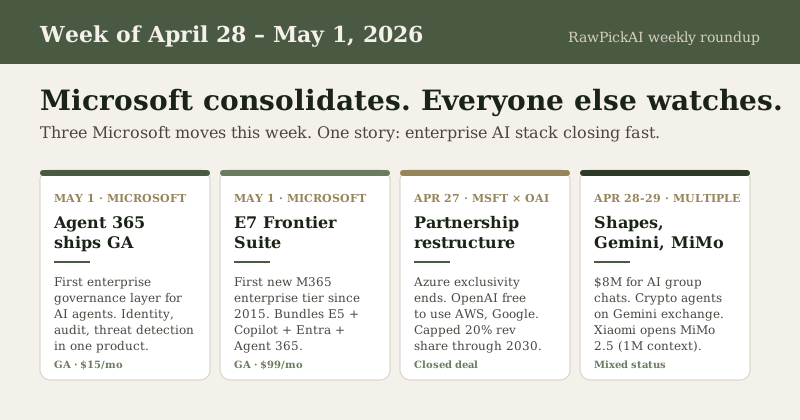
1. Microsoft Agent 365 hits general availability - $15/user/month
When: May 1, 2026 (today) What: Microsoft Agent 365 generally available as a standalone product Why it matters: This is the first enterprise governance layer specifically built for AI agents.
The pitch is simple: every enterprise running AI agents - Copilot, custom Azure agents, third-party agents - needs a way to see them, audit them, and stop them when they go wrong. Agent 365 extends Microsoft's existing identity (Entra), data protection (Purview), and threat protection (Defender) stack to treat AI agents as first-class identities alongside humans.
Pricing: $15 per user per month (≈ ₹1,395) standalone. No prerequisite SKU.
What it actually does on day one:
- Identity governance - agents get treated like users in Entra. You can apply Conditional Access policies to agents, the same way you'd block a human from accessing financial data outside business hours
- Data protection - Purview labels apply to agent-touched content automatically
- Audit trails - every agent action shows up in Microsoft 365 audit logs
- Threat detection - Defender flags suspicious agent behavior (data exfiltration patterns, unusual API calls)
What it doesn't do on day one:
- Build agents - this is governance, not a development platform
- Cover autonomous agents with their own identities - those remain in the Frontier preview program
- Runtime threat protection - the "Agent 365 tools gateway" is still in public preview, not GA
The honest analyst take
Agent 365 is the right product at the right time, but the pricing assumes mass agent deployment that hasn't happened yet. Microsoft Copilot has roughly 3% penetration across 450 million Microsoft 365 business subscribers. If your organization has 12 agents, paying $15/user/month for governance is overkill. If you have 1,200 agents, this is the only product on the market.
The 12-month bet: Microsoft is betting agent counts explode. If they do, Agent 365 becomes essential. If they don't, this becomes a heavily-discounted SKU by Q4 2026.
2. Microsoft 365 E7 "Frontier Suite" launches - $99/user/month
When: May 1, 2026 (today) What: New top-tier enterprise bundle combining E5 + Copilot + Entra Suite + Agent 365 Why it matters: The first new Microsoft 365 enterprise edition since E5 launched in 2015.
E7 bundles four products that would cost $117/user/month (≈ ₹10,881) separately: Microsoft 365 E5 ($60/mo, ≈ ₹5,580 from July 2026), Microsoft 365 Copilot ($30/mo, ≈ ₹2,790), Entra Suite ($12/mo, ≈ ₹1,116), and Agent 365 ($15/mo). At $99 (≈ ₹9,207), the bundle saves about 15%.
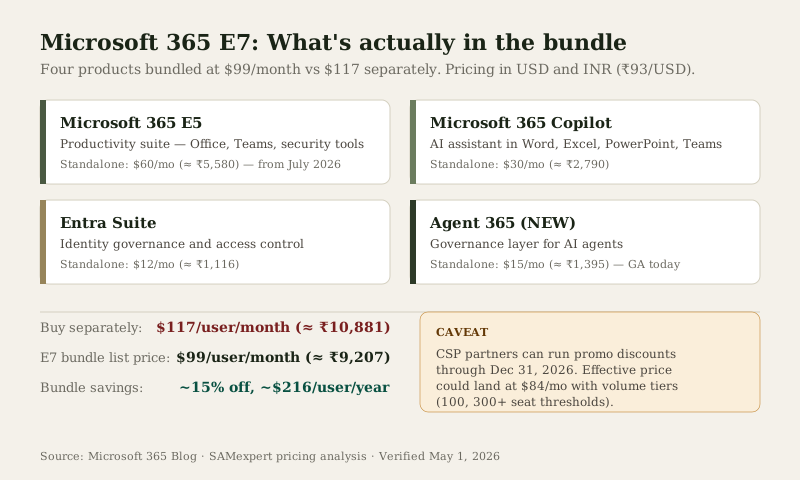
The math here is fine if you're already at E5 and planning Copilot adoption. The math is questionable if you're at E3 and Microsoft is using E7 to push you upmarket. CSP partners will run promotional discounts through December 31, 2026 - Microsoft has historically run 15-30% promos on Copilot, so the effective E7 price could land closer to $84/user/month (≈ ₹7,812).
When E7 makes sense
- You're already using E5
- You expect Copilot adoption in the next 6-12 months
- You have AI agents in pilot or production and need governance
- You can hit 100+ seats to qualify for the larger CSP promotional discounts
When E7 doesn't make sense
- You're on Business Premium and only want Copilot
- You don't have a meaningful identity governance gap (Entra ID P1 covers most needs)
- Your seat count is below promo thresholds
- Your AI usage is light
3. Microsoft-OpenAI partnership restructured - exclusivity ends
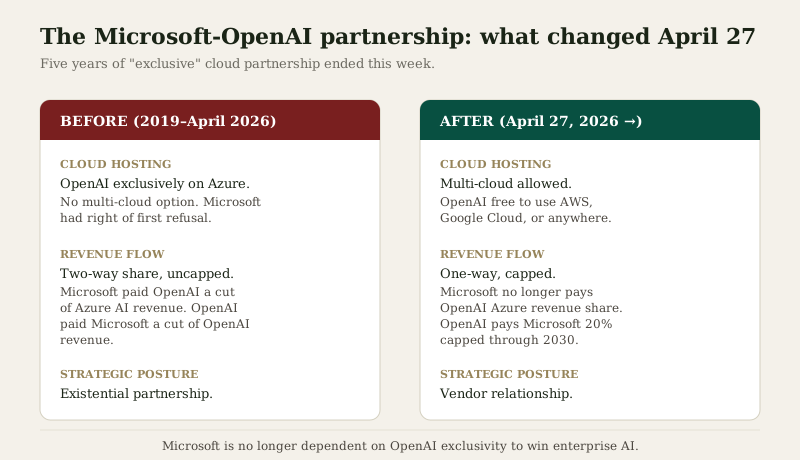
When: April 27, 2026 What: Microsoft and OpenAI announced revised partnership terms Why it matters: Five years of "exclusive" cloud partnership ends. This is bigger than it sounds.
The new terms, as reported:
- Microsoft ends its Azure revenue share to OpenAI - Microsoft no longer pays OpenAI a cut of Azure AI revenue
- OpenAI keeps paying Microsoft a capped 20% revenue share through 2030 - but this is now capped, not unlimited
- OpenAI can use other cloud providers - the Microsoft cloud exclusivity, which was the cornerstone of the original deal, is gone
What this signals:
OpenAI is preparing to use AWS and Google Cloud more aggressively. The "ChatGPT runs on Azure exclusively" era is over. Within 18 months, expect OpenAI to publish "deployed on AWS" and "deployed on Google Cloud" announcements that would have been unthinkable two years ago.
For developers building on OpenAI's API, this changes nothing in the short term. Pricing is unaffected. Latency might marginally improve in some regions as OpenAI distributes load across multiple clouds.
For Microsoft, this is consolidation cover. The Agent 365 launch, the E7 bundle, and the partnership restructuring all fit one narrative: Microsoft is no longer dependent on OpenAI's exclusivity to win the enterprise AI market. Microsoft has its own MAI models (launched in April), its own Agent control plane, and its own integrated Copilot stack. The OpenAI partnership is now a vendor relationship, not an existential dependency.
4. Also worth knowing this week
Shapes raised $8M (≈ ₹74.4 crore) from Lightspeed (April 29) - App that drops AI characters into human group chats. CEO Anushk Mittal pitches it as a counter to "AI psychosis," arguing shared social context beats isolated one-on-one AI sessions. 400,000 monthly active users already, 3 million AI Shapes created. Worth watching if you're interested in social AI rather than productivity AI.
Gemini exchange launched Agentic Trading - Crypto trading platform Gemini lets you connect Claude or ChatGPT directly to a trading account via the MCP standard. First agentic trading tool on a regulated US exchange. The risk surface here is enormous and I'd avoid it personally, but it's a meaningful "agents touch real money" milestone.
Xiaomi open-sourced MiMo-V2.5 - MIT license, 1M token context, ranked #1 among open-source models on GDPVal-AA. Pro and base variants both available. If you're running self-hosted models, this is worth evaluating against Llama and Mistral.
OpenAI shipped gpt-realtime-1.5 - Voice-controlled interactive applications. Niche but useful for accessibility-focused apps and hands-free workflows.
My take
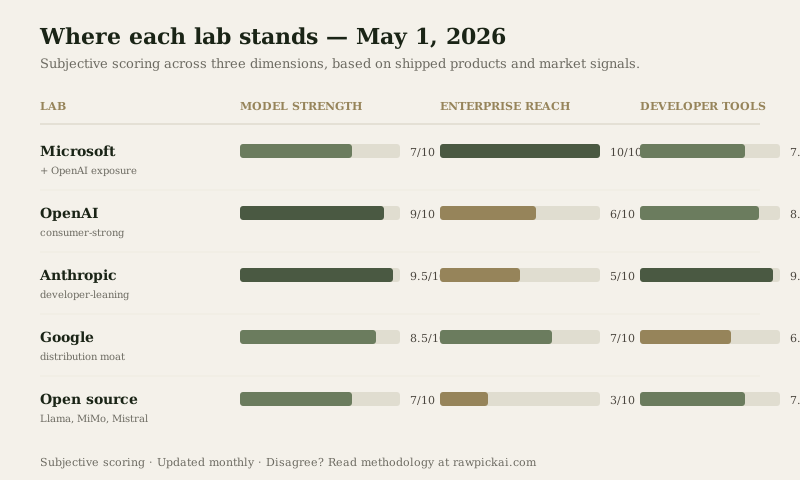
The Microsoft moves this week aren't separate stories - they're one story about consolidation. Microsoft is building the only end-to-end enterprise AI stack in the market: identity, governance, models, agents, and integration with Office. Anthropic and Google have models. OpenAI has consumer reach. Microsoft has the enterprise distribution muscle nobody else can match. If you're a startup building enterprise AI tools, this week was a warning: the platform layer is closing fast.
What I'm watching next week
- Sonnet 4.8 release - expected from Anthropic in May per their public roadmap
- Microsoft E7 promotional pricing - the actual discount levels CSP partners offer will tell us how confident Microsoft is
- Agent 365 adoption signals - first enterprise customers should publish case studies within 30 days
- OpenAI cloud diversification - first signs of OpenAI explicitly running on non-Azure infrastructure
What this means for indie operators (the part most coverage misses)
If you're a solo developer or small team using AI tools, here's the honest read on this week's news:
- You don't need Agent 365. Unless you're managing 50+ AI agents across an organization, this isn't for you.
- You don't need E7. If you're paying $30/mo (≈ ₹2,790) for ChatGPT Pro and $20/mo (≈ ₹1,860) for Claude Pro, you're better positioned than 95% of E7 customers will be.
- The Microsoft-OpenAI restructure won't hit your API costs. Pricing pages haven't changed.
- MiMo-V2.5 is interesting if you self-host. Free, MIT license, competitive performance. If you're running Llama 3 or Mistral locally, test this.
The enterprise consolidation story is real. The indie story is unchanged: pick the tools that work for your workflow, pay for the ones you actually use, ignore the platform wars.

Related reading
-
ChatGPT Images 2.0 Ships Multilingual Text: Last week's roundup - what shipped April 21–24
-
The 2026 AI Tools Reality Check - independent study of 48 AI tools with downloadable dataset
-
Claude Opus 4.7 Review: The Tokenizer Cost Trap - Anthropic's competitive response to Microsoft's stack
-
What Is Vibe Coding? - practical guide to AI-assisted coding with security data
-
Composer 2 vs Claude Sonnet 4.6 - hands-on benchmark of the top two AI coding models
Common Questions
Should I buy Microsoft 365 E7 right now?
Only if you're already on E5 and have AI agents in production or planned within 6 months. The $99 list price assumes you'll use Copilot, Entra Suite, and Agent 365 - if you'll use one or two of those, separate purchases are cheaper. Wait for the December 2026 CSP promotional discounts before committing on annual contracts.
Does Agent 365 work with non-Microsoft AI agents?
Partially. At GA on May 1, Agent 365 governs agents acting on behalf of licensed users - including Copilot, Microsoft Foundry agents, Copilot Studio agents, and third-party agents that integrate with Entra. Autonomous agents with their own identities (without a human "owner") remain in the Frontier preview program with no published GA date.
What changes for OpenAI API users with the partnership restructure?
Nothing in the short term. Pricing, latency, and rate limits stay the same. The change is structural: OpenAI can now use AWS or Google Cloud as primary infrastructure if they choose. Within 12-18 months, expect more multi-cloud deployments which may improve regional latency in markets where Azure isn't the strongest provider.
Is Xiaomi MiMo-V2.5 actually competitive with Claude or GPT?
For a free open-source model, it's strong on benchmarks but weaker on real-world tasks. Use cases where it makes sense: high-volume, lower-stakes work where you want full control over the deployment. Use cases where it doesn't: anything requiring nuanced reasoning, complex agentic workflows, or production-grade reliability. Treat it as a Llama 3 alternative, not a Claude replacement.
When is Sonnet 4.8 launching?
Anthropic publicly hinted at "May 2026" for Sonnet 4.8 but hasn't given a specific date. If it follows their typical pattern, expect early-to-mid May. The Opus 4.7 launch on April 16 has set the pricing precedent - expect similar token economics.
Published May 1, 2026. Pricing verified at ₹93/USD. I don't get paid by any of the companies mentioned. New roundup every Friday - subscribe to the newsletter for weekly delivery.
What to read next
Gemini vs ChatGPT
Apr 2026