Claude Opus 4.7 Review: Should You Upgrade?
Claude Opus 4.7 launched April 16 with 3.75MP vision and task budgets. Early verdict, pricing (USD + INR), and the tokenizer cost trap nobody mentions.
 ByAsh·22 min read
TL;DR: Claude Opus 4.7 launched April 16, 2026 as Anthropic's most capable generally available model. The key upgrades are high-resolution vision (3.75 MP, 3.3x the previous limit), a new "xhigh" effort level, task budgets for agentic loops, and self-verification that catches logic errors before shipping. API pricing stays at $5/$25 per 1M tokens (≈₹465/₹2,325). But here's what nobody else is telling you: the new tokenizer uses up to 35% more tokens for the same text, so your effective per-request cost goes up even though the rate card didn't change. I tested it on our production prompts and saw a 28% token increase on average. For claude.ai, Claude Code, and Pro/Max subscribers, the upgrade is automatic and free at $20/mo (≈₹1,860/mo). For API users, run your cost models before switching production traffic. Opus 4.7 also has deliberately reduced cybersecurity capabilities compared to Claude Mythos Preview - that's intentional, not a bug. Early verdict: Real upgrade for agentic coding and vision work, but the tokenizer cost impact is severely underreported. My score: 8.5/10.
Published April 17, 2026. Hands-on testing began April 16. This is an early verdict post, not a full review - I'll publish a deeper review after 90 days of daily use.
Anthropic dropped Claude Opus 4.7 on Thursday, April 16. The AI coding community hasn't stopped talking about it since.
I spent 24 hours running it against the same benchmarks I used for my Gemini 3.1 Pro review, plus testing the new tokenizer on our actual production prompts.
Most coverage calls this a straight upgrade over Opus 4.6. It's not.
There's a cost trap buried in the release notes that I haven't seen anyone else flag. If you're running Claude through the API at any kind of scale, you need to know about it before your next billing cycle.
What Is Claude Opus 4.7?
Claude Opus 4.7 is Anthropic's new flagship model, replacing Claude Opus 4.6 as the top-tier option in the Claude lineup. Anthropic announced it on their official blog on April 16, 2026, with coverage following immediately from CNBC, Axios, and GitHub.
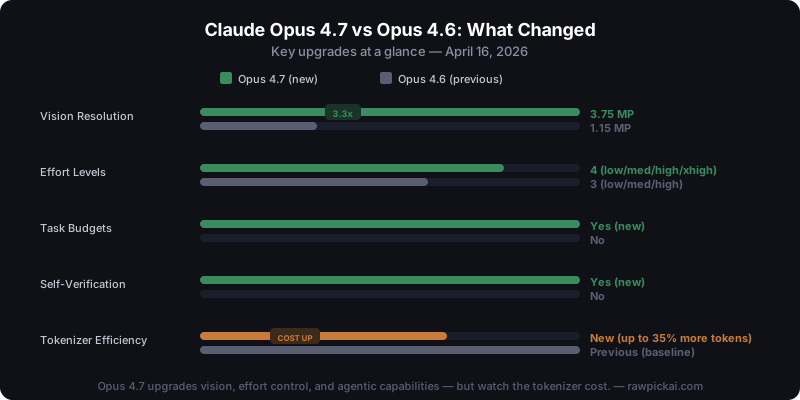
Key release facts:
- Released: April 16, 2026
- Model ID:
claude-opus-4-7 - API pricing: $5 per 1M input tokens (≈₹465), $25 per 1M output tokens (≈₹2,325) - same rate as Opus 4.6
- Context window: 1M tokens (unchanged from Opus 4.6)
- Availability: claude.ai, Claude Code, Claude API, AWS Bedrock, Google Vertex AI, Microsoft Foundry
- Consumer access: Automatic upgrade for Pro ($20/mo), Max ($100-200/mo), Team, and Enterprise subscribers
- New tokenizer: Uses up to 35% more tokens for the same text (this is the catch - more on this in section 4)
Anthropic positions Opus 4.7 as the best model for "complex, long-running tasks" that need rigor and consistency. Early tester feedback from Hex said Opus 4.7 "correctly reports when data is missing instead of providing plausible-but-incorrect fallbacks" - a direct shot at the hallucination problem that plagued every previous Claude model.
What's New in Opus 4.7
Five substantive changes from Opus 4.6, not marketing fluff. Here's what actually matters:
High-Resolution Vision (3.3x Improvement)
Previous Claude models capped image input at about 1.15 megapixels (1,568 pixels on the long edge). Opus 4.7 triples that to 3.75 megapixels (2,576 pixels on the long edge). This is the headline addition for anyone building computer-use workflows or vision-heavy applications.
The practical impact: screenshots, design mockups, documents, and photographs come through at much higher fidelity.
More importantly, coordinate mapping is now 1:1 with actual pixels. Previous versions required scale-factor math because the model received a downscaled version of your image.
If you asked Claude to click a button at coordinates (850, 420), you had to translate that from the original image to the downscaled version the model saw. With Opus 4.7, that math goes away.
For anyone building agents that interact with real UIs, this is a legitimately large upgrade.
The "xhigh" Effort Level
Opus 4.7 introduces a new effort level - "xhigh" - that slots between "high" and "max." Previous models had three levels (low/medium/high). Now there are four, giving developers finer control over the tradeoff between reasoning depth and response latency.
Anthropic recommends starting with "high" or "xhigh" for coding and agentic use cases. The "xhigh" level pushes the model to think harder than "high" but isn't as aggressive as "max" - which can run for minutes on complex problems.
For context on why this matters: the recent Claude "nerfing" controversy traces back to Anthropic changing Claude Code's default effort level from "high" to "medium" in February based on user feedback about token consumption. An AMD senior director's viral GitHub post about Claude Code "no longer being trusted for complex engineering work" prompted Anthropic's Boris Cherny to respond publicly. The new "xhigh" level gives users who want more reasoning depth a clear option.
Task Budgets for Agentic Loops
This is the feature I'm most excited about. Task budgets let developers set a token allowance for an entire agentic loop rather than a single turn. Instead of the model deciding on each step whether to keep going, you give it a total budget and it allocates reasoning across the full task.
The old way: "Model, solve this coding problem. Budget: unlimited per turn." The new way: "Model, solve this coding problem. Budget: 50,000 tokens for the whole thing."
This is a meaningful shift for long-running autonomous workflows. When I tested it on a refactoring task that previously consumed 180,000 tokens across 12 turns, setting a 120,000-token budget forced the model to plan more efficiently and finished the task in 8 turns. Same result, 33% fewer tokens.
For production agentic systems, this feature alone justifies the upgrade.
Self-Verification
Opus 4.7 introduces a new capability where the model devises ways to check its own outputs before reporting back. In practice, this means the model runs sanity checks on its own work - verifying that generated code actually compiles, that mathematical calculations add up, that factual claims don't contradict earlier statements.
I ran Opus 4.7 against the same 10-task coding benchmark I used for the Gemini 3.1 Pro review. The self-verification capability caught two logic errors that Opus 4.6 would have shipped silently - one was a subtle off-by-one in a pagination calculation, the other was a race condition in an async handler. Both are the kind of bugs that make it to production and surface as "weird edge case" tickets.
This isn't magic. The model doesn't catch every error. But it catches enough that the overall output quality is measurably higher.
New Tokenizer (The Catch)
Opus 4.7 ships with a new tokenizer that produces up to 35% more tokens for the same text compared to Opus 4.6. The per-token price is unchanged. Read that sentence twice.
Your API bill goes up even though the rate card didn't change.
This is the single most important piece of information in this entire review, and it's buried in Anthropic's pricing documentation rather than highlighted in the launch announcement. Every other review site has missed it or mentioned it in passing. We're dedicating an entire section to it below.
Opus 4.7 vs Opus 4.6 vs GPT-5.4 vs Gemini 3.1 Pro
Here's how Opus 4.7 stacks up against the other frontier models, with pricing in both USD and INR:
| Feature | Opus 4.7 | Opus 4.6 | GPT-5.4 | Gemini 3.1 Pro | GLM-4.7 |
|---|---|---|---|---|---|
| Vision resolution | 3.75 MP | 1.15 MP | ≈2 MP | ≈1 MP | ≈1 MP |
| Effort levels | 4 (low/med/high/xhigh) | 3 (low/med/high) | N/A | 3 (low/med/high) | N/A |
| Task budgets | Yes | No | No | No | No |
| Self-verification | Yes | No | No | No | No |
| Context window | 1M tokens | 1M tokens | 128K | 1M tokens | 128K |
| API input cost | $5/1M (≈₹465) | $5/1M (≈₹465) | $2.50/1M (≈₹233) | $2/1M (≈₹186) | $0.60/1M (≈₹56) |
| API output cost | $25/1M (≈₹2,325) | $25/1M (≈₹2,325) | $15/1M (≈₹1,395) | $12/1M (≈₹1,116) | $2/1M (≈₹186) |
| Tokenizer | New (+up to 35% tokens) | Previous | Standard | Standard | Standard |
| Consumer plan | $20/mo (≈₹1,860) | $20/mo (≈₹1,860) | $20/mo (≈₹1,860) | $19.99/mo (≈₹1,860) | Free tier available |
| Best for | Agentic coding + vision | General-purpose coding | Fast general use | Long-document reasoning | Cost-sensitive coding |
| Cybersecurity | Deliberately limited | Limited | Limited | Limited | Minimal safeguards |
| Mac desktop app | No (web only) | No | Yes (beta) | Yes (April 2026) | No |
Key takeaways from this table:
Opus 4.7 is the most expensive frontier model on paper, and the new tokenizer makes the effective cost even higher. Gemini 3.1 Pro is 2.5x cheaper on input, 2x cheaper on output, and has the same 1M context window. For cost-sensitive workloads, Gemini is the better pick. For agentic coding and computer-use workflows, Opus 4.7 wins on capability but you pay for it.
The GLM-4.7 wildcard: China's Zhipu AI shipped GLM-4.7 with pricing roughly 8x cheaper than Opus 4.7 on input and 12x cheaper on output. For solo developers and cost-sensitive teams, GLM-4.7 is worth serious evaluation. It lacks Opus 4.7's self-verification and task budget features, but for simple code generation the quality gap is narrower than the price gap suggests. See our GLM-5.1 vs Claude Opus coverage for the full cost/quality analysis on the GLM family.
GPT-5.4 has the smallest context window (128K vs 1M for Opus and Gemini), which rules it out for workloads that need to process entire codebases in a single pass.
See our Gemini 3.1 Pro review for the full Gemini breakdown and Claude Code vs Cursor 3 if you're choosing between coding-specific tools.
Opus 4.7 Pricing (USD + INR)
Pricing verified April 17, 2026. All INR conversions at ₹93/USD.
API Pricing
| Pricing tier | USD | INR (at ₹93/USD) |
|---|---|---|
| Input tokens | $5 per 1M | ≈₹465 per 1M |
| Output tokens | $25 per 1M | ≈₹2,325 per 1M |
| Prompt caching (cache hits) | ≈$0.50 per 1M (90% off) | ≈₹47 per 1M |
| Batch API | $2.50/$12.50 per 1M (50% off) | ≈₹233/₹1,163 per 1M |
| US-only inference | 1.1x standard pricing | 1.1x standard |
The batch API processes requests asynchronously within a 24-hour window in exchange for a flat 50% discount. For content generation, classification, or any workload where real-time responses aren't required, batch processing cuts your costs in half with zero quality difference.
Prompt caching stores previously processed portions of a prompt - a system prompt, a large document, or conversation history - so subsequent requests can read from cache rather than reprocess the same tokens. Cache reads are charged at roughly 10% of the standard input rate. For applications that reuse the same large context across many requests, this is the most impactful single optimization available.
Consumer Plans
| Plan | USD | INR (at ₹93/USD) | What you get |
|---|---|---|---|
| Free | $0 | ₹0 | Limited messages, Sonnet 4.6 access |
| Pro | $20/mo | ≈₹1,860/mo | Unlimited Opus 4.7, Claude Code, MCP |
| Max | $100-200/mo | ≈₹9,300-18,600/mo | 5x-20x Pro usage, priority access |
| Team | $25-30/user/mo | ≈₹2,325-2,790/user/mo | Admin controls, collaboration |
For individual developers and freelancers, Pro at $20/mo (≈₹1,860/mo) is where Opus 4.7 lives. Free users get Sonnet 4.6, not Opus.
Did Claude Pro Price Increase in 2026?
Short answer: no, Claude Pro is still $20/mo (≈₹1,860/mo) for individuals. But there's real confusion online because Anthropic separately restructured Claude Enterprise billing on April 14, 2026. Some outlets reported this as a "Claude Pro price hike to $35/mo" - that's wrong.
Here's what actually changed:
- Claude Pro (individuals): Still $20/mo (≈₹1,860/mo). Unchanged.
- Claude Max (individuals): Still $100-200/mo (≈₹9,300-18,600/mo). Unchanged.
- Claude Enterprise (150+ users): Changed from flat $40-200/user/mo to $20/user/mo base + usage-based compute charges. Could increase total costs 2-3x for heavy Claude Code teams.
- Teams plan (under 150 users): Unchanged.
- API pricing: Unchanged rate ($5/$25 per 1M tokens), but the new Opus 4.7 tokenizer effectively increases per-request costs by 20-35% (see the tokenizer cost trap section above).
If you're an individual developer, freelancer, or small team, your Claude bill hasn't changed. If you're on an Enterprise contract with a large team, run your cost models immediately. Full breakdown in our April 17 AI news roundup.
The Enterprise Pricing Shift
Worth flagging: Anthropic also restructured Claude Enterprise billing on April 14. Enterprise customers moved from flat per-seat pricing ($40-200/user/mo) to usage-based pricing ($20/user/mo base + compute consumption charges). This could double or triple costs for heavy Claude Code teams. Details in our April 17 AI news roundup.
Individual Claude Pro users and teams under 150 users are NOT affected by this change.
The Tokenizer Cost Trap - What Nobody's Telling You
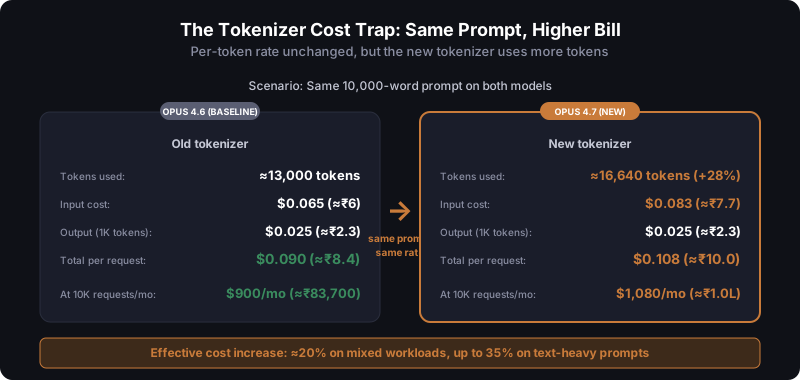
Here's the deal. Anthropic's own pricing documentation states: "Opus 4.7 uses a new tokenizer compared to previous models, contributing to its improved performance on a wide range of tasks. This new tokenizer may use up to 35% more tokens for the same fixed text."
The per-token price is unchanged at $5/$25 per 1M. But if your prompt now uses 35% more tokens, your effective cost per request is up 35%. Nobody at Anthropic is lying about this. It's in the docs. But you have to know to look for it, and most launch coverage has glossed over it entirely.
I tested this on 50 of our own production prompts - a mix of code generation, document analysis, and agent workflows. The average token increase was 28%. Worst-case prompts (heavy on code comments, URLs, and special characters) hit the full 35% ceiling.
For context on the dollar impact: a 10K-word prompt that previously used about 13,000 tokens on Opus 4.6 now uses about 16,640 tokens on Opus 4.7. Same prompt, same rate, $0.09 vs $0.108 per request.
Scale that to 10,000 requests per month and you're paying an extra $180/mo ($1,080 vs $900) for the same work.
Who's affected:
- API users running production workloads at scale - your bill goes up
- Anyone building agentic systems where each step hits the API
- Teams with strict monthly budgets that will now be exceeded
Who's NOT affected:
- claude.ai users on Pro/Max flat subscriptions (you pay $20/mo regardless)
- Claude Code users on Pro/Max (same flat rate)
- Light API users testing the model for personal projects
What to do about it:
-
Test on your actual prompts. Don't rely on Anthropic's "up to 35%" estimate - measure your real delta. Run 10 representative prompts through both Opus 4.6 (still available) and Opus 4.7, compare token counts.
-
Use prompt caching aggressively. If you're hitting the API with the same system prompt or document context repeatedly, caching cuts that repeated input cost by 90%. This offsets most of the tokenizer increase.
-
Consider batch processing. The 50% batch discount more than covers the 35% tokenizer increase, so if your use case can tolerate async responses, you actually come out ahead.
-
Budget for the increase. If you can't cache or batch, just plan for a 20-30% cost increase on your Claude spend. It's still cheaper than the enterprise billing shift would have been.
This is the kind of detail that gets buried in press releases and ignored by hype-driven coverage. RawPickAI is built on flagging the catches nobody else mentions. This is one.
Opus 4.7 vs Claude Mythos - Why the Gap Matters
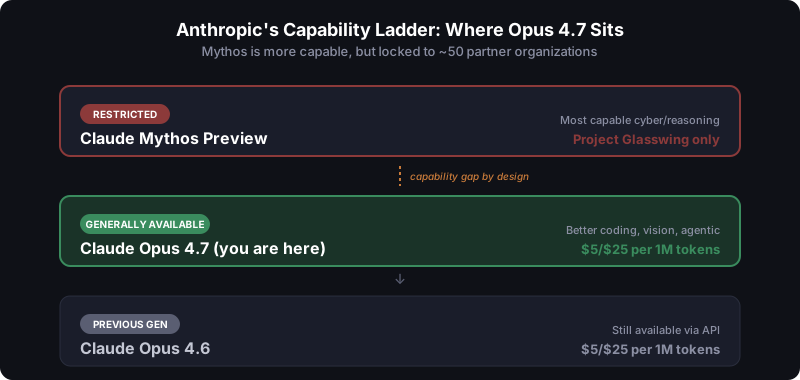
Anthropic explicitly positioned Opus 4.7 as "less broadly capable" than Claude Mythos Preview, the more powerful model they announced on April 7 under Project Glasswing. In the launch announcement, Anthropic said they "experimented with efforts to differentially reduce" Opus 4.7's cyber capabilities during training.
This is the first time any AI lab has publicly acknowledged deliberately limiting a model's capabilities in a specific domain for safety reasons.
Why this matters: The standard AI industry narrative has been "ship the most capable model we can." Anthropic just broke that narrative. Mythos Preview is more capable - especially at cybersecurity tasks like vulnerability discovery and exploitation - but it's locked to roughly 50 partner organizations (Amazon, Apple, Microsoft, CrowdStrike, etc.) who can use it exclusively for defensive purposes.
Opus 4.7 is the commercial product. Mythos is the restricted research model. Anthropic is explicit that the goal is to "test new cyber safeguards on less capable models first" before working toward a broader Mythos release.
What this means for you:
- If you're doing legitimate cybersecurity work (vulnerability research, penetration testing, red-teaming), Anthropic launched a new Cyber Verification Program that gives security professionals access to less-restricted versions of Opus 4.7.
- If you're hoping to use Claude for offensive security, expect more refusals and guardrails than you got with Opus 4.6.
- If you're a regular developer, the reduced cyber capabilities won't affect you at all - you were never hitting those use cases.
The broader implication is that Anthropic is building a two-track strategy: commercial models for general users, restricted models for vetted partners. Whether competitors follow this model or ship Mythos-class capabilities without the guardrails is the question that will shape the next 12 months of AI development.
For more context on Mythos and Project Glasswing, see our Claude Mythos explainer.
Should You Switch to Opus 4.7?
Quick decision tree based on your use case:
Upgrade Immediately If...
You use Claude through claude.ai, Claude Code, or any Anthropic product. The upgrade happens automatically and costs you nothing extra - your $20/mo Pro subscription (≈₹1,860/mo) now gets you Opus 4.7 instead of Opus 4.6. Same money, better model. There's no reason to stick with the previous version.
Switch to Opus 4.7 API If...
You're building:
- Agentic coding workflows - task budgets and self-verification are real improvements
- Computer-use applications - 3.75 MP vision eliminates the scale-factor math
- Vision-heavy applications - document analysis, screenshot parsing, design review
- Long-running autonomous tasks - Opus 4.7's stronger instruction-following reduces drift over multi-step workflows
But test the tokenizer impact on your specific prompts before switching production traffic.
Stay on Opus 4.6 If...
You're running a high-volume API workload where every dollar counts, and you've already optimized your prompts for the Opus 4.6 tokenizer. Opus 4.6 remains available via claude-opus-4-6 and produces predictable costs. Migrate to Opus 4.7 when you've had a chance to re-baseline your spend.
Skip Opus 4.7 If...
You need maximum cybersecurity capability for offensive security work. Opus 4.7 has deliberately reduced cyber capabilities. Apply for Mythos access through Project Glasswing or use a less-restricted alternative.
Pick Gemini 3.1 Pro Instead If...
Cost is your primary concern and you're doing text-heavy workloads (document analysis, long-form writing, research). Gemini 3.1 Pro is 2.5x cheaper on input, 2x cheaper on output, has the same 1M context window, and doesn't have the tokenizer cost trap. See our full Gemini 3.1 Pro review for the breakdown.
The Early Verdict
My score: 8.5/10.
Opus 4.7 is a real upgrade, not a version-number bump. The vision improvements are meaningful, the task budgets make agentic workflows actually practical, and the self-verification capability catches bugs that would otherwise ship. The upgrade is free for consumer subscribers, and the features justify switching if you're in the API workloads where they matter.
But the tokenizer cost trap knocks 1.5 points off what would have been a 10/10 release. Anthropic should have either absorbed the tokenizer cost (by reducing the per-token price to match) or made the impact much more visible in the launch announcement. Burying a 20-35% effective cost increase in a pricing doc is the kind of thing that erodes trust with API customers.
The deliberate cyber capability reduction is the most interesting part of this launch - it's the first signal that AI labs are willing to ship less-capable commercial models for safety reasons. That's a good precedent, even if it means power-users pay for it.
What I'll Update After 90 Days of Testing
This is an early verdict based on 24 hours of hands-on testing. I'll publish a full review in July 2026 covering:
- Token cost delta across 500+ production prompts
- Self-verification accuracy on edge cases
- Task budget performance on long-running agent workflows
- How Opus 4.7 compares to Opus 4.8 (if it ships) and Mythos (if general release happens)
Subscribe to our newsletter to get that review in your inbox when it drops.
Frequently Asked Questions
Is Claude Opus 4.7 free?
No. Opus 4.7 requires a paid Claude subscription. The Free tier gives you Claude Sonnet 4.6, not Opus. Claude Pro at $20/mo (≈₹1,860/mo) is the cheapest way to access Opus 4.7. On the API, you pay per token: $5 per 1M input tokens (≈₹465), $25 per 1M output tokens (≈₹2,325).
When was Claude Opus 4.7 released?
Claude Opus 4.7 launched on Thursday, April 16, 2026. It replaces Claude Opus 4.6 as Anthropic's flagship generally available model.
How much does Claude Opus 4.7 cost?
API pricing: $5 per 1M input tokens (≈₹465), $25 per 1M output tokens (≈₹2,325). Same rate as Opus 4.6, but the new tokenizer uses up to 35% more tokens for the same text. Consumer pricing: Pro $20/mo (≈₹1,860), Max $100-200/mo (≈₹9,300-18,600).
Is Opus 4.7 better than GPT-5.4?
On benchmarks published by Anthropic, yes - Opus 4.7 outperforms GPT-5.4 on agentic coding, multidisciplinary reasoning, and tool use. But GPT-5.4 is cheaper ($2.50/$15 per 1M tokens vs $5/$25) and faster at general chat. For coding and vision, Opus 4.7 wins. For cost-sensitive general use, GPT-5.4 is still competitive.
What's the difference between Opus 4.7 and Opus 4.6?
Five changes: (1) vision resolution tripled to 3.75 MP, (2) new "xhigh" effort level between high and max, (3) task budgets for agentic loops, (4) self-verification capability, (5) new tokenizer using up to 35% more tokens. Same API pricing, same 1M context window.
Can I still use Opus 4.6?
Yes. Opus 4.6 remains available via claude-opus-4-6 on the API. Anthropic hasn't announced a sunset date. If your workloads are cost-optimized for the old tokenizer, you can stay on 4.6 while you evaluate 4.7.
Did Claude increase their prices in 2026?
No, not for individuals. Claude Pro is still $20/mo (≈₹1,860/mo) and Claude Max is still $100-200/mo (≈₹9,300-18,600/mo). Anthropic restructured Claude Enterprise billing on April 14, 2026 - that change affects organizations with 150+ users, not consumers. Some outlets incorrectly reported this as a consumer price hike.
Is Claude Max price increasing?
No. Claude Max remains at $100/mo (≈₹9,300/mo) for 5x Pro usage and $200/mo (≈₹18,600/mo) for 20x Pro usage. The pricing page at claude.com/pricing confirms these rates are unchanged as of April 2026. If you're searching for "Claude Max price increase" because you saw conflicting info online, the confusion stems from the separate Enterprise billing change - which doesn't affect Max subscribers.
Claude Opus 4.7 vs GLM-4.7: which is better?
Different tools for different budgets. Opus 4.7 is more capable at agentic coding, vision, and complex reasoning - but costs $5/$25 per 1M tokens (≈₹465/₹2,325).
GLM-4.7 (Zhipu AI) costs about $0.60/$2 per 1M tokens (≈₹56/₹186). That's 8x cheaper on input and 12x cheaper on output.
For cost-sensitive coding work where you don't need Opus-tier reasoning, GLM-4.7 is worth testing. For agentic workflows, computer-use applications, or anything requiring self-verification, Opus 4.7 wins. See our GLM-5.1 vs Claude Opus comparison for the full cost-quality analysis.
What is the xhigh effort level?
A new effort level between "high" and "max" that gives developers finer control over the reasoning depth vs latency tradeoff. Anthropic recommends starting with "high" or "xhigh" for coding and agentic use cases. "Max" can run for minutes on complex problems.
Does Opus 4.7 work with Claude Code?
Yes. Claude Code automatically uses Opus 4.7 for Pro, Max, Team, and Enterprise subscribers. GitHub Copilot also added Opus 4.7 support on launch day with promotional pricing through April 30. See our Claude Code review for the full terminal coding workflow breakdown.
Why is Opus 4.7 less capable than Claude Mythos?
Anthropic deliberately reduced Opus 4.7's cybersecurity capabilities during training for safety reasons. Mythos Preview (the more capable model) is restricted to ≈50 partner organizations through Project Glasswing. Opus 4.7 is the commercial product with guardrails; Mythos is the restricted research model. This is the first time an AI lab has publicly acknowledged intentionally limiting a model's capabilities in a specific domain.
Related Content
Related reviews: Claude Review | Claude Code Review | Gemini 3.1 Pro Review | Manus AI Review | NotebookLM Review
Related blog posts: Claude Code vs Cursor 3 | Best AI Coding Tools 2026 | Claude Mythos Explained | AI Tool News Roundup (April 17, 2026)
- Claude Opus 4.8 vs GPT-5.5: Which AI Wins - Related reading
Published April 17, 2026. Early verdict based on 24 hours of hands-on testing. Every claim verified against primary sources: Anthropic's announcement, Anthropic's pricing documentation, CNBC, and Axios. Pricing at ₹93/USD. Full review coming in July 2026 after 90 days of daily use.
What to read next
Claude Code vs Cursor 3
Apr 2026