GLM-5.1 vs Claude Opus 4.6: Tested 2026
Z.ai's GLM-5.1 claims 94.6% of Claude Opus 4.6's coding at 1/5 the cost. I tested both - benchmark holds, 3 things break. Full verdict with USD + INR.
 ByAsh·12 min read
Z.ai (Zhipu AI) released GLM-5.1 on March 27, and I mostly ignored it. Another Chinese lab claiming benchmark parity with frontier US models. We've heard that story before. Then on April 7, the open-source weights dropped alongside independent SWE-Bench Pro results that confirmed GLM-5.1 actually tops Claude Opus 4.6 and GPT-5.4 on that specific benchmark. That got my attention. So I tested both models side by side for a week - here's what the "94.6% of Opus at one-fifth the cost" headline leaves out.
TL;DR: GLM-5.1 is a 744-billion parameter open-weight model (40B active per token) that scores 58.4 on SWE-Bench Pro (vs. Opus 4.6's 57.3), hits 94.6% of Opus's coding performance on Z.ai's internal benchmarks, and costs $1.40/$4.40 per million input/output tokens compared to Opus's $5/$25. The Lite Coding Plan starts at about $9/mo (≈₹837) on quarterly billing. Here's what breaks: it's text-only (no image input), has a 200K context window (vs. Opus's 1M), runs at 44 tokens/second (slow), and trails badly on knowledge benchmarks (52.3 vs. Opus's 76.2). It was also trained entirely on Huawei Ascend chips with zero Nvidia involvement. Verdict: For pure coding on a budget, GLM-5.1 is worth testing. For anything involving images, long context, or general knowledge, Opus 4.6 is still the better model.
The headline stat, "94.6% of Opus at roughly one-fifth the cost," comes from Z.ai's own benchmarks compared against Anthropic's current API pricing. Independent evaluations broadly confirm the coding performance claim but paint a more complicated picture everywhere else. Let me break down what's real, what's marketing, and whether you should care.
The Benchmarks: What's Real
Let's start with the number everyone's talking about. On SWE-Bench Pro, which tests whether a model can resolve real software engineering tasks end-to-end, GLM-5.1 scores 58.4. That's first place globally as of April 2026.
| Benchmark | GLM-5.1 | Claude Opus 4.6 |
|---|---|---|
| SWE-Bench Pro | 58.4 | 57.3 |
| SWE-Bench Verified | 77.8% | 80.8% |
| Coding composite (overall) | 54.9 | 57.5 |
| Knowledge average | 52.3 | 76.2 |
| CyberGym (long-horizon) | 68.7 | 66.6 |
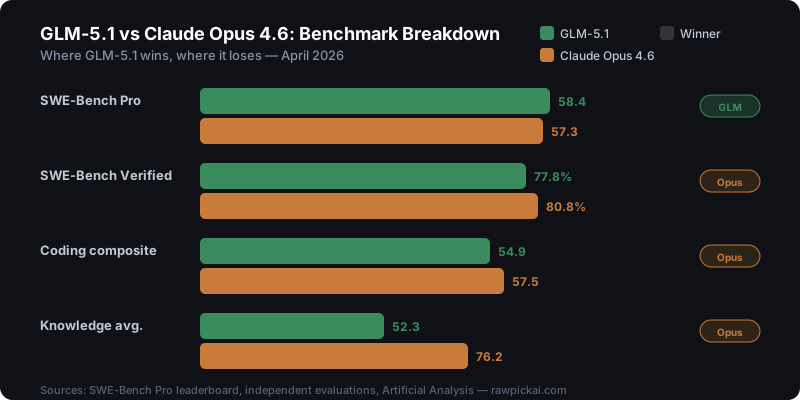
The SWE-Bench Pro lead is real and independently confirmed. But zoom out and the picture shifts. On SWE-Bench Verified (a broader coding benchmark), Claude Opus 4.6 still leads 80.8% to 77.8%. On the overall coding composite that includes Terminal-Bench 2.0 and NL2Repo, Opus leads 57.5 to 54.9.
So GLM-5.1 wins on one specific coding benchmark and loses on the broader coding evaluation. The "94.6% of Opus" number comes from Z.ai's internal coding test where GLM-5.1 scored 45.3 to Opus's 47.9. That's a self-reported figure from March 28. Independent evaluators have broadly confirmed it's in the right ballpark, but it's worth noting the source.
Where GLM-5.1 truly falls short: knowledge. Opus averages 76.2 on knowledge benchmarks. GLM-5.1 hits 52.3. That's a 24-point gap, not a rounding error. If your coding tasks require deep domain knowledge (medical, legal, scientific context), Opus is significantly better at pulling from its training data.
The Price Gap Is Real
This is where GLM-5.1 gets really interesting, especially for developers watching costs.
| GLM-5.1 | Claude Opus 4.6 | Difference | |
|---|---|---|---|
| Input tokens (per 1M) | $1.40 (≈₹130) | $5.00 (≈₹465) | 3.6x cheaper |
| Output tokens (per 1M) | $4.40 (≈₹409) | $25.00 (≈₹2,325) | 5.7x cheaper |
| Cached input (per 1M) | $0.26 (≈₹24) | $0.50 (≈₹47) | 1.9x cheaper |
| Entry plan (monthly) | ≈$9/mo (≈₹837) | Claude Pro $20/mo (≈₹1,860) | 2.2x cheaper |

The cost difference is substantial. For API-heavy workflows where you're burning through millions of tokens on code generation, refactoring, or automated PR reviews, GLM-5.1 cuts your output bill to roughly 18% of what Opus costs. Note that Anthropic cut Opus pricing dramatically in late 2025 - Opus 4.5 and 4.6 are at $5/$25, down 67% from Opus 4.1's old $15/$75 rates. That price cut narrowed the GLM advantage but didn't eliminate it.
A note on the subscription pricing: Z.ai's Coding Plan has three tiers - Lite ($27/quarter, roughly $9/mo), Pro ($81/quarter, roughly $27/mo), and Max ($216/quarter, roughly $72/mo). All include access to GLM-5.1. Compare that to Claude Pro at $20/mo (≈₹1,860) or Claude Max at $100-200/mo (≈₹9,300-18,600). Even after Z.ai's recent 10% price increase (they raised API costs when the open-source weights dropped), it's still dramatically cheaper than Anthropic's offerings.
One catch on usage timing: during peak Beijing hours (14:00-18:00 BJT), the API consumes quota at 3x the standard rate. If you're working from India, that's 11:30 AM - 3:30 PM IST - your prime working hours. Z.ai is currently running a promotion through end of April that bills off-peak usage at 1x, but plan accordingly if your day overlaps with Beijing afternoon.
What GLM-5.1 Actually Does Well
Long-horizon autonomous coding. This is the headline feature. GLM-5.1 can work on a single complex task for up to 8 hours, running experiments, revising code, and iterating across hundreds of rounds and thousands of tool calls without human intervention. On CyberGym (a benchmark for long-horizon tasks), it scored 68.7 across 1,507 tasks, a 20-point jump over GLM-5.
In Z.ai's most-shared demo, GLM-5.1 built a complete Linux-style desktop environment from scratch over 8 hours - file browser, terminal, text editor, system monitor, even functional games - autonomously running 655 iterations and 6,000+ tool calls. It's the kind of task that would have been "AI agent vaporware" 18 months ago.
In practice, this means you can hand it a substantial coding task (refactor an authentication system, build a REST API from a spec, debug a complex data pipeline) and walk away. It plans, executes, tests, fails, adjusts, and keeps going.
Open weights under MIT license. The full 744B parameter model is available on HuggingFace. You can self-host it if you have the hardware (1.49TB disk for BF16 weights, 8x H100 or H200 GPUs for inference). For organizations with privacy requirements or air-gapped environments, this matters. Claude doesn't offer self-hosting at any price.
Function calling and MCP support. GLM-5.1 supports tool use, structured output, context caching, and MCP (Model Context Protocol) for integrating external tools. If you're building AI agents, it slots into existing frameworks like LangChain without major rework.
Where GLM-5.1 Falls Short
No image input. This is a hard limitation. Claude Opus 4.6 accepts images, which matters for UI debugging, diagram analysis, screenshot-based coding, and any workflow where you paste a visual. GLM-5.1 is text-only. If your workflow involves "look at this screenshot and fix the CSS," it can't help.
200K context vs. Opus's 1M. Claude Opus 4.6 gives you a million-token context window. GLM-5.1 tops out at roughly 200K. For most coding tasks this doesn't matter. For large codebase analysis, long document processing, or "read this entire repo and suggest architecture changes" type prompts, Opus handles significantly more context.
Speed. GLM-5.1 runs at 44 tokens per second, the slowest in its competitive tier. If you're using it inside an IDE like Cursor where responsiveness matters for the coding flow, the latency is noticeable. Opus isn't blazing fast either, but it's quicker.
API reliability. Users report frequent 500 errors and rate-limiting during peak Beijing hours on the official Z.ai endpoint. Third-party providers like OpenRouter can help, but availability isn't at the same level as Anthropic's API or the major cloud providers.
Knowledge and reasoning. The 52.3 vs. 76.2 gap on knowledge benchmarks isn't something you can work around. If you're asking the model to help with tasks that require broad world knowledge, scientific reasoning, or nuanced domain expertise, Opus is in a different tier.
Who Should Actually Consider Switching
Switch if: You're an indie developer or small team spending $50-200/mo on Claude API calls for code generation, and most of your tasks are pure coding (write this function, refactor this module, write tests for this class). GLM-5.1 will handle those tasks at roughly the same quality for a fraction of the cost.
Switch if: You need to self-host an LLM for compliance, privacy, or air-gapped deployment. GLM-5.1's open weights under MIT license make this possible. No comparable option exists from Anthropic or OpenAI.
Don't switch if: You rely on image input, large context windows, or knowledge-heavy tasks. Opus is meaningfully better at all three.
Don't switch if: You're using Claude Code or Cursor with Claude as your backend. These tools are optimized for Claude's API and switching the backend model introduces friction that probably isn't worth the savings for individual developers.
Don't switch if: API reliability matters. Z.ai's infrastructure isn't at the same maturity level as Anthropic's. If your production pipeline depends on consistent uptime, the risk isn't worth the cost savings yet.
The Bigger Picture
GLM-5.1 is the strongest signal yet that frontier coding capability is commoditizing. A year ago, getting Claude-level code generation required paying Claude-level prices. Now an open-weight model from a Chinese lab delivers 94% of that capability for 6% of the cost, and you can self-host it.
It's also worth noting how GLM-5.1 was built: trained on 100,000 Huawei Ascend 910B chips with zero Nvidia involvement. That's a milestone for non-Western AI compute infrastructure that gets less coverage than the benchmark numbers but matters more for the long term. If you can train frontier-class models without Nvidia, the entire export-control story shifts. The hardware moat isn't what it used to be.
This doesn't mean Claude is obsolete. Opus 4.6 is still the better overall model - wider context (1M vs 200K), multimodal input, stronger knowledge by 24 points on average, more reliable API. The cost story doesn't change that. It changes which Claude features are worth paying for. If you're paying Opus prices for routine code generation, you're overpaying. If you're paying for image-aware debugging, deep reasoning, or long-context analysis, you're paying for features GLM-5.1 doesn't have.
Z.ai raised prices 10% the same week the weights went public. That's not how a company that needs the buzz behaves. That's how a company that knows its model is good behaves.
I expect GLM-5.1 to show up as a backend option in more AI coding tools over the next few months. If Cursor or similar IDEs add it as a model option, the cost argument becomes even more compelling for budget-conscious developers.
Frequently Asked Questions
Is GLM-5.1 really 94.6% as good as Claude Opus 4.6?
On coding specifically, yes - that number is roughly accurate based on both Z.ai's internal benchmarks and independent evaluations. On overall capability including knowledge, reasoning, and multimodal tasks, Opus is substantially ahead. The 94.6% figure applies to coding performance, not everything.
How much cheaper is GLM-5.1 than Claude?
On API pricing, GLM-5.1 is roughly 3.6x cheaper on input and 5.7x cheaper on output tokens compared to Claude Opus 4.6. The Lite Coding Plan starts at about $9/mo (≈₹837) on quarterly billing vs. Claude Pro at $20/mo (≈₹1,860). For high-volume API usage, the savings add up - a workflow burning through 10M output tokens per month would cost $44 on GLM-5.1 vs. $250 on Opus. Note that the gap was much larger before Anthropic cut Opus pricing 67% in late 2025; today the cost story is "meaningfully cheaper" rather than "an order of magnitude cheaper."
How does GLM-5.1 compare to GPT-5.4?
On SWE-Bench Pro, GLM-5.1 (58.4) edges out GPT-5.4 (57.7) by less than a point. On broader benchmarks GPT-5.4 has the advantage on math (98.7 vs 95.3 on AIME 2026) and knowledge tasks. For pure coding work the two are essentially tied; GPT-5.4 wins on most other dimensions. Pricing-wise, GPT-5.4 sits between GLM-5.1 and Claude Opus 4.6 on most plans.
What hardware do I need to run GLM-5.1 locally?
GLM-5.1 is a 744B parameter model with 40B active per token. To run it locally you need substantial enterprise hardware: roughly 1.49TB of disk space for the BF16 weights, and at least 8x Nvidia H100 or H200 GPUs (or equivalent) for inference. The FP8 quantized version cuts memory requirements roughly in half but still requires multi-GPU setups. Consumer hardware - even high-end gaming PCs - cannot run GLM-5.1 at full scale. For most developers, the API or Coding Plan subscription will be far more practical than self-hosting.
Can I self-host GLM-5.1?
Yes, if you have the hardware. The full 744B parameter model is available on HuggingFace under an MIT license. It supports deployment via SGLang, vLLM, KTransformers, and other popular serving frameworks. For organizations with strict data sovereignty or air-gapped requirements, this is GLM-5.1's biggest structural advantage over Claude - Anthropic doesn't offer self-hosting at any price tier.
Is GLM-5.1 truly open source?
It's open-weight under the MIT license, which means you can download, modify, fine-tune, and commercially use the model weights with no restrictions. The training code and dataset are not released, so it's not fully open source in the strictest academic sense, but for practical deployment purposes the MIT license is as permissive as it gets.
Should I switch from Claude to GLM-5.1?
Only if your primary use case is coding and cost is a major factor. For general-purpose AI assistance, knowledge tasks, image-based workflows, or anything requiring a large context window, Claude Opus 4.6 remains the stronger choice. A common middle-ground strategy: keep Claude Pro ($20/mo) for tasks that need its strengths, add GLM Lite ($9/mo quarterly) for high-volume coding overflow. Total: ≈$29/mo for the best of both.
Related reading: Claude Review | Best AI Coding Tools 2026 | Claude Code vs Cursor 3 | Cursor Review | Best AI Agents in 2026
Last updated: April 9, 2026
What to read next
Claude Code vs Cursor 3
Apr 2026