Alphabet Hits $4.8T on AI Stack Dominance, 76% of Companies Now Have a Chief AI Officer
Alphabet nearly overtakes Nvidia as most valuable company. IBM finds 76% of firms have a CAIO, up from 26% last year. Stanford AI Index: 53% adoption.
 ByAsh·6 min read
Three stories today that paint a clear picture of where the AI industry stands in May 2026. Google's parent company is closing in on the most valuable company on Earth. Three out of four large companies now have a dedicated AI executive. And Stanford's annual report shows AI adoption hit 53% of the global population in just three years - faster than the personal computer or the internet.
Alphabet Closes at $4.8 Trillion, Nearly Overtakes Nvidia
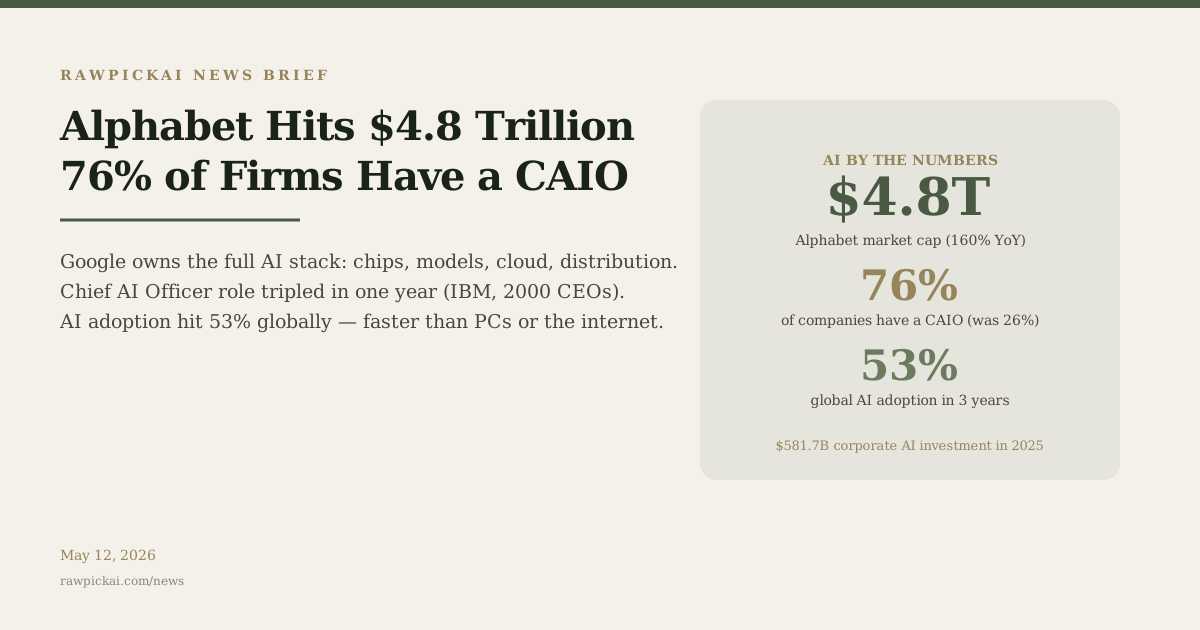
Alphabet closed the week at a market cap of $4.8 trillion, up 160% in the past year. Nvidia sits at $5.2 trillion, but the gap has narrowed from $750 billion at the end of 2025 to roughly $400 billion today. Alphabet briefly overtook Nvidia in after-hours trading on Tuesday after news broke that Anthropic committed to spend $200 billion on Google Cloud over five years.
Wall Street's thesis is simple: Google owns more of the AI stack than anyone else. Chips (TPUs), models (Gemini/DeepMind), infrastructure (Google Cloud), and distribution (Search, YouTube, Android). Gene Munster of Deepwater Asset Management called Google one of the "two best-positioned AI companies" alongside SpaceX/xAI.
The Anthropic relationship is a double-edged sword for investors, though. A significant share of Google Cloud's backlog growth comes from Anthropic, which raised capital from Google and then spent much of it back on Google Cloud and TPUs. Oracle lost about half its stock value over five months after investors realized a similar dynamic with OpenAI. Analysts estimate that nearly half of the $2 trillion in combined cloud backlog across Microsoft, Oracle, Amazon, and Google traces back to commitments from OpenAI and Anthropic.
My take: For anyone using Gemini, this market cap story translates to product investment. Google has the revenue and infrastructure to keep Gemini competitive with Claude and ChatGPT indefinitely. The Google I/O keynote on May 19 should make that concrete - expect significant Gemini updates. For tool pricing, Google's AI Pro subscription at $20/mo (≈₹1,860/mo) is priced identically to Claude Pro and ChatGPT Plus. With $4.8 trillion in market cap, Google can afford to keep it there or undercut competitors. The circular investment dynamic between Google and Anthropic is worth watching - if it unwinds, it affects both companies' ability to maintain current pricing.
IBM: 76% of Companies Now Have a Chief AI Officer
IBM's Institute for Business Value surveyed 2,000 CEOs across 33 countries and found that 76% of organizations now have a Chief AI Officer - up from just 26% in 2025. That's a near tripling in 12 months. The role has gone from experimental to standard faster than any C-suite position in modern business history.
The numbers behind the shift: companies with an AI-first C-suite structure scaled 10% more AI initiatives than peers. 64% of CEOs say they're comfortable making major strategic decisions using AI-generated input. By 2030, CEOs expect 48% of operational decisions to be made by AI without human intervention, up from 25% today.
The workforce implications are significant. Between 2026 and 2028, CEOs expect 29% of employees to need reskilling for entirely different roles, and 53% to need upskilling for their current jobs. 83% of CEOs said AI success depends more on people's adoption than the technology itself.
Not everyone is convinced the CAIO role will last. Gartner's Jonathan Tabah said he doesn't expect it to go mainstream, calling it costly and potentially redundant with existing CIO and CTO roles. Tim Crawford of AVOA compared it to the chief digital officer trend a decade ago - a role that "struggled because they weren't as in tune with the business" and eventually folded back into other positions.
My take: The 76% number is striking, but the more important finding is the 83% stat - that AI success depends on people, not technology. Every tool I review focuses on whether real users can actually get value from it, not whether the underlying model scores well on benchmarks. The CAIO trend validates that approach. The reskilling data (29% of employees changing roles within 2 years) is the stat that should concern individual workers more than any AI product launch. If you're in a role that could be automated, the time to learn AI tools is now, not in 2028. Our best-of lists and compare tool exist specifically to help you find the right tools for your work.
Stanford AI Index: 53% Adoption in Three Years, Faster Than PCs or Internet
Stanford's Human-Centered AI Institute released its 2026 AI Index Report with a striking headline: generative AI reached 53% population adoption within three years of ChatGPT's launch. That's faster than the personal computer (which took over a decade) or the internet (which took roughly seven years to reach similar penetration).
The US ranks 24th globally at 28.3% adoption - lower than expected, with the UAE leading at 70.1% and Singapore at 61%. The estimated value of generative AI tools to US consumers reached $172 billion annually by early 2026. The median value per user tripled between 2025 and 2026.
On the competition front, the US lead over China has nearly evaporated. US and Chinese models have traded places at the top of performance rankings multiple times since early 2025. As of March 2026, Anthropic's top model leads by just 2.7 percentage points.
The environmental cost data is sobering: AI data center power capacity hit 29.6 GW (enough to power New York state at peak demand). Annual GPT-4o inference water usage alone may exceed the drinking water needs of 1.2 million people. Global corporate AI investments hit $581.7 billion in 2025, up 130% from the prior year.
My take: The 53% adoption number explains why every company I review is raising prices or adding premium tiers - the user base is massive and growing. The US ranking at 24th is surprising but makes sense when you consider that many American workers are in industries (construction, logistics, healthcare) where AI tool adoption is slower than in tech. For AI tool buyers, the environmental data adds a new dimension to the value-for-money calculation - the compute behind these tools isn't free, and pricing will eventually reflect infrastructure costs. The US-China gap narrowing to 2.7% means that open-source alternatives from Chinese labs (DeepSeek, Qwen) will keep putting pricing pressure on US-based tools like Claude and ChatGPT.
Quick Hits
Publishers who blocked AI crawlers lost 7% of traffic. Research shows the drop came from reduced visibility in AI-driven discovery channels, not just bot activity. Publishers are shifting to richer, more interactive content formats rather than trying to outproduce AI. The lesson: blocking AI crawlers protects your data but costs you reach.
Bain study: SaaS firms could reap $100 billion in margins by automating coordination work and converting labor costs into software spending. The report frames this as efficiency, not job elimination - though the distinction matters less to the workers affected.
Google I/O on May 19 - one week away. Expect Gemini Agent updates, possibly Gemini 2.5 Ultra, and details on how the shuttered Project Mariner technology integrates into Chrome. This will be the biggest Gemini product announcement of 2026.
Published May 12, 2026. Prices at ≈₹93/USD.