Cisco Cuts 4,000 Jobs Despite Record Quarter, Google and SpaceX Plan Data Centers in Orbit
Cisco fires 4,000 while stock soars 17% on AI orders. Google talks to SpaceX about orbital data centers via Project Suncatcher. AI exec order stalls.
 ByAsh·5 min read
Two days after Cloudflare cut 1,100 employees at record revenue, Cisco just did the same thing at 4x the scale. Meanwhile, Google and SpaceX are in talks to put AI compute into orbit. And the White House AI executive order has stalled over internal disagreements. The theme of this week is clear: AI infrastructure is scaling faster than anyone expected, the jobs displaced by that scaling are piling up, and the government can't agree on how to regulate any of it.
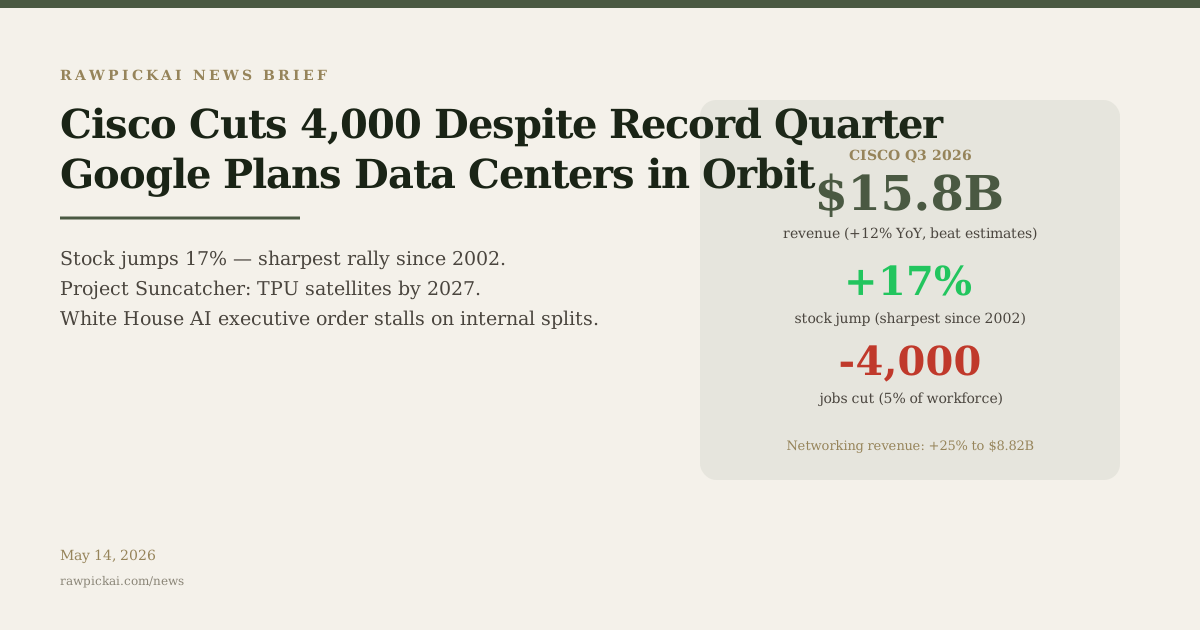
Cisco Cuts 4,000 Jobs, Stock Jumps 17% on AI Revenue Surge
Cisco announced it will cut fewer than 4,000 jobs - about 5% of its 86,200 employees - starting May 14. The layoff notifications begin today. The restructuring will cost up to $1 billion, with $450 million recognized this quarter and the rest in fiscal 2027.
The market reaction tells you everything about where Wall Street's priorities are: Cisco's stock jumped 17% in after-hours trading, the sharpest rally since 2002. Revenue hit $15.84 billion in Q3, up 12% year-over-year, beating estimates. Networking revenue - the segment most directly tied to AI infrastructure - surged 25% to $8.82 billion.
CEO Chuck Robbins was direct about the reasoning. In a blog post, he wrote that the companies winning in the AI era will be "those with focus, urgency, and the discipline to continuously shift investment toward the areas where demand and long-term value creation are strongest." Translation: AI infrastructure demand is so strong that Cisco is reallocating human capital to meet it, even if that means cutting 4,000 people in the process.
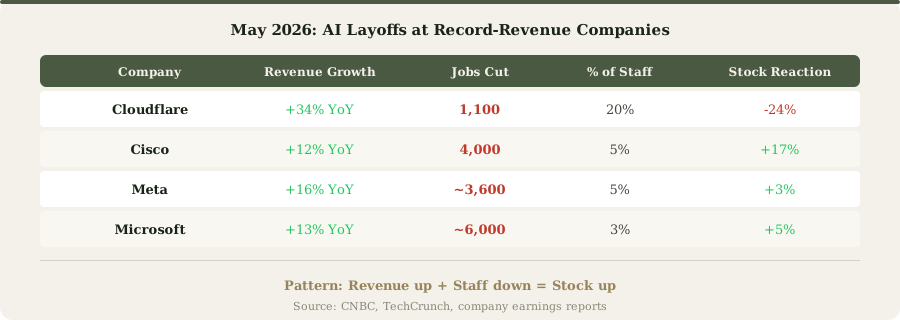
My take: This is the second "record revenue + mass layoffs" announcement this week after Cloudflare's 1,100 cuts on Monday. The pattern is now impossible to ignore: Cloudflare (+34% revenue, -20% staff), Cisco (+12% revenue, -5% staff), and Meta, Microsoft, Amazon all doing variants of the same thing. Wall Street is rewarding this behavior - Cisco gained 17% on the announcement, Cloudflare's stock recovered after the initial drop. For anyone working in tech, the signal is clear: AI infrastructure roles are growing (networking revenue up 25%), but support, operations, and coordination roles are being automated. The practical response isn't panic - it's learning the tools that are replacing those roles. Our compare tool and best-of lists exist for exactly that transition.
Google and SpaceX in Talks for Orbital Data Centers
Google is in advanced discussions with SpaceX to launch AI data centers into orbit, according to The Wall Street Journal. The partnership would combine Google's Project Suncatcher - which aims to deploy solar-powered satellites equipped with Tensor Processing Units (TPUs) - with SpaceX's Starship launch capability.
The pitch from SpaceX is that orbital data centers will be the cheapest place to run AI compute within a few years. Satellites in orbit get uninterrupted solar power, dissipate heat directly into space (no cooling costs), and avoid the NIMBY opposition that slows ground-based data center construction. Elon Musk wants to put up to a million satellites into orbit to form what he calls a space-based AI cloud.
Google isn't going all-in on SpaceX alone - they're also talking to other launch companies and partnering with Planet Labs to build the satellites. Prototype launches are planned for 2027 under Project Suncatcher. This follows Anthropic's deal with SpaceX last week for the Colossus facility, and both companies expressed interest in orbital collaboration.
The economics are still questionable. TechCrunch recently reported that today's terrestrial data centers are significantly cheaper than orbital ones once you factor in satellite construction and launch costs. But SpaceX is betting that Starship's reusable rockets will change that math within 3-5 years.
My take: This sounds like science fiction, but the business logic is real. Every major AI company - Google, Anthropic, OpenAI - is running into the same wall: there isn't enough power, land, and cooling capacity on Earth to meet AI compute demand. Google's $4.8 trillion market cap gives it the capital to bet on unproven infrastructure. For tool pricing, this is long-term bullish - if orbital compute works, the cost of running AI models drops significantly, which means subscription prices for Gemini, Claude, and ChatGPT at $20/mo (≈₹1,860/mo) can hold steady or even decrease. But that's a 2028+ story. Short term, nothing changes for users.
White House AI Executive Order Stalls Over Internal Disagreements
The White House's planned executive order on AI vetting - which we covered when it was first announced on May 7 - has stalled. According to Axios, the disagreements are over which federal agencies should oversee AI testing, how advanced models should be evaluated, and how far the government should go in regulating frontier systems.
The delay comes at a particularly bad time. State legislatures aren't waiting - Colorado, Iowa, New York, and Hawaii have all passed or are passing AI-specific laws. Without a federal framework, the regulatory environment for AI companies is fragmenting into a patchwork of state-level rules.
My take: Regulatory uncertainty is becoming a business risk for AI companies and their users. If you're evaluating AI tools for enterprise use, the lack of federal guidance means your compliance obligations depend on which states your customers are in. For individual users, this doesn't change tool selection today - but it's worth watching because federal regulation could affect which features are available in which models.
Quick Hits
Google I/O is Monday, May 19. Five days away. Expect a major Gemini model update (possibly 4.0), deeper details on Gemini Intelligence for Android, Veo 4 for video generation, and updates on the orbital data center plans. We'll have a full breakdown.
The AI layoff counter for May 2026 so far: Cloudflare (1,100), Cisco (4,000), plus ongoing cuts at Meta, Microsoft, Amazon, and Accenture. Total confirmed tech layoffs tied to AI restructuring in May alone exceeds 8,000. Developer employment continues to grow (2.2 million in the US, up 8.5%), but the types of roles available are shifting fast.
Apple reportedly planning to let users choose AI providers in iOS 27. An internal program called "Extensions" would let users swap in Google, Anthropic, or other AI providers to power Apple Intelligence features. This could be the most significant change to the AI competitive dynamics since ChatGPT launched - imagine picking Claude as your default AI across your entire iPhone.
Published May 14, 2026. Prices at ≈₹93/USD.