Cloudflare Cuts 1,100 Jobs at Record Revenue, Google Launches Gemini Intelligence for Android
Cloudflare fires 20% of staff despite $640M record quarter. CEO says AI made support roles obsolete. Google previews Gemini Intelligence and Googlebooks.
 ByAsh·5 min read
Two stories today that capture the AI paradox of May 2026 in perfect clarity. A company just posted its best revenue quarter ever - then laid off 20% of its workforce because AI made their jobs unnecessary. Meanwhile, Google unveiled the most aggressive integration of AI into a consumer operating system in history. One story shows what AI takes away. The other shows what it builds. Both happened on the same day.
Cloudflare Fires 1,100 Employees While Posting Record Revenue
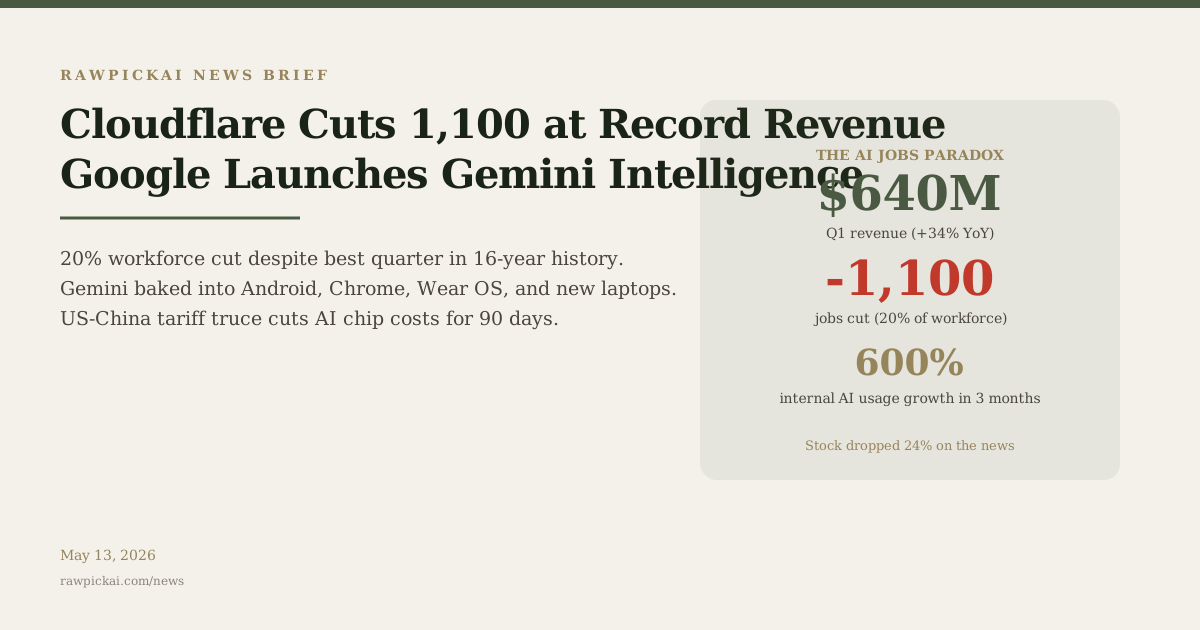
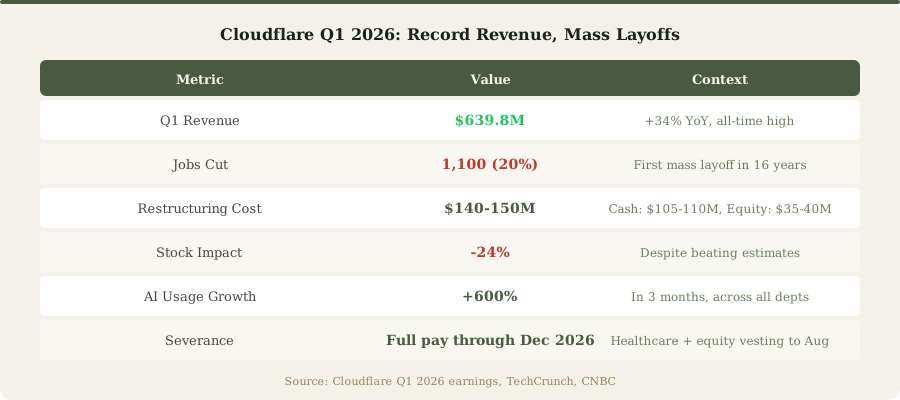
Cloudflare announced it is cutting 1,100 jobs - 20% of its entire workforce - despite just posting $639.8 million in Q1 2026 revenue, a 34% year-over-year increase and the highest quarterly revenue in the company's 16-year history. This is Cloudflare's first mass layoff ever.
CEO Matthew Prince was explicit about the reason: AI made these roles unnecessary. On the earnings call, he said the productivity gains from employees who directly talk to customers and write code have been "incredible," and that "a lot of the support roles behind them are not going to be the roles that drive companies going forward." The company's internal AI usage jumped 600% in just three months, with AI agents now running thousands of sessions daily across HR, marketing, finance, and engineering.
The market punished the stock anyway - shares dropped 24% after the announcement, even though Cloudflare beat revenue and earnings estimates. Investors struggled to reconcile record growth with mass layoffs. The company will take $140-150 million in restructuring charges in Q2 2026, with $105-110 million in cash severance costs.
The severance package is notable: full base pay through end of 2026, continued healthcare for US employees through December, and equity vesting through August 15. Every team is affected except quota-carrying salespeople. Prince said he expects Cloudflare will have more employees in 2027 than at any point in 2026 - but in different roles.
My take: This is the clearest example yet of what "AI-driven restructuring" actually looks like in practice. Not cost-cutting at a struggling company - workforce reshaping at a record-revenue company. Prince's line is the one that should concern anyone in a support role: "Just because you are fit does not mean you cannot get fitter." The pattern is now repeating across Meta, Microsoft, Amazon, and Cloudflare - companies growing revenue 30-40% while cutting 15-20% of staff. If you work in a support, operations, or coordination role, the urgency to learn AI tools isn't theoretical anymore. Our best-of lists and compare tool exist to help you find the right tools for your workflow before your company makes the decision for you.
Google Previews Gemini Intelligence, Googlebooks, and XR Glasses at Android Show
Google dropped its biggest Android update in years at the pre-I/O Android Show on May 12 - a week before the main Google I/O keynote on May 19. The centerpiece: Gemini Intelligence, a suite of agentic AI features deeply integrated into Android, Wear OS, Chrome, and a brand new laptop category called Googlebooks.
Gemini Intelligence is Google's answer to the question "what if your phone's OS was built around an AI agent?" Long-press on a grocery list in your notes app and Gemini creates a shopping cart. It books spin classes in the background. It works across Gemini in Chrome on Android (powered by Gemini 3.1) to summarize webpages, answer questions about content, and connect to Gmail, Calendar, and Keep without switching apps.
Googlebooks are the hardware play - premium Android-powered laptops from Acer, ASUS, and Lenovo launching this fall. They run Gemini Intelligence natively, support Android apps, stream phone apps, and include features like Magic Pointer and AI-generated widget creation. Think of them as Google's Copilot+ PC competitor, but built on Android instead of Windows.
Google also confirmed Android XR glasses will be previewed at I/O next week - camera, speakers, and microphones for hands-free Gemini interaction, no display. A display version is in development but has no launch date. Other announcements: wireless iPhone-to-Android transfer, AI-powered emoji redesign in 3D, Gboard's Rambler mode for cleaning up messy voice-to-text, and Instagram editing tools built into Android.
My take: Google I/O on May 19 is shaping up to be massive. The Android Show was just the appetizer - expect a major new Gemini model (possibly 4.0), Veo 4 for video generation, and deeper details on everything announced today. For tool comparison purposes, Google is making the strongest case yet that Gemini is more than a chatbot - it's becoming an operating system layer. The competition between ChatGPT (which is building Agent Mode and a rumored phone), Claude (which dominates coding), and Gemini (which owns the Android ecosystem) is now a platform war, not just a model war. If you're deep in the Google ecosystem, Gemini Intelligence makes the $20/mo AI Pro subscription (≈₹1,860/mo) significantly more valuable than it was a week ago.
Quick Hits
US-China tariff truce reshapes AI chip supply. Both countries agreed to slash tariffs for 90 days - US tariffs on Chinese goods drop from 145% to 30%, China's tariffs on US goods drop from 125% to 10%. This directly affects AI hardware pricing. NVIDIA chips going to Chinese data centers and Chinese-manufactured components coming to US cloud providers both get cheaper, at least temporarily.
Google I/O keynote is May 19 at 10 AM PT. Beyond what was announced at the Android Show, expect: a next-gen Gemini model, Aluminium OS updates (Google's answer to Chrome OS), possible Veo 4 announcement for AI video, and updates to Nano Banana, Gemma, and Lyria. We'll have a full breakdown that week.
AI-driven layoffs accelerating across tech. Cloudflare joins Meta, Microsoft, Amazon, and Accenture in cutting staff while reporting strong revenue. The common thread: companies are eliminating coordination and support roles while hiring more people who work directly with AI tools. The net effect on total tech employment is still positive (developer employment hit 2.2 million in 2025, up 8.5%), but the type of roles available is shifting fast.
Published May 13, 2026. Prices at ≈₹93/USD.