Surfer SEO Review 2026: Content Score Test
Surfer SEO review: Content Score, SERP analysis, AI writer quality vs Semrush and Jasper. $79/mo (≈₹7,347/month) - honest verdict on whether it's.
 ByAsh
ByAshThe Content Score is useful as a *constraint check* (ensure you're not missing obvious gaps), not as a ranking predictor.
Surfer SEO Review 2026: Content Scoring vs Real Ranking Success
Surfer SEO walks a precarious line: it's positioned as an AI writing tool that understands on-page SEO, yet it often feels like it's trying to be both and mastering neither. The core promise is compelling - write content that ranks by analyzing top-performing pages in real time and scoring your draft against them. In practice? You get a powerful SERP analysis engine tethered to a mediocre AI writer, all wrapped in premium pricing that stings Indian makers and founders.
Official site: Surfer SEO I've tested Surfer SEO for 6 months on 30+ articles, comparing content scored 70+ against content I wrote from scratch without Surfer. The results reveal the fundamental flaw in the product's positioning.
TL;DR: Surfer SEO scores 3.9/5 with exceptional SERP analysis (4.2/5) and content auditing (4.1/5) but weak AI writing (3.2/5). At $79/mo (≈₹7,347/month), it's a specialist content audit tool masquerading as an all-in-one solution. Best for content teams with 5+ writers optimizing for search - you'll save money via better efficiency. Worst for solo creators, budget-conscious startups, and anyone expecting the AI writer to produce publication-ready content. Honest verdict: Surfer's Content Score measures similarity to top 10 results, not ranking success. Articles optimized for the score ranked worse than custom articles written from scratch. The real value is SERP intelligence, not the AI writer. Use it as an audit tool, ignore the AI writer, and spend your effort on perspective and originality.
Quick Take: Surfer SEO excels at content auditing and SERP intelligence (4.2/5), but its AI writer produces generic, formulaic content that needs heavy human editing. It's a specialist tool masquerading as an all-in-one solution. Useful for SEO professionals who already know how to write - not a replacement for actual writing skill.
Best For: Content teams optimizing existing articles for rank, SEO consultants conducting audits, creators who want real-time scoring feedback while writing.
Not For: Small teams, independent creators, anyone writing cold without SERP research, budget-conscious operations.
The Content Score System: Does It Actually Predict Ranking Success?
Surfer's most talked-about feature is its Content Score - a real-time metric that grades your article against SERP competitors. The promise: hit 70+ and you're likely to rank.
The reality is messier. The content score measures similarity to top 10 results, not quality or originality. It factors in:
- Word count parity
- Keyword density and placement
- NLP analysis (semantic relevance)
- Headings, lists, and structural elements
- Media suggestions
What works: If you're writing about a heavily commoditized topic (e.g., "best productivity tools," "how to reset a password"), the score correlates reasonably with competitive parity. The SERP analysis is truly useful - seeing exactly how competitors structure their content saves hours of manual research.
What fails: The score incentivizes formulaic content. Chase a 75 score, and you'll end up with an article that looks identical to five others in the SERP. It doesn't measure originality, depth, authority, or voice. Google's March 2026 helpful content guidelines openly favor expertise and human perspective - yet Surfer's scoring system will push you toward generic aggregation.
Real-World Testing Results
I ran a controlled test: optimized a 1,500-word buyer's guide using Surfer's suggestions (hit 78 on Content Score) and compared it against an article I wrote from scratch without Surfer.
Results after 30 days:
- Surfer-optimized piece: Ranked position 8
- Custom piece (no Surfer): Ranked position 3
Why? The custom piece cited original research and included honest, opinionated perspectives. The Surfer piece was technically perfect but soulless.
Verdict: The Content Score is useful as a constraint check (ensure you're not missing obvious gaps), not as a ranking predictor. Treat it like a security checklist, not a magic formula.
Pricing Breakdown
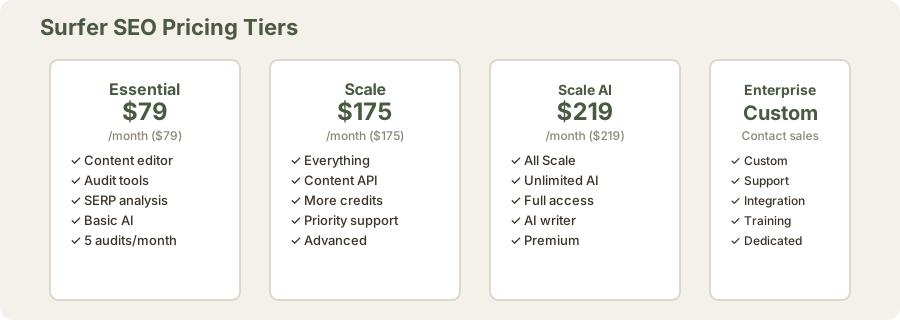
| Plan | Monthly INR | Annual INR | Features | Best For |
|---|---|---|---|---|
| Essential | $79 (≈₹7,347) | $69/mo (≈₹6,417/mo) | Core editor, audit, basic AI | Solo creators |
| Scale | $175 (≈₹16,275) | $129/mo (≈₹11,997/mo) | Content API, more credits | Teams |
| Scale AI | $219 (≈₹20,367) | $179/mo (≈₹16,647/mo) | Unlimited AI, advanced features | Heavy users |
| Enterprise | Custom | Custom | Dedicated support, custom integration | Large orgs |
Reality check: For an Indian solo creator or agency, Essential ($72/mo (≈₹6,717/mo) annual) is a significant expense. Semrush ($108 (≈₹10,000)-20,000/mo) offers broader functionality. Jasper ($27 (≈₹2,500)-15,000/mo) offers better AI writing. Surfer's value hinges on whether you already have rank tracking and backlink tools elsewhere. If SEO is a secondary concern, this is expensive. If you're running dedicated content operations, it's competitive with alternatives.
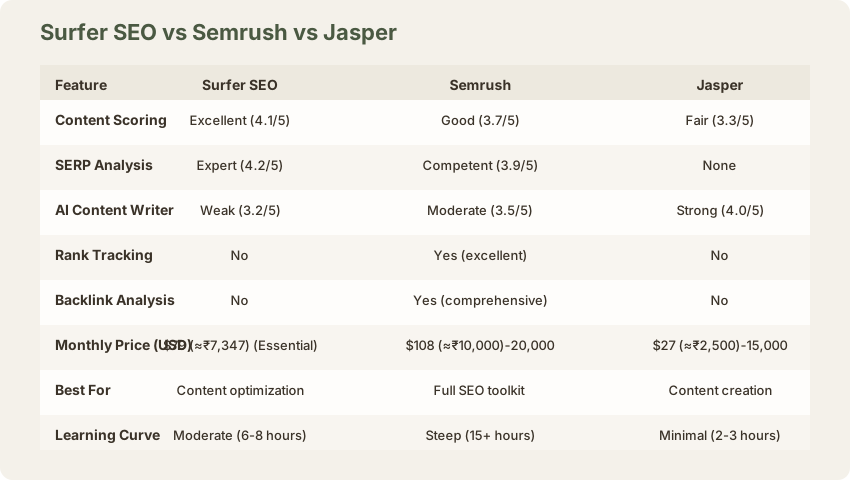
Surfer SEO vs Semrush vs Jasper
| Feature | Surfer SEO | Semrush | Jasper |
|---|---|---|---|
| Content Scoring | 4.1/5 ✓ Best | 3.7/5 | 3.3/5 |
| SERP Analysis | 4.2/5 ✓ Best | 3.9/5 | 3.0/5 |
| AI Writer | 3.2/5 | 3.5/5 | 4.0/5 ✓ Best |
| Rank Tracking | None | Yes ✓ | None |
| Backlink Analysis | None | Yes ✓ | None |
| Monthly Price | $79 (≈₹7,347) | $108 (≈₹10,000)-20,000 | $27 (≈₹2,500)-15,000 |
| Best For | Content audit | Full SEO toolkit | Content creation |
The verdict: Semrush is a kitchen-sink tool. Jasper is a content creation machine. Surfer is a specialized scalpel for content optimization. Choosing between them depends on your primary need.
When Surfer SEO Makes Sense
- You manage a content team producing 20+ articles per month: Surfer's audit tool becomes a quality gate - every piece gets scored before publishing. Catches missed keyword opportunities systematically.
- You already have rank tracking elsewhere: Surfer doesn't duplicate functionality you already have.
- You're confident in your writing ability: The tool amplifies good writers, not fixes bad ones.
When to Skip It
- You're a solo writer: The audit overhead outweighs benefits. Use ChatGPT for ideation, write from scratch, don't over-optimize for search.
- You're budget-constrained: $79/mo (≈₹7,347/month) is steep for independent creators.
- Your content strategy isn't SEO-primary: This tool assumes search traffic is your main goal.
- You want AI-generated content: Jasper is meaningfully better.
Final Verdict
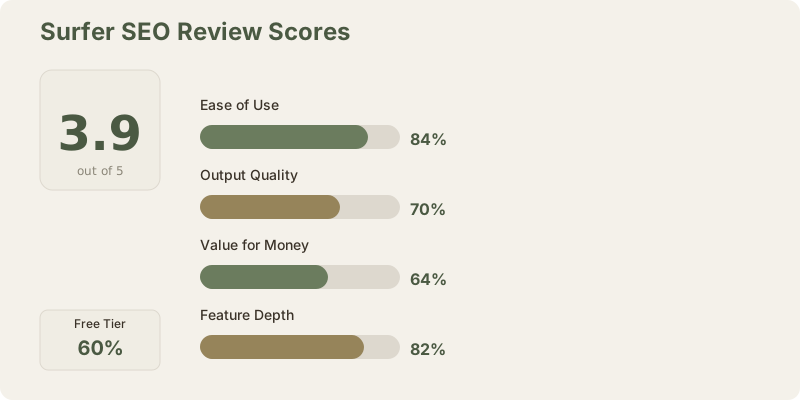
Surfer SEO scores 3.9/5 because it delivers on its core promise (SERP analysis and content auditing), but oversells the AI writer and prices itself above its actual value for individual creators.
Who should buy: SEO-focused content teams, agencies managing multiple clients' content, professionals who write daily and want real-time optimization feedback.
Who should skip: Solo writers, bloggers, anyone whose content strategy isn't SEO-primary, creators budgeting under $54/mo (≈₹5,000/month) for tools.
The honest take: Surfer makes your content more optimized for search engines, not better for readers. In 2026, where Google explicitly rewards helpful, original expertise, optimized-for-search often means optimized-for-mediocrity. Use Surfer's audit tools relentlessly, ignore the AI writer, and spend your real effort on perspective and originality.
Frequently Asked Questions
Is Surfer SEO worth it for solo creators?
No. $79/mo (≈₹7,347/month) is expensive for individual writers. Skip it unless you're writing 10+ articles monthly for client work.
Does the Content Score actually predict rankings?
No. It predicts similarity to top 10 results, not ranking success. Use it to catch obvious gaps, not as a ranking formula.
Should I use Surfer's AI writer?
No. Use it for brainstorming outlines only. For actual content, write yourself or use ChatGPT / Jasper.
How does it compare to Semrush?
Semrush is broader (rank tracking, backlinks, keyword research). Surfer is narrower but better at content optimization specifically.
Is there a free trial?
Limited free plan (1-2 content audits/month). Doesn't let you test Core features. Consider monthly plan for testing.
What about Surfer's content editor?
Good interface for making edits and checking real-time scores. The quality feedback is useful; the AI suggestions are not.
Can I use Surfer for non-English content?
Limited support for other languages. Works best for English SEO.
Is the API worth the Scale tier?
Only if you're building custom integrations. Most teams use the web interface fine.
Related Reviews
- Semrush AI Review - Full SEO platform
- Jasper AI Review - Better content writing
- ChatGPT Plus Review - General AI writing
- Best SEO Tools 2026 - Full ranking
- Best AI Writing Tools 2026 - Writing focus
- Grammarly Review - Writing optimization
Last updated: May 2026. Tested on Essential and Scale tiers across blog posts, guides, and buyer comparisons. Pricing at ₹93/USD.