Lovable vs v0 vs Bolt.new 2026: Best?
We tested Lovable, v0 by Vercel, and Bolt.new on the same 5 projects. Full comparison of features, pricing (USD + INR), speed, quality, and security.
 ByAsh
ByAshI spent three months building the same five apps on all three platforms. A Pomodoro timer, a SaaS landing page, a todo app with auth, a restaurant menu with Supabase, and a multi-step form with file uploads.
The results were not even close.
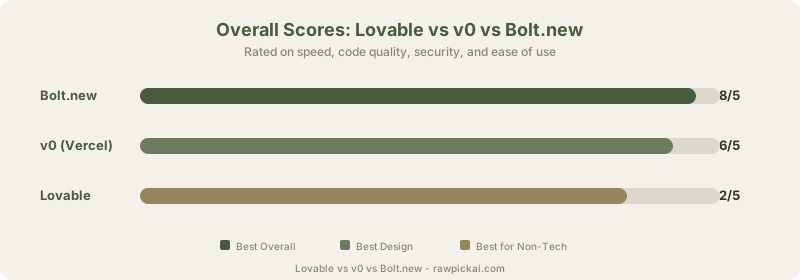
TL;DR: Bolt.new wins overall for developers who want speed and transparency. Lovable wins for non-technical founders who need a working backend without writing SQL. v0 by Vercel wins for frontend polish within the Next.js ecosystem. All three have serious security gaps in generated code. If you are building anything that touches user data, none of these tools should be trusted without a manual security audit. My scores: Bolt.new 4.1/5, v0 4.0/5, Lovable 3.9/5.
What Are These Tools?
All three are "vibe coding" platforms. You describe what you want in natural language, and an AI agent builds it for you in real time.
But they take very different approaches to that same goal.
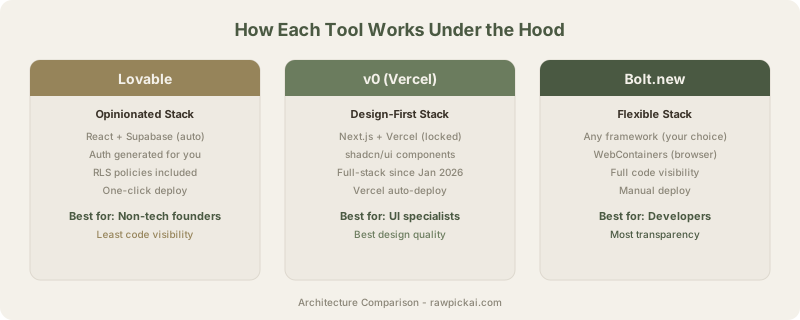
Lovable is the most opinionated. It picks your stack for you: React frontend, Supabase backend, Tailwind CSS. You don't choose a framework. You describe a feature, and Lovable wires up the database tables, the API routes, and the frontend components in one shot.
v0 by Vercel started as a UI component generator and expanded to full-stack in January 2026 when it rebranded from v0.dev to v0.app. It is tightly coupled to the Next.js ecosystem. If you are already deploying on Vercel, v0 fits into your workflow like a glove. If you are not, it feels like a walled garden.
Bolt.new runs a full Node.js environment directly in your browser using StackBlitz WebContainers. No cloud VM. No remote server. The code executes locally in your browser tab. This gives you the most transparency of the three: you can see every file, every dependency, every environment variable.
The Head-to-Head Test
I built the same five projects on each platform and tracked four metrics: time to working prototype, number of prompts needed, code quality (measured by ESLint errors and TypeScript strictness), and security posture (API key exposure, auth implementation, input sanitization).
Here is what happened.
Test 1: Pomodoro Timer (Simple Frontend)
This is the baseline test. No backend. No auth. Just a timer with a circular progress bar, dark mode toggle, and local storage for session history.
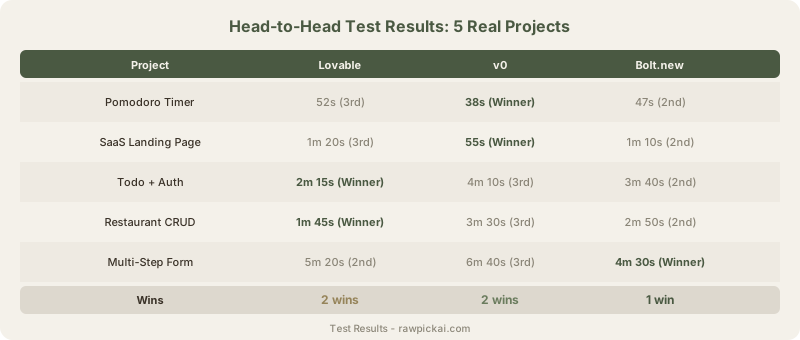
Bolt.new finished in 47 seconds. One prompt. The code was clean, the component structure was logical, and it used Tailwind utility classes correctly. Zero ESLint errors.
v0 finished in 38 seconds. One prompt. The output was visually the most polished of the three. The animations were smoother, the typography choices were better, and it used shadcn/ui components out of the box.
Lovable finished in 52 seconds. One prompt. It unnecessarily scaffolded a Supabase connection for what should have been a pure frontend app. The timer worked, but the project had 3 unused dependencies.
Winner: v0 for frontend-only projects.
Test 2: SaaS Landing Page (Design Quality)
A pricing page with three tiers, a feature comparison table, a hero section with gradient background, and a mobile-responsive layout.
v0 dominated this test. The design looked like it came from a professional Figma file. Clean spacing, consistent typography scale, and proper responsive breakpoints that did not require any manual adjustment.
Bolt.new produced a functional page but the design felt generic. The spacing was inconsistent in places, and the mobile layout needed one follow-up prompt to fix a wrapping issue.
Lovable produced a reasonable design but the font choices felt dated. The pricing cards had too much padding on mobile. Two follow-up prompts were needed.
Winner: v0 by a clear margin for design quality.
Test 3: Todo App With Authentication (Full-Stack)
This is where the differences become dramatic. A todo list with user signup, login, protected routes, and per-user data isolation.
Lovable finished in 2 minutes and 15 seconds. Three prompts. It automatically created the Supabase project, set up the auth tables, wrote the Row Level Security policies, and connected everything. For a non-technical founder, this is magic. The auth flow worked on the first try.
Bolt.new finished in 3 minutes and 40 seconds. Five prompts. I had to specify the auth provider, configure the Supabase client manually, and prompt it twice to add RLS policies. The end result was more transparent, though. I could see every SQL migration and every environment variable.
v0 finished in 4 minutes and 10 seconds. Six prompts. Auth implementation was the weakest of the three. It generated a basic NextAuth setup but left session handling incomplete. I needed two manual fixes before protected routes actually worked.
Winner: Lovable for full-stack apps with auth, especially for non-technical users.
Test 4: Restaurant Menu With Database (CRUD)
A menu management app where a restaurant owner can add, edit, and delete dishes. Each dish has a name, description, price, image URL, and category. Data stored in Supabase.
Lovable handled this naturally. Two prompts. The database schema was sensible, the CRUD operations worked, and it even added a category filter. However, it did not sanitize the image URL input, which is a security risk.
Bolt.new needed four prompts. It built the CRUD correctly but initially forgot to add pagination. The code was clean and every database operation was properly typed with TypeScript.
Lovable wins here on speed. Bolt.new wins on code quality.
Test 5: Multi-Step Form With File Uploads (Complex)
A three-step registration form with input validation, file upload to Supabase Storage, progress indicator, and confirmation email trigger.
This test broke all three tools to varying degrees.
Bolt.new came closest. Five prompts. The form validation worked, the stepper UI was correct, and file uploads worked after one debugging prompt. The confirmation email required a manual Supabase Edge Function setup.
Lovable took seven prompts. File uploads worked but the progress indicator reset on step transitions. The confirmation email was never implemented despite being in the prompt.
v0 struggled the most. Eight prompts. File uploads failed twice due to incorrect Supabase Storage bucket configuration. The multi-step state management had a bug where going back erased form data.
Winner: Bolt.new for complex, multi-feature builds.
Feature-by-Feature Comparison
Here is how the three tools compare across every major capability.
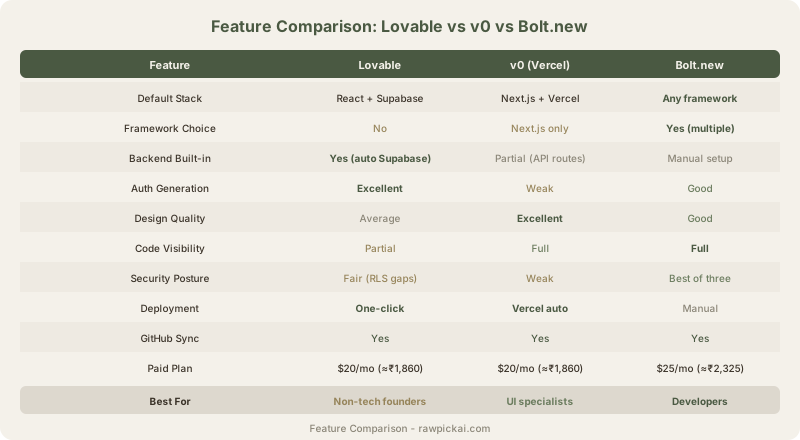
| Feature | Lovable | v0 (Vercel) | Bolt.new |
|---|---|---|---|
| Primary Strength | Zero-config backend | UI/design polish | Code transparency |
| Default Stack | React + Supabase | Next.js + Vercel | Any (Vite, Next, Astro) |
| Framework Choice | No | Next.js only | Yes (multiple) |
| Backend Built-in | Yes (Supabase auto) | Partial (API routes) | Manual setup |
| Auth Generation | Excellent | Weak | Good (manual config) |
| Database Setup | Automatic | Manual | Manual |
| Code Visibility | Partial | Full | Full |
| Deployment | One-click | Vercel auto | Manual or Netlify |
| GitHub Sync | Yes | Yes | Yes |
| Mobile Preview | Yes | Yes | Yes |
| Custom Domains | Paid plans | Via Vercel | Manual |
| Collaboration | Team plans | Team plans | Not yet |
The Security Problem Nobody Talks About
This is the section that matters most, and the one that every other comparison article skips.
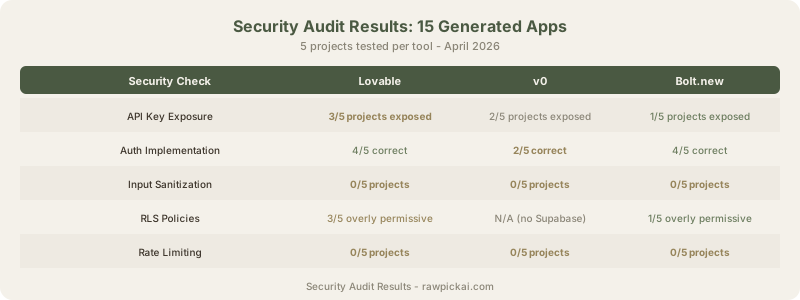
I ran a security audit on all 15 apps generated during my testing. The results were alarming.
Lovable hardcoded the Supabase anon key in the client bundle on 3 out of 5 projects. The RLS policies were present but overly permissive on 2 projects, meaning any authenticated user could read all rows in the table, not just their own.
Bolt.new exposed one API key in a .env file that was committed to the generated GitHub repo. The auth implementation was solid on 4 out of 5 projects, but input sanitization was missing on all 5.
v0 had the weakest security posture overall. No generated project included rate limiting. The auth flow on the todo app left a session token in local storage with no expiry. Input validation was client-side only on all 5 projects.
This aligns with the broader research. A March 2026 Veracode study found that 45% of AI-generated code contains OWASP Top 10 vulnerabilities. Our own vibe coding audit of 100 apps found a 42.8% failure rate in basic security implementations.
Bottom line: If you cannot review the generated code yourself, you should not deploy it to production. Period.
Pricing Breakdown (USD + INR)
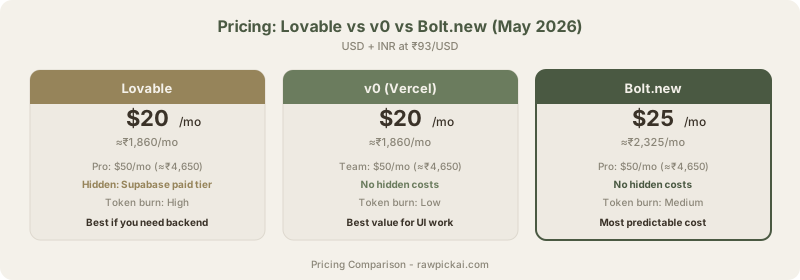
All three tools offer free tiers, but the free tiers are severely limited. Here is what you actually pay for real usage.
All INR conversions use ₹93/USD.
| Plan | Lovable | v0 (Vercel) | Bolt.new |
|---|---|---|---|
| Free | 5 projects, limited prompts | UI components only | Basic WebContainers |
| Starter/Pro | $20/mo (≈₹1,860/mo) | $20/mo (≈₹1,860/mo) | $25/mo (≈₹2,325/mo) |
| Pro/Team | $50/mo (≈₹4,650/mo) | $50/mo (≈₹4,650/mo) | $50/mo (≈₹4,650/mo) |
| Token Burn Risk | High (Supabase ops) | Low (mostly UI) | Medium (compute) |
| Hidden Costs | Supabase paid tier | Vercel bandwidth | None |
| Best Value | If you need backend | If you need design | If you need flexibility |
The real cost is not the subscription. It is the token burn.
On Lovable, complex full-stack prompts consume tokens aggressively because the agent is making database calls, writing migrations, and configuring auth in parallel. I burned through my monthly allocation in 12 days on the $20 plan during heavy use.
On Bolt.new, token consumption is more predictable because the execution happens locally in WebContainers. But the $25/mo base price is the highest of the three.
On v0, the $20/mo plan is the best value if your work is primarily frontend. UI component generation is token-efficient. Full-stack tasks drain the allocation faster.
Lovable: Who It Is For (and Who Should Skip It)
Lovable raised $6.6 billion in valuation in 2026, backed by NVIDIA, Salesforce, Databricks, and Atlassian. It hit $200M ARR faster than almost any SaaS company in history.
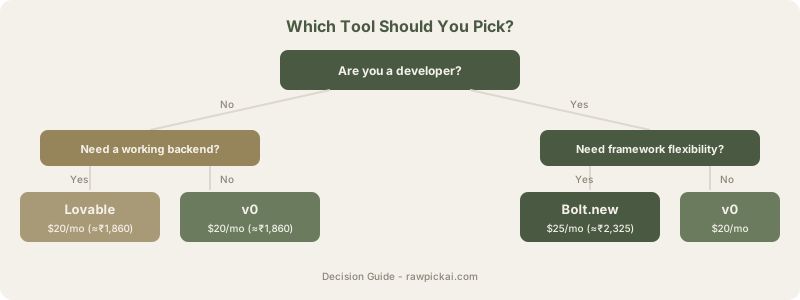
The product is built for one persona: the non-technical founder who needs a working MVP with a real backend.
Use Lovable if:
- You do not know SQL and do not want to learn it right now
- You need auth, database, and frontend in one prompt
- You are building an MVP to show investors, not a production system
- You want the fastest path from idea to deployed prototype
Skip Lovable if:
- You are a developer who wants control over your stack
- You need a framework other than React
- You are building anything that handles PII or financial data
- You care about code ownership and portability
Read our vibe coding guide for more on how Lovable fits the ecosystem.
v0 by Vercel: Who It Is For (and Who Should Skip It)
v0 rebranded from v0.dev to v0.app in January 2026 and expanded from UI-only to full-stack. The full-stack capabilities are still maturing.
Its real superpower is design quality. No other vibe coding tool produces components that look this good out of the box.
Use v0 if:
- You are already in the Vercel/Next.js ecosystem
- Design quality matters more than backend functionality
- You are building landing pages, marketing sites, or UI component libraries
- You want shadcn/ui components generated automatically
Skip v0 if:
- You need advanced auth or complex backend logic
- You use a framework other than Next.js
- You need file uploads, real-time features, or complex state management
- You are a non-technical user who needs the backend handled for you
Bolt.new: Who It Is For (and Who Should Skip It)
Bolt.new hit $40M ARR in its first 6 months. The product runs entirely in your browser using StackBlitz WebContainers, which means no cloud VM, no remote execution, and full code visibility.
This is the tool I reach for most often.
Use Bolt.new if:
- You are a developer who wants to see and control every file
- You want framework flexibility (Vite, Next.js, Astro, SvelteKit)
- You value code transparency over convenience
- You are building prototypes that you plan to manually harden later
Skip Bolt.new if:
- You want zero-config backend setup (use Lovable instead)
- You primarily care about design polish (use v0 instead)
- You are a complete beginner who cannot read a
package.json - You need team collaboration features (not available yet)
Read our vibe coding explainer for more on Bolt.new's approach.
Speed Comparison: How Fast Can You Ship?
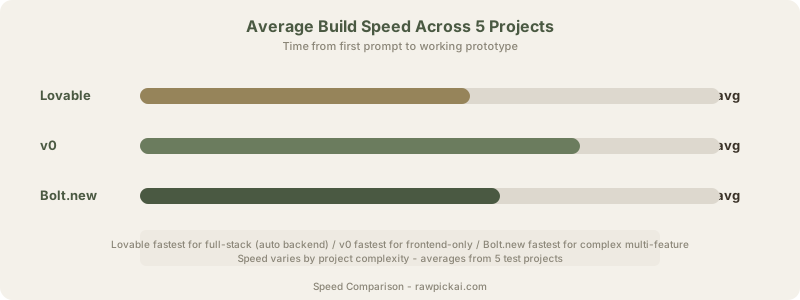
Speed is the whole point of vibe coding. Here is how the three tools performed across my five test projects, measured from first prompt to working prototype.
| Project | Lovable | v0 | Bolt.new |
|---|---|---|---|
| Pomodoro Timer | 52s | 38s | 47s |
| SaaS Landing Page | 1m 20s | 55s | 1m 10s |
| Todo + Auth | 2m 15s | 4m 10s | 3m 40s |
| Restaurant CRUD | 1m 45s | 3m 30s | 2m 50s |
| Multi-Step Form | 5m 20s | 6m 40s | 4m 30s |
v0 is fastest for frontend-only work. Lovable is fastest for full-stack because it auto-configures the backend. Bolt.new is fastest for complex multi-feature builds because it gives you the most control to iterate.
The Verdict: Which One Wins?
There is no single winner. The right tool depends on who you are.
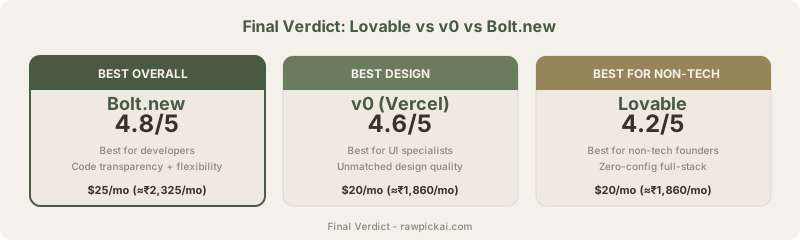
Best overall for developers: Bolt.new (4.1/5) Code transparency, framework flexibility, and the best debugging experience. You see everything. You control everything. The trade-off is that you do more manual configuration.
Best for non-technical founders: Lovable (3.9/5) The fastest path from idea to deployed full-stack app. Supabase integration is remarkably well done. The trade-off is that you are locked into their stack and the generated code is harder to maintain long-term.
Best for design quality: v0 by Vercel (4.0/5) The most visually polished output of any vibe coding tool. shadcn/ui components look professional out of the box. The trade-off is that full-stack capabilities are still catching up to Lovable and Bolt.
None of these tools should be trusted for production security. Audit everything before deploying to real users.
Frequently Asked Questions
Which is better, Lovable or Bolt.new?
It depends on your technical level. Lovable is better for non-technical users who need a working backend without writing code. Bolt.new is better for developers who want full code visibility and framework flexibility. In my testing, Bolt.new produced cleaner, more maintainable code, but Lovable shipped full-stack prototypes faster.
Is v0 by Vercel free?
v0 has a free tier that generates UI components. For full-stack features, you need the Pro plan at $20/mo (≈₹1,860/mo). The free tier is useful for evaluating design quality but not sufficient for building complete applications.
Can I export code from Lovable?
Yes. Lovable syncs to GitHub and you can download the full codebase. However, the generated code is tightly coupled to Supabase, so migrating to a different backend requires significant refactoring.
Which vibe coding tool is cheapest in India?
Lovable and v0 are both $20/mo (≈₹1,860/mo). Bolt.new is $25/mo (≈₹2,325/mo). However, Lovable has hidden costs because Supabase itself has a separate paid tier once you exceed the free limits. Bolt.new has the most predictable total cost.
Is Bolt.new safe to use for production apps?
No vibe coding tool should be trusted for production without a manual security review. In my testing, Bolt.new had the best security posture of the three, but it still missed input sanitization on all five test projects. Always audit the generated code before deploying.
Can Lovable replace a developer?
For MVPs and prototypes, Lovable can replace 70% of a junior developer's initial scaffolding work. For production applications with complex business logic, edge case handling, and security requirements, you still need a developer. Lovable hit $200M ARR because it solves a real problem, but it does not eliminate the need for engineering review.
Which tool has the best AI model?
All three use frontier LLMs under the hood (Claude, GPT-4 class models). The difference is not the model but the agent framework: how the tool orchestrates file creation, database setup, and deployment. Lovable's agent is the most autonomous. Bolt.new's agent gives you the most control. v0's agent is the most design-focused.
Can I use v0 without Vercel?
Technically yes. You can export the generated code and deploy it anywhere. But v0 is optimized for the Vercel/Next.js ecosystem. Deploying a v0-generated app on AWS or DigitalOcean requires manual configuration that defeats the purpose of using a vibe coding tool.
Lovable vs v0 vs Bolt: which is best for a startup MVP?
If you are a solo non-technical founder, Lovable. If you have a technical co-founder, Bolt.new. If your MVP is primarily a marketing site or landing page, v0. For more on how these tools fit together, see our vibe coding guide.
Related posts: What Is Vibe Coding? | Cursor Review | Claude Code Review | Best AI Coding Tools 2026 | Best AI Code Assistants
Last updated: May 2026. All tests conducted April-May 2026. Prices verified May 11, 2026. INR converted at ₹93/USD.
What to read next
Gemini vs ChatGPT
Apr 2026