Anthropic Eyes $900B Valuation, Apple Pays $250M Over Broken Siri Promises
Anthropic may raise $50B at $900B valuation to surpass OpenAI. Apple settles Siri class action for $250M. Five Eyes warns on agentic AI security.
 ByAsh·5 min read
Three stories today that define the current state of AI: one company is being valued at nearly a trillion dollars, another is paying a quarter billion for overpromising on AI features, and five governments are jointly warning that agentic AI is moving faster than anyone can secure it. The money, the accountability, and the risk are all scaling at the same pace.
Anthropic Targeting $900B Valuation in $50B Funding Round
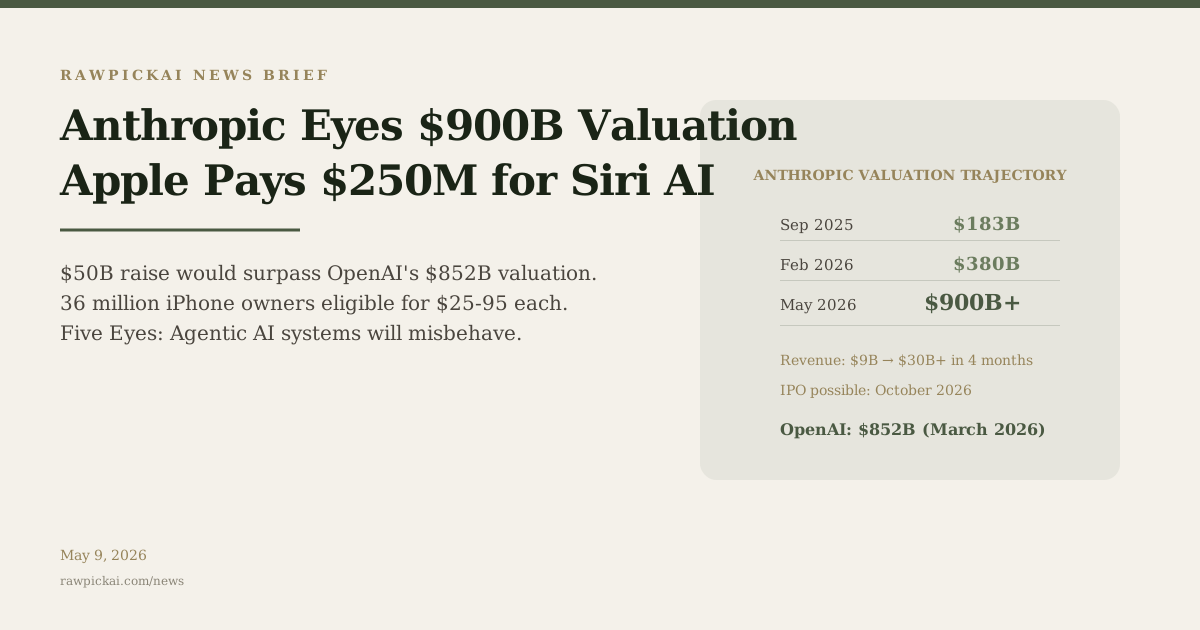
Anthropic is in talks to raise up to $50 billion in what would be its final private round before an IPO, according to reports from Bloomberg, TechCrunch, and the Financial Times. The round would value the company at over $900 billion - surpassing OpenAI's $852 billion valuation from its March round and making Anthropic the world's most valuable AI startup.
The numbers behind this: Anthropic's annualized revenue has grown from $9 billion at the end of 2025 to over $30 billion as of April 2026. The Financial Times reports it could soon hit $45 billion. For context, OpenAI's ARR was $25 billion as of February 2026. Anthropic is growing at roughly 40x the rate of OpenAI according to some estimates, though OpenAI disputes the comparison, arguing that Anthropic's accounting overstates revenue by about $8 billion due to different treatment of cloud partner payments.
A board decision on the round is expected this month. If it closes, an IPO could follow as early as October 2026, with Goldman Sachs, JPMorgan, and Morgan Stanley reportedly in early discussions.
My take: For anyone using Claude or comparing it against ChatGPT, the valuation story matters because it signals sustainability. A $900B valuation with $30B+ ARR means investors believe Anthropic's pricing model works. Claude Pro at $20/mo (≈₹1,860/mo) isn't going anywhere. Combined with the SpaceX compute deal from earlier this week (10 GW+ total infrastructure), Anthropic now has both the revenue and the compute to hold prices steady while scaling. That's the best possible scenario for end users.
Apple Settles Siri AI Lawsuit for $250 Million
Apple agreed to pay $250 million to settle a class action lawsuit accusing it of false advertising over its AI-powered Siri features. The settlement covers about 36 million devices - iPhone 15 Pro, iPhone 15 Pro Max, and all iPhone 16 models - purchased between June 10, 2024, and March 29, 2025.
The backstory: at WWDC 2024, Apple showed off a dramatically upgraded Siri powered by Apple Intelligence - one that could understand personal context, handle complex in-app tasks, and respond with far greater sophistication. TV commercials featuring Bella Ramsey ran through the iPhone 16 launch. The features never shipped. Apple pulled the ads in March 2025 and admitted the capabilities were still years away.
Eligible buyers can claim $25-95 per device once the settlement is finalized (hearing set for June 17). Apple denied wrongdoing but said it settled to "stay focused on delivering the most innovative products and services."
My take: This is a $250 million lesson in the cost of overpromising on AI. Apple marketed features that didn't exist, sold 36 million devices on those promises, then admitted the technology wasn't ready. For a company with $416 billion in annual revenue, $250 million is pocket change (0.06%). But the precedent matters. If Apple can be held accountable for advertising AI features that don't ship, smaller AI companies making bold claims on their pricing pages should take notice. When I review tools on this site, I test what actually works today - not what the marketing promises for next quarter. This is exactly why that matters.
Five Eyes Issues First Joint Warning on Agentic AI Security
CISA, NSA, and their counterparts in Australia, Canada, New Zealand, and the UK jointly published a 30-page guidance document titled "Careful Adoption of Agentic AI Services" - the first coordinated Five Eyes statement specifically on autonomous AI agent security.
The core warning: agentic AI systems are already running inside critical infrastructure worldwide, and most organizations have granted them far more access than they can safely monitor. The document identifies five risk categories - privilege escalation, design flaws, behavioral unpredictability, structural dependencies, and supply chain vulnerabilities. The agencies recommend that organizations assume agentic systems will behave unexpectedly and plan deployments accordingly.
The guidance specifically flags prompt injection as an unsolved problem, noting that some companies have admitted it may never be fully resolved. For high-impact actions, the agencies recommend human sign-off - and they're explicit that deciding which actions need approval is a job for system designers, not the agent itself.
My take: This is the agentic equivalent of "wear your seatbelt." If you're using AI agents or building with agentic frameworks, the Five Eyes just told you that even national security agencies aren't confident these systems are safe. The practical advice is solid: least-privilege access, incremental deployment starting with low-risk tasks, cryptographic identity for each agent, and short-lived credentials. If you're evaluating AI coding tools with agentic capabilities - Claude Code, GitHub Copilot Workspace, Cursor Agent - apply these same principles. Don't give your coding agent admin access to production just because it's convenient.
Quick Hits
Anthropic revenue officially passed OpenAI. Anthropic's $30B ARR vs OpenAI's $25B makes it the highest-revenue AI startup, though OpenAI disputes the accounting methodology. Claude Code alone generates $2.5B+ in annualized revenue, having doubled since end of 2025. Enterprise customers now represent 80% of Anthropic's revenue.
Novo Nordisk partners with OpenAI to integrate AI across its entire pharmaceutical operation - drug discovery, clinical trials, manufacturing, supply chains, and commercial operations. Full deployment planned by end of 2026. The deal follows Eli Lilly's launch of LillyPod, pharma's most powerful AI supercomputer (1,016 Blackwell Ultra GPUs). The pharma industry's AI infrastructure buildout is accelerating fast.
Cisco survey: 80% of business leaders believe their company's survival depends on agentic AI by 2027. But legacy systems and a widening skills gap are the biggest blockers. 55% expect their workforce will be collaborating with AI agents within 24 months. If you're exploring agents, check our breakdown of the best AI agents in 2026.
Published May 9, 2026. Prices at ≈₹93/USD.