Google I/O 2026 Preview: Everything Expected Monday, Plus the Data Center Backlash Grows
Full Google I/O preview: Gemini 4.0, Omni video model, Android XR glasses, Aluminium OS. Meanwhile, anti-data-center resistance is spreading across the US.
 ByAsh·4 min read
Two days from now, Google holds its biggest annual event. The leaks have been extraordinary this year - Gemini Omni, Gemini 3.2, new model tiers, XR glasses, a Chrome OS replacement. Here's everything I expect from the keynote, based on confirmed announcements and credible leaks. Plus: the growing anti-data-center movement that nobody in AI is talking about but everyone should be.
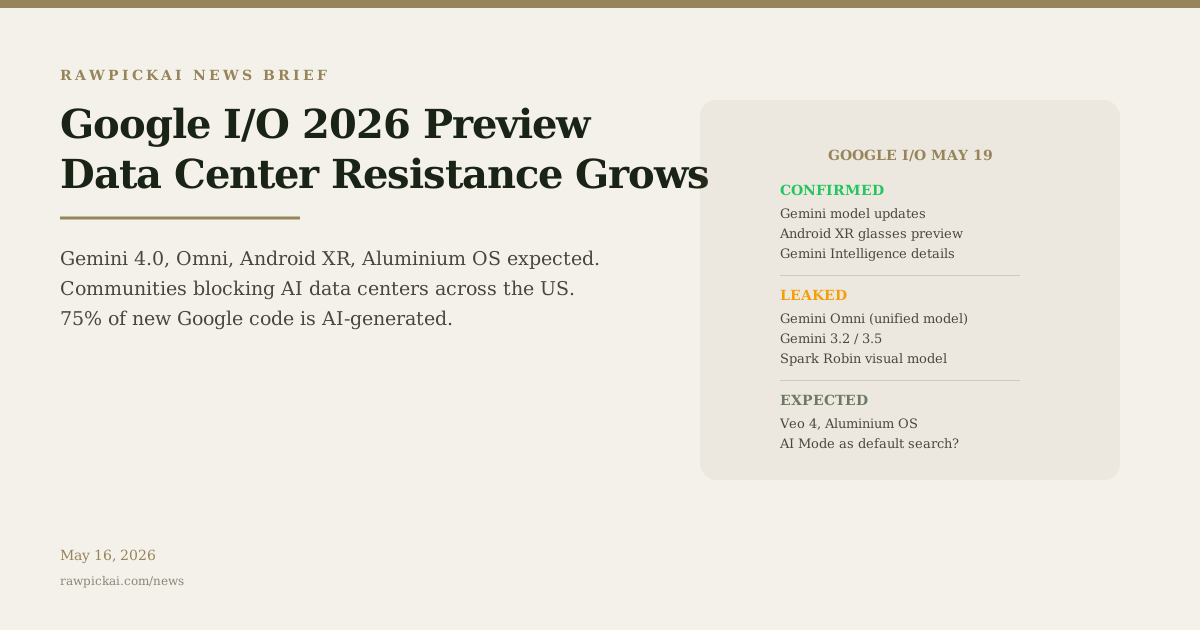
Everything Expected at Google I/O 2026 (May 19)
I've tracked every leak, pre-announcement, and credible rumor from the past two weeks. Here's the full picture of what's coming Monday at 10 AM PT:
Confirmed by Google:
- Gemini model updates (new capabilities, likely a major version bump)
- Android XR glasses preview (camera, speakers, microphones - no display yet)
- Gemini Intelligence details (agentic features for Android, previewed at the Android Show May 12)
- Googlebooks launch timeline (Android-powered laptops from Acer, ASUS, Lenovo)
Leaked with strong evidence:
- Gemini Omni - unified text, image, and video model. Users already have early access. Would be the first top-tier omni-modal model.
- Gemini 3.2 and/or Gemini 3.5 - leaked via UI strings and developer references. May coincide with Omni launch.
- Gemini 3.1 Pro - identified by users in Gemini Live, with different behavior than the current Flash Live model. The infrastructure to switch between models is already built.
- Spark Robin - a visual model codename, possibly a companion image generation system.
Expected but unconfirmed:
- Veo 4 (next-gen video generation)
- Aluminium OS (Chrome OS replacement, desktop Android with virtual desktops and app dock)
- AI Mode becoming the default search experience (would be devastating for publishers)
- Nano Banana, Gemma, and Lyria updates
My take: If even half of the leaks are accurate, this will be the most significant Google I/O since the original Gemini launch. For tool comparison, the key question is whether Gemini Omni matches or exceeds ChatGPT on text AND adds competitive image and video generation on top. If yes, the $20/mo AI Pro subscription (≈₹1,860/mo) becomes the best value in AI by a wide margin. I'll publish a full breakdown Monday evening with scores and pricing analysis. Follow the news section for real-time coverage.
The AI Data Center Resistance Nobody Is Talking About
While AI companies race to build infrastructure, a grassroots movement is pushing back hard - and winning. Across the US, communities are blocking data center construction through local ordinances, lawsuits, and ballot measures. The AI industry has responded by putting $400 million into elections in 2026, according to Senator Bernie Sanders.
The opposition isn't coming from the expected places. These aren't environmental activists or tech skeptics. It's farmers, small-town residents, and local business owners who are saying no to projects that consume massive amounts of water and electricity while creating 30-50 jobs (mostly low-wage security and sanitation). Some companies are now proposing robot dogs for security - meaning even those jobs could be automated.
The scale of the problem: AI data center power capacity hit 29.6 GW globally in 2025, enough to power New York state at peak demand. Annual GPT-4o inference water usage alone may exceed the drinking water needs of 1.2 million people. The Stanford AI Index reported these numbers last week, and they're only growing.
This resistance is why companies like Google and SpaceX are exploring orbital data centers - not because space is cheaper (it isn't), but because there's nobody in orbit to object to the environmental impact.
My take: This story matters for AI tool pricing in a way most people don't realize. If communities successfully block enough data center construction, the compute supply tightens, and AI companies face a choice: raise prices or throttle capacity. The current $20/mo pricing for Claude, ChatGPT, and Gemini depends on continuous infrastructure expansion. If that expansion slows, the "unlimited AI for $20" era has an expiration date. This is the hidden risk nobody puts in their AI tool reviews. I do - because it matters for the value-for-money calculation.
Quick Hits
Cannes 2026 opens with two AI-assisted films screening outside competition. The festival is still wrestling with where to draw the line - no AI-generated film has competed for the Palme d'Or, but the boundary between "AI-assisted" and "AI-generated" is blurring fast.
Google says 75% of new code is now AI-generated and approved by engineers. Last fall it was 50%. A complex code migration was completed 6x faster with AI agents. If the company building Gemini is writing three-quarters of its code with AI, the question for developers isn't whether to adopt AI coding tools - it's which one.
Mercor data breach: 4TB of voice samples stolen from approximately 40,000 AI contractors. The breach highlights the growing security risks in the AI training data supply chain. If you're contributing voice or text data to AI training programs, your data may be less secure than you think.
Published May 16, 2026. Prices at ≈₹93/USD.