Trump-Xi Summit Ends With No AI Chip Deal, Gemini Omni Leaks Three Days Before Google I/O
Beijing blocks Nvidia H200 purchases despite US approval. Trump discussed AI guardrails with Xi. Gemini Omni leak points to unified text-image-video model.
 ByAsh·5 min read
The Trump-Xi summit just wrapped in Beijing and the AI chip stalemate is worse than expected. Meanwhile, Google's next-generation AI model has been leaking all week, and it looks like the biggest upgrade since Gemini launched. Two stories that will shape AI pricing, availability, and competition for the rest of 2026.
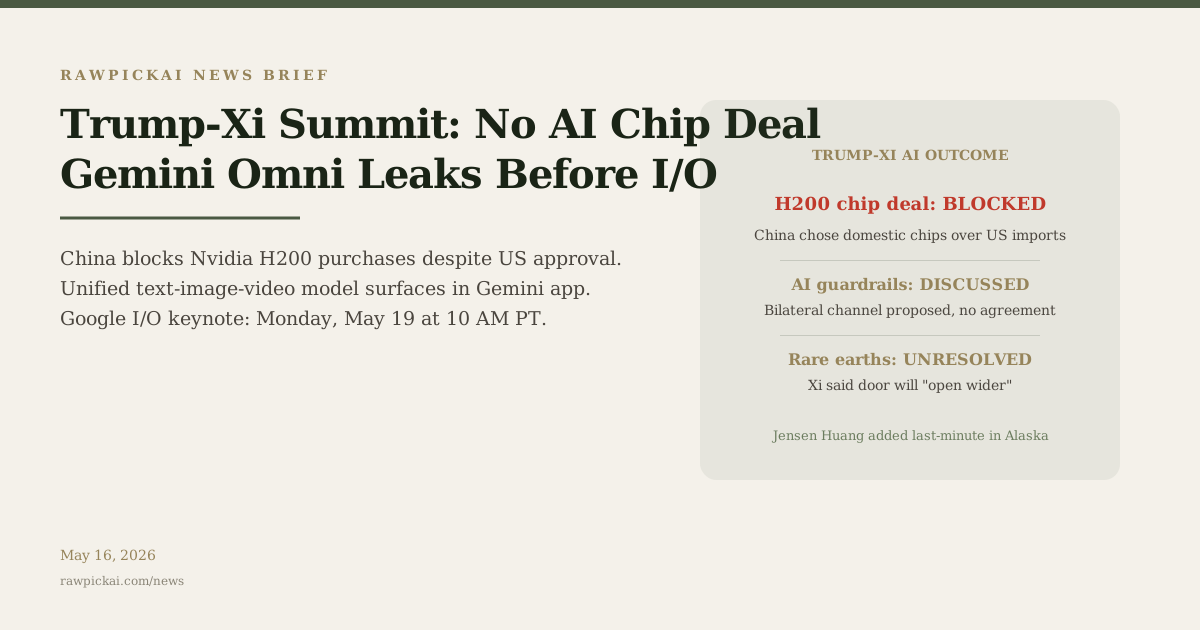
Trump-Xi Summit: No AI Chip Deal, China Blocks H200 Purchases
President Trump concluded a two-day summit with Chinese President Xi Jinping in Beijing on May 15. The headline takeaway for AI: nothing was resolved. In fact, it got more complicated.
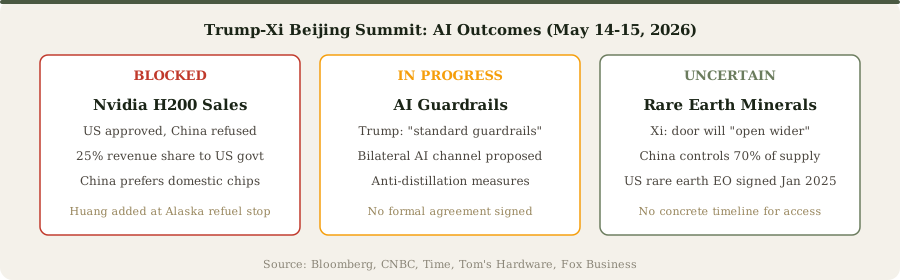
Trump told reporters aboard Air Force One that China "chose not to" approve purchases of Nvidia's H200 AI chips because "they want to develop their own." This is remarkable because the US had already cleared the sales - Washington approved Nvidia H200 exports to several major Chinese tech firms just days before the summit. China rejected the offer.
The backstory matters for pricing. Trump reversed Biden-era export controls in December 2025, structuring H200 sales as a revenue-sharing deal where Nvidia pays 25% of Chinese sales revenue to the US government. Nvidia CEO Jensen Huang wasn't even on the original delegation list - he was added at the last minute during a refueling stop in Alaska, boarding Air Force One in hopes of closing the deal.
Trump said he discussed "standard guardrails" on AI with Xi, and the White House is now exploring a dedicated bilateral channel for regular AI discussions between the two countries. But no concrete agreements were reached on chip exports, rare earth minerals, or AI governance.
My take: China blocking its own companies from buying H200s is the most counterintuitive development this week - but it makes strategic sense. If Chinese firms buy American chips, they become dependent on a supply chain that the US can shut off at any time (as Biden did in April 2025). China is betting that investing in domestic chip development (Huawei's Ascend 920, SMIC's N+2 process) is worth the short-term performance gap. For AI tool users, this means the US-China compute split deepens. Tools built on Chinese models (DeepSeek, Qwen, GLM) will run on Chinese chips. Tools from OpenAI, Anthropic, and Google will run on Nvidia and TPU hardware. Pricing for US-based tools at $20/mo (≈₹1,860/mo) shouldn't be affected - Nvidia has plenty of demand domestically. But the open-source model competition from China, which has been pushing prices down, may slow if Chinese labs can't access the latest hardware.
Gemini Omni Leak: Google's Unified Text-Image-Video Model Surfaces Three Days Before I/O
Google I/O opens Monday (May 19), and the leaks have been relentless. The biggest one: "Gemini Omni" - a unified model that handles text, image, and video generation in a single pipeline. If real, this is the first top-tier AI model to combine all three modalities under one system.
The evidence started May 2 when a user spotted "Powered by Omni" in Gemini's video generation tab, right next to "Toucan" - Google's internal codename for Veo 3.1. Since then, a Reddit user gained early access to Omni and posted demo videos. The results: a math-chalkboard test showed accurate reasoning and lifelike rendering, though a dinner-scene prompt was less convincing with objects appearing from nowhere. The model currently generates 10-second clips and reportedly burns through most of a daily AI Pro quota in two generations.
The leaks don't stop at Omni. References to Gemini 3.2, Gemini 3.5, and a visual model codenamed "Spark Robin" have all surfaced this week. Gemini 3.1 Flash-Lite already launched quietly on May 8. The volume of leaks suggests Google is rolling out a full platform refresh, not just a single model update.
My take: If Gemini Omni delivers on the unified model promise, it changes the competitive math entirely. Right now, you need ChatGPT or DALL-E for images, Runway or Pika for video, and a text model separately. Omni would let you do all three in one interface at one subscription price. The $20/mo Gemini AI Pro plan (≈₹1,860/mo) already includes Veo 3.1 for video - adding a unified model would make it the best value in AI if the quality holds up. I'll have a full breakdown after the I/O keynote on Monday. If you're comparing AI video generators, wait until after May 19 before making any decisions.
Quick Hits
Google I/O keynote is Monday, May 19 at 10 AM PT. Confirmed on the agenda: Gemini model updates, Android 17 features, Aluminium OS (Chrome OS replacement), Android XR glasses preview, and possibly Veo 4. We'll cover it in full.
75% of all new code at Google is now AI-generated. Up from 50% last fall. Google's engineers now orchestrate "fully autonomous digital task forces" of AI agents. A complex code migration that would have taken weeks was completed 6x faster with agents. This validates the AI coding tools category - if Google is going all-in on AI-assisted development, so should you.
White House anti-distillation measures. The administration unveiled measures targeting "distillation attacks" - when Chinese AI developers extract outputs from US frontier models (OpenAI, Anthropic, Google) to train competing systems at lower cost. This could affect how open-source models are released going forward.
Published May 16, 2026. Prices at ≈₹93/USD.