Pope Leo XIV Releases AI Encyclical with Anthropic, $900B Valuation Confirmed
The Vatican's first AI encyclical presented alongside Anthropic's Chris Olah. Anthropic closing $30B round at $900B+, surpassing OpenAI's valuation.
 ByAsh·4 min read
Pope Leo XIV presented his first encyclical today, titled Magnifica Humanitas ("Magnificent Humanity"), focused on "the protection of the human person in the age of artificial intelligence." He presented it alongside Christopher Olah, co-founder of Anthropic. On the same day, Bloomberg reported that Anthropic is closing a $30 billion funding round at a $900 billion-plus valuation, surpassing OpenAI's $852 billion for the first time.
These two stories are connected. The Vatican choosing Anthropic as its partner for the most significant religious document on AI is a direct endorsement of safety-first development. And the market is now pricing that positioning as more valuable than OpenAI's approach.
The encyclical: AI as this era's Industrial Revolution
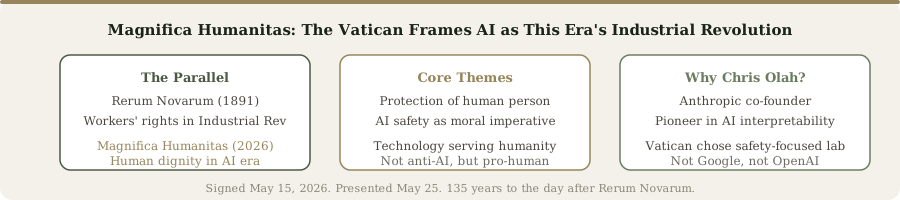
The timing is loaded with symbolism. Pope Leo XIV signed Magnifica Humanitas on May 15, exactly 135 years to the day after Pope Leo XIII signed Rerum Novarum, the foundational Catholic social teaching document that addressed workers' rights during the Industrial Revolution. The parallel is explicit: Leo XIV is framing AI as the defining transformation of our era, requiring the same moral framework that guided the Church's response to industrialization.
The document centers on human dignity in the age of AI. Early reports describe it as "not anti-AI, but pro-human," calling for technology to serve human flourishing rather than replace human agency. The choice to co-present with Christopher Olah, who pioneered AI interpretability research (the science of understanding what's happening inside neural networks), sends a specific message: the Church trusts researchers who are trying to understand AI, not just build it faster.
Why Anthropic and not Google or OpenAI? Anthropic has consistently positioned itself as the safety-focused lab. Claude's Constitutional AI approach, where the model is trained to follow ethical principles, aligns more naturally with the Vatican's emphasis on human dignity than the "move fast and scale" approaches of competitors. The Gates Foundation partnership ($200 million for health and education) and Karpathy hire (using Claude to improve Claude) all fit the same narrative: Anthropic is the responsible choice.
Anthropic hits $900B+, surpasses OpenAI
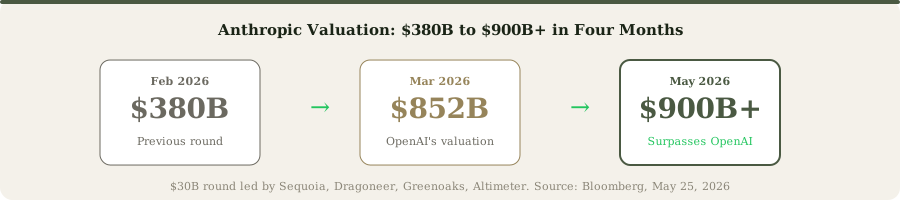
Bloomberg reports Anthropic is closing a $30 billion round co-led by Sequoia, Dragoneer, Greenoaks, and Altimeter. If the term sheet lands at the upper end, Anthropic's valuation will surpass OpenAI's $852 billion March round for the first time.
The speed of this reversal is remarkable. In February 2026, Anthropic was valued at $380 billion. Four months later, it's at $900 billion-plus. What changed: Claude Code crossed $2.5 billion in annualized revenue, total Q2 revenue is projected at $10.9 billion, and Anthropic posted its first-ever operating profit ($559 million).
Investors aren't pricing in hope. They're pricing in a trajectory: $900 million in 2024, $4.8 billion in Q1 2026, $10.9 billion in Q2 2026. If that curve holds, Anthropic could reach $50 billion in annual revenue within 18 months.
For AI tool users, the valuation race matters because it determines which company has more resources to invest in model improvements, infrastructure, and pricing. Anthropic surpassing OpenAI's valuation means more compute, more researchers (like Karpathy), and potentially more competitive pricing for Claude products.
Quick hits

OpenAI was named a leader in the 2026 Gartner Magic Quadrant for Enterprise AI Coding Agents. Codex was specifically recognized for enterprise-scale deployment. Virgin Atlantic used Codex to revamp and ship its mobile app by a fixed deadline with near-total test coverage and zero P1 defects.
Notable absence: neither Cursor nor Claude Code appeared in the Gartner quadrant. Gartner evaluates enterprise readiness (compliance, support, scalability), not raw coding quality. This is a reminder that the tools developers love and the tools enterprises buy aren't always the same. Our best AI coding tools list evaluates from a developer perspective, which tells a different story.
AdventHealth is using ChatGPT for Healthcare to reduce administrative burden on clinical staff. The healthcare AI space is growing fast, but specific pricing and availability remain limited to enterprise agreements.
My take

The Vatican choosing Anthropic over Google and OpenAI to co-present the first papal AI encyclical tells you everything about how safety-first positioning is paying off. This isn't just brand perception. It's institutional trust at the highest level.
The $900 billion valuation surpassing OpenAI isn't just a number. It's the market saying: the company that prioritizes safety, transparency, and responsible development is also winning commercially. Claude's 90/100 on our Transparency Index isn't unrelated to this. The same principles that make a tool trustworthy to users make a company trustworthy to investors and institutions.
For AI tool users choosing between Claude and ChatGPT today: both companies are well-funded and will continue improving. The encyclical and valuation news don't change which tool is better for your specific tasks. But if you care about which company's values align with responsible development, this week made the distinction very clear.
Sources: BuildFastWithAI, Bloomberg, OpenAI Blog, UITG AI Daily
Related: Claude Review · ChatGPT Review · Claude Code Review · Transparency Index · 2026 AI Tools Reality Check · Anthropic $10.9B Revenue · Karpathy Joins Anthropic · Gates Foundation Partnership