Anthropic $30B Round Closes at $900B+, SpaceX IPO Set for June 12
Anthropic's $30B round closed at $900B+ valuation this week. SpaceX IPO targets June 12. Study: AI now outperforms average humans on creativity tests.
 ByAsh·5 min read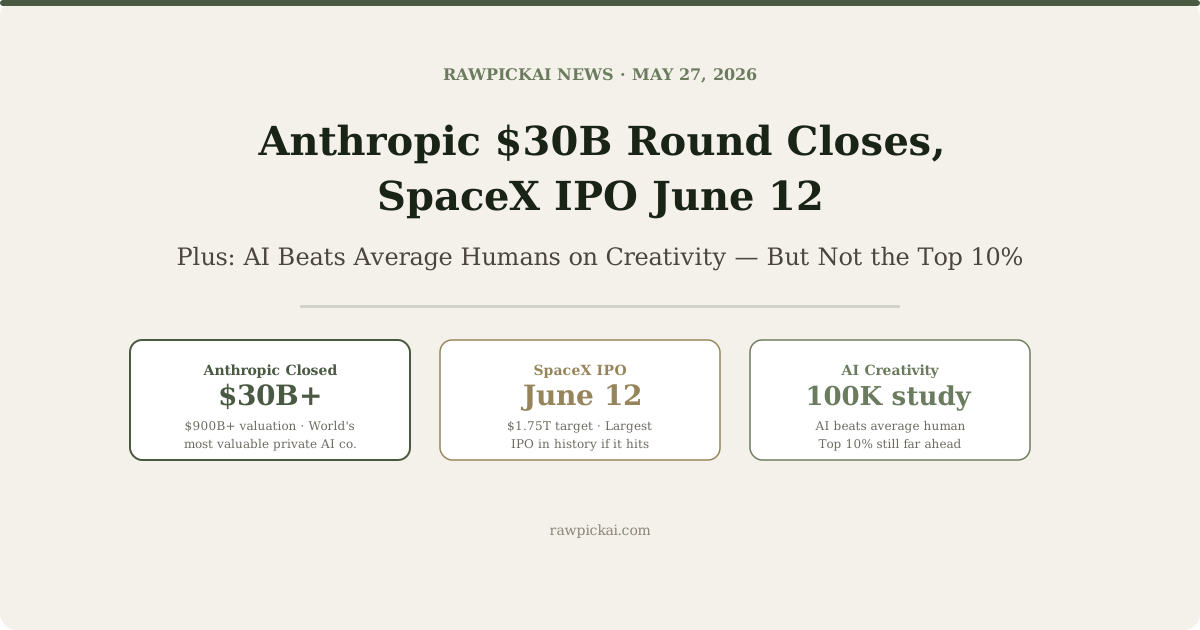
Two major financial events confirmed today. Anthropic's $30 billion-plus funding round officially closed during the week of May 26, making it the world's most valuable private AI company at over $900 billion, surpassing OpenAI's $852 billion March valuation. Separately, SpaceX confirmed its IPO timeline: roadshow begins June 4, pricing on June 11, and Nasdaq trading opens under the ticker SPCX on June 12. If it hits its $1.75 trillion target, it will be the largest IPO in capital markets history.
Anthropic closes the round
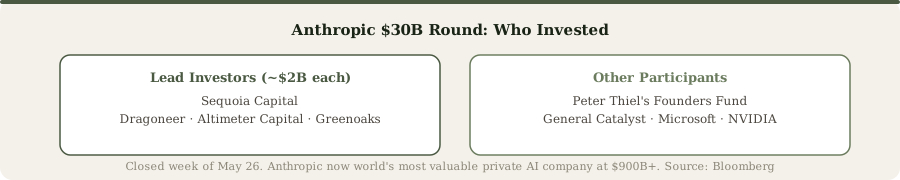
The $30 billion round was co-led by Sequoia Capital, Dragoneer Investment Group, Altimeter Capital, and Greenoaks Capital Partners, each contributing approximately $2 billion. Additional participants include Peter Thiel's Founders Fund, General Catalyst, Microsoft, and NVIDIA.
This is the fastest valuation acceleration in AI history. In February 2026, Anthropic was valued at $380 billion. By March, OpenAI's raise pushed its valuation to $852 billion. Now, three months later, Anthropic has closed above that at $900 billion-plus. The reversal from being the smaller company to the more valuable one happened in under four months.
For Claude users, the closed round has immediate implications. Anthropic now has the capital to expand compute infrastructure, hire aggressively (the Karpathy pre-training team is just the start), and sustain the $1.25 billion-per-month SpaceX Colossus compute payments through 2029. The risk flagged in earlier earnings projections, that scheduled compute costs could erase operating profits, is now backed by $30 billion in fresh capital.
The question for users is whether Anthropic uses this capital to hold pricing steady or eventually raises it post-IPO. The answer probably depends on how the October IPO roadshow goes. Microsoft and NVIDIA participating as investors also signals deeper infrastructure partnerships ahead, which could affect Claude Code pricing and availability.
SpaceX IPO: June 12 on Nasdaq

SpaceX's IPO timeline is now concrete. The investor roadshow starts June 4, pricing is scheduled June 11, and trading begins June 12 on Nasdaq under SPCX. Goldman Sachs is lead bookrunner alongside Morgan Stanley, Bank of America, Citigroup, and JPMorgan Chase, with 21 banks in total underwriting the offering.
In an unusual move, 30% of the float is being routed directly to retail investors through Robinhood, Fidelity, and Charles Schwab. This is meaningful for Indian investors with US brokerage accounts who want exposure to the AI infrastructure buildout without buying Anthropic or OpenAI directly (which remain private until October and September respectively).
The SpaceX connection to AI tools runs deep. Anthropic pays SpaceX $1.25 billion per month for GPU compute access on Colossus 2 through 2029. Cursor's Composer 2.5 partnership with SpaceXAI to train a larger model from scratch is also active. SpaceX isn't just a rocket company anymore. It's become core infrastructure for frontier AI development.
The $75 billion target raise, if achieved, would surpass Saudi Aramco's 2019 record of $35.4 billion as the largest IPO in capital markets history.
AI beats average humans on creativity: the study resurfacing today
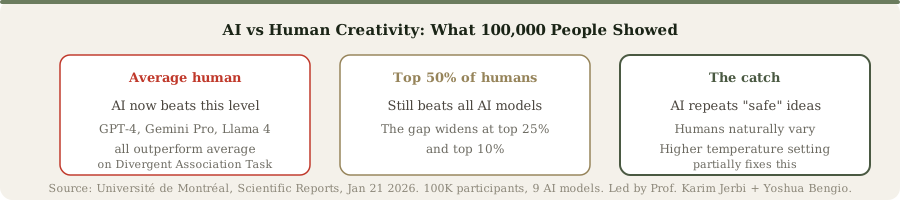
A study published in Scientific Reports in January 2026 is resurfacing in today's AI coverage. The research, led by Professor Karim Jerbi at the Université de Montréal with Yoshua Bengio (deep learning pioneer), tested nine AI models against 100,000 human participants on the Divergent Association Task, a standardized measure of creative thinking.
Generative AI systems have now reached a level where they can outperform the average human on certain creativity measures. At the same time, the most creative people still show a clear and consistent advantage over even the strongest AI models.
Specifically: GPT-4, Gemini Pro 1.5, Llama 3, and Llama 4 all outperformed the average human participant. But the top 50% of humans beat all AI models, and the gap widened significantly at the top 25% and top 10%. The study focused on linguistic creativity (generating semantically distant words), not visual or musical creativity.
The important nuance: AI tends to repeat the same "safe" ideas, while people naturally vary their responses. Raising an AI's randomness setting reduces this repetition and boosts scores. This is the fundamental limitation that the benchmark numbers don't capture. AI clusters around reliably decent output. Humans span a much wider range, from terrible to transcendent.
For users of Claude, ChatGPT, and Gemini for creative work: these tools now outperform average human output on structured tasks. That's the practical threshold that matters for daily work. The question isn't whether AI is more creative than humans in the abstract. It's whether AI is good enough for your specific creative task. For most routine creative work, the answer is increasingly yes.
Quick hits
China is widening travel restrictions on AI researchers at companies including Alibaba and DeepSeek, according to Bloomberg. Researchers involved in advanced AI work are facing overseas travel limitations. This is a significant escalation in talent control and suggests Beijing is treating frontier AI capabilities as a strategic asset subject to the same controls as defense technology.
The Gemini API had a breaking change go live yesterday affecting how developers handle multimodal inputs. Developers using the Gemini API directly should check the changelog. The breaking change doesn't affect Gemini app users.
My take

The creativity study finding is less about "AI vs humans" and more about what happens to the middle. AI doesn't replace the top 10% of creative workers. It replaces average output. For AI tool users, this means: if you're using AI to produce average work, you're now competing with a free tool that does the same thing. The value of human creativity in the AI era isn't being slightly better than AI. It's being in the top 10% that AI still can't reach.
The Anthropic round closing and SpaceX IPO timing this week confirms the pattern: the AI infrastructure buildout is accelerating, not slowing. The companies that win are the ones building at the infrastructure layer, compute, model training, and developer tools, not at the application layer. For AI tool users choosing where to spend $20-100/mo (≈₹1,860-9,300/mo), the application layer is still where the value is. But the companies providing that value are now backed by $30 billion and counting.
Sources: BuildFastWithAI May 27, ScienceDaily / Université de Montréal, StudyFinds, Bloomberg
Related: Claude Review · ChatGPT Review · Gemini Review · Claude Code Review · Anthropic $10.9B Revenue · Pope Encyclical + $900B Valuation · Meta Surveillance News