Google Slashes AI Ultra to $100/mo, White House Drafts AI Model Access EO
Google restructures AI subscriptions with a new $100/mo Ultra tier including Gemini Spark agent. White House drafts voluntary AI model access framework.
 ByAsh·5 min read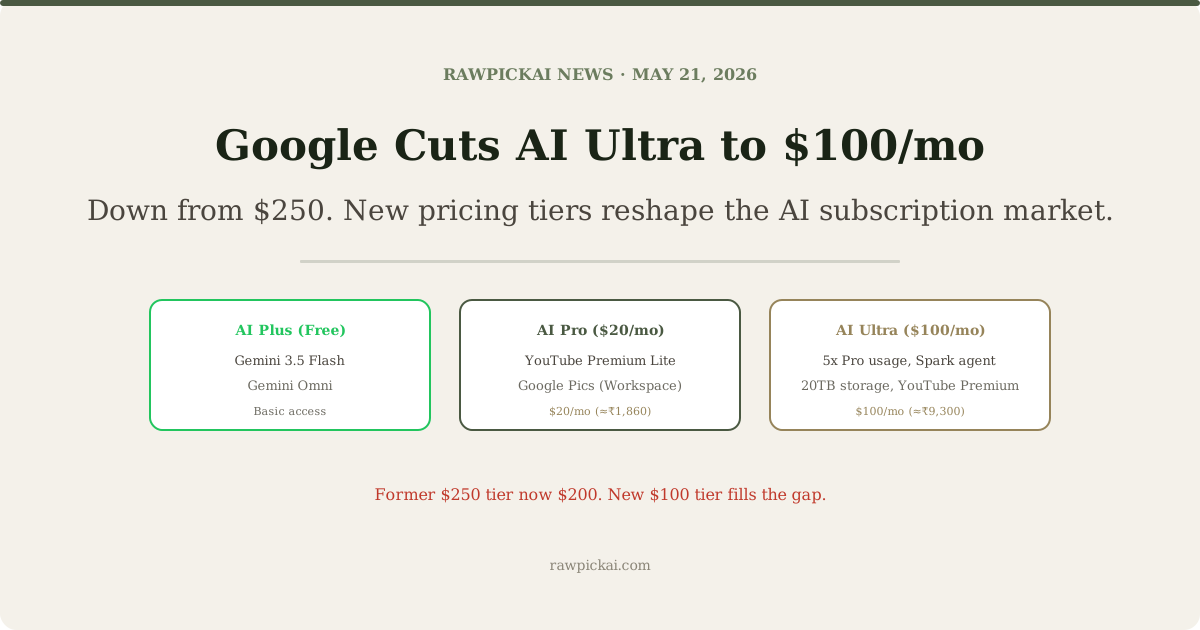
Google just made its biggest pricing move of 2026. Coming out of I/O, the company restructured its entire AI subscription lineup, introducing a new $100/mo (≈₹9,300/mo) AI Ultra tier and cutting its former top plan from $250 to $200/mo (≈₹18,600/mo). Meanwhile, Axios reports the White House is drafting an executive order that would create a voluntary framework for AI companies to give government agencies early access to models before public release.
The pricing restructure, explained
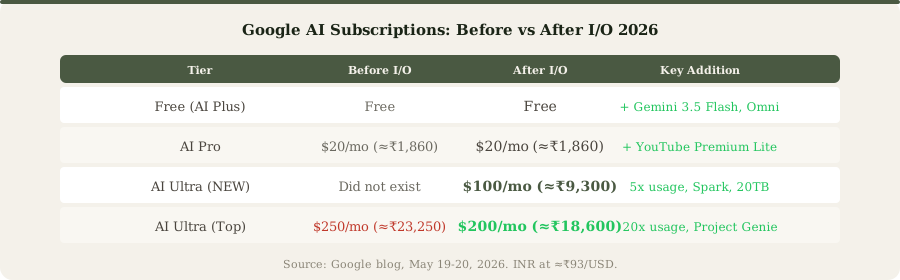
Google's AI subscription lineup now has four tiers:
AI Plus (Free): The base tier now includes access to Gemini 3.5 Flash and Gemini Omni. This is a meaningful upgrade from what the free tier offered a month ago. For casual users who only need occasional AI help, this eliminates the need to pay at all.
AI Pro ($20/mo, ≈₹1,860/mo): Unchanged in price, but now bundles YouTube Premium Lite and upcoming Google Pics in Workspace. The $20/mo price point remains the industry standard, matching ChatGPT Plus and Claude Pro.
AI Ultra ($100/mo, ≈₹9,300/mo): The new tier. It includes 5x the usage limits of Pro in the Gemini app and Google Antigravity (their coding platform), 20TB cloud storage, full YouTube Premium, and beta access to Gemini Spark. This tier targets developers, technical leads, and power users who were stuck between the $20 Pro plan and the $250 Ultra plan that most couldn't justify.
AI Ultra ($200/mo, ≈₹18,600/mo): The former $250 tier, now $200. Same capabilities: 20x usage limits over Pro, Project Genie access (globally), and everything in the $100 tier. The price cut is a direct response to competitive pressure from Claude Max at the same price point.
The shift to compute-based usage limits is also significant. Instead of daily prompt caps, Google is moving to a system where you use compute credits and can buy more when you run out. This is more transparent than arbitrary "you've used too many messages today" limits.
How Google stacks up now
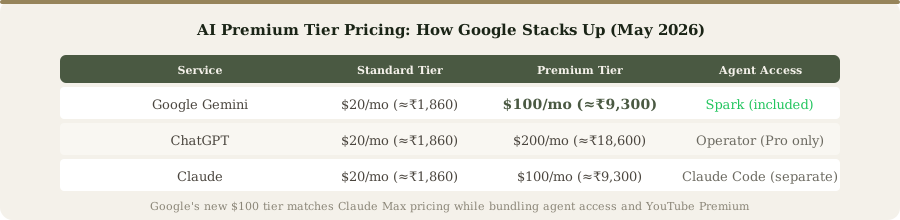
The $100 AI Ultra tier is strategically positioned. At the same price as Claude Max ($100/mo), it bundles agent access (Gemini Spark), YouTube Premium, and 20TB storage. ChatGPT's comparable agent access (Operator) requires the $200/mo Pro tier.
For developers specifically, the $100 tier's 5x usage limits and Google Antigravity access make it competitive with Cursor Pro ($20/mo, ≈₹1,860/mo) plus a separate Claude or ChatGPT subscription. Google is betting that consolidation, one subscription for AI plus coding plus storage plus entertainment, beats the current approach of juggling three or four subscriptions.
The free tier upgrade matters for our Transparency Index rankings too. With Gemini 3.5 Flash and Omni now free, Google's free tier score should increase.
Gemini Spark: the agent is live
Gemini Spark rolls out as a beta to US AI Ultra subscribers this week. What makes it different from regular Gemini: it runs on Google Cloud virtual machines 24/7, even when your device is off. It can send emails, add calendar events, track prices, and coordinate across Google Workspace apps autonomously.
Google built a notification layer called Android Halo that shows Spark's progress in the status bar. For high-stakes actions (sending an email, making a purchase), Spark asks for approval first.
This is Google's most direct challenge to ChatGPT's Operator and the growing agent ecosystem. The structural advantage: Spark can access Gmail, Calendar, Drive, Maps, YouTube, and Search natively. No API integrations needed, no third-party permissions to manage.
White House drafts AI model access EO

Separately, Axios reports that a draft White House executive order would create a "voluntary framework" for AI companies to provide government agencies with early access to models before public release. Microsoft and xAI have reportedly already agreed to participate.
The word "voluntary" is doing heavy lifting here. If participation is truly optional, companies with the most to lose from government scrutiny (those with the most capable models) have the least incentive to participate. Companies that do participate get a reputational boost but also risk slower release cycles.
For AI tool users, the practical impact is limited in the short term. Models would still reach the public, just potentially with a brief delay. The longer-term question is whether "voluntary" becomes "expected" and eventually "required."
My take

Google's $100 AI Ultra tier is the most interesting pricing development since our 2026 AI Tools Reality Check found the $16-30/mo sweet spot. The $20/mo tier remains where most users should start. But for power users who were choosing between multiple $20/mo subscriptions (ChatGPT Plus + Claude Pro + Cursor Pro = $60/mo), Google's pitch is compelling: $100/mo for everything, including an agent that works while you sleep.
The bundling strategy is pure Google: use YouTube Premium and cloud storage as sweeteners to justify a price point that's 5x the standard tier. It worked for Google One, and it'll likely work here.
For Gemini, I'll be updating the review with the new tier breakdown and testing Spark access this week. The free tier upgrade to Gemini 3.5 Flash alone could bump the free tier score significantly.
The White House EO is worth watching but not worth worrying about yet. "Voluntary" frameworks rarely change market dynamics until they become mandatory.
Sources: TechTimes, Dataconomy, Google Blog, Axios
Related: Google Gemini Review · ChatGPT Review · Claude Review · Cursor Review · 2026 AI Tools Reality Check · Transparency Index · Google I/O Gemini 3.5 Flash News · Composer 2.5 News