Google I/O 2026: Gemini 3.5 Flash Beats Pro, OpenAI Ships Content Verification
Gemini 3.5 Flash surpasses 3.1 Pro on coding and agentic benchmarks at Flash pricing. OpenAI launches a public tool to verify AI-generated images.
 ByAsh·5 min read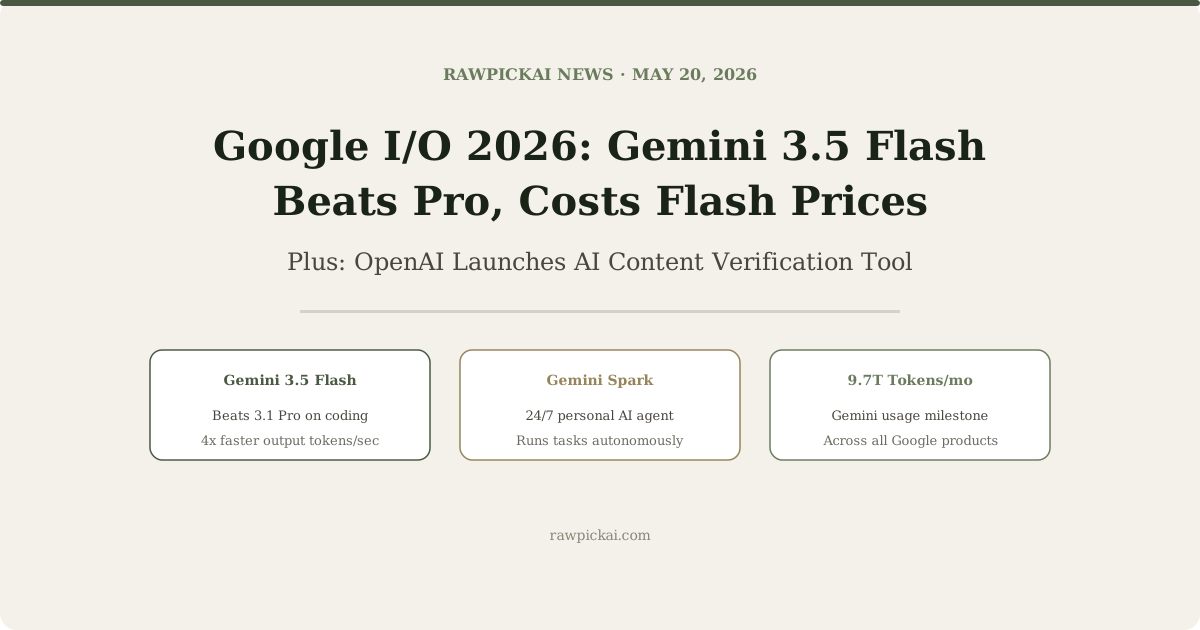
Google I/O 2026's keynote ran yesterday and the message was clear: Gemini is the company now. Sundar Pichai opened by noting Gemini processes 9.7 trillion tokens per month across Google's products. Nearly every announcement tied back to Gemini in some way.
Meanwhile, OpenAI quietly dropped a significant safety feature: a public tool that lets anyone check whether an image was generated by OpenAI's models.
Google I/O: Gemini 3.5 Flash is the headline
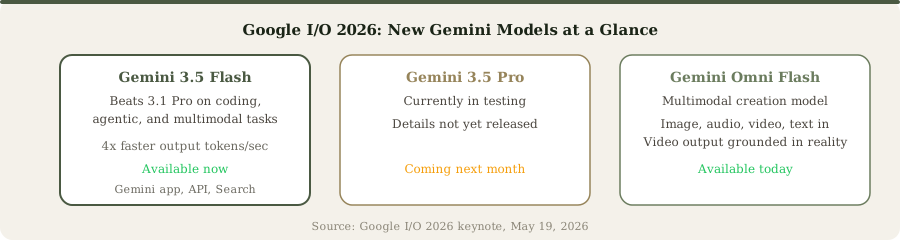
The biggest technical announcement: Gemini 3.5 Flash now surpasses 3.1 Pro on coding, agentic, and multimodal benchmarks while maintaining Flash-tier pricing and running 4x faster in output tokens per second. This matters because Flash models are dramatically cheaper than Pro models in the API. Developers who were paying Pro prices for complex tasks can now get better results at Flash costs.
Gemini 3.5 Flash is rolling out starting today in the Gemini app, Google Search, Antigravity 2.0, and the Gemini API.
Gemini 3.5 Pro is currently in testing and will be available next month. Google didn't share benchmark details yet, which suggests they're still tuning it.
Gemini Omni is a new model series that combines reasoning with creation. Omni Flash accepts image, audio, video, and text input and outputs video grounded in real-world knowledge. This is Google's answer to the multimodal generation space that tools like Runway and Pika currently dominate.
Gemini Spark: Google's agent play
Google unveiled Gemini Spark, which it describes as a "24/7 personal AI agent." Unlike the current Gemini assistant, Spark is designed to run tasks autonomously in the background, coordinate across Google services, and proactively surface information before you ask for it.
This is Google's most direct response to ChatGPT's agent capabilities and OpenAI's push into autonomous task completion. The advantage Google has: deep integration across Gmail, Calendar, Drive, Maps, and Search, giving Spark access to context that standalone agents can't match.
Beyond Gemini: hardware and creative tools
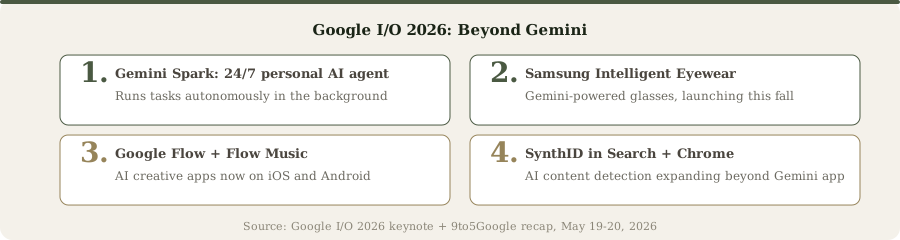
Samsung's "Intelligent Eyewear" glasses launched at the keynote, powered by Gemini. They're coming this fall with hardware partnerships from Samsung, Warby Parker, Gentle Monster, and XREAL. This is Google's second attempt at smart glasses after Google Glass, but with a very different approach: partner with existing eyewear brands rather than building its own hardware.
Google Flow and Flow Music are now available as mobile apps for AI-powered creative work. The Flow app is on Android in beta (iOS coming soon), and Flow Music is on iOS (Android coming soon).
The Gemini app itself got a visual redesign called "Neural Expressive" with fluid animations, haptic feedback, and new typography. Gemini Live no longer opens a fullscreen interface, switching to an inline experience so you don't have to leave what you're doing.
SynthID detection is expanding beyond the Gemini app to Search and Chrome. This means Google will start flagging AI-generated content directly in search results and while browsing.
OpenAI: content verification goes public
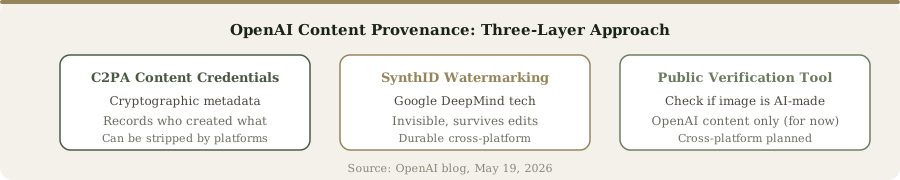
On the same day as Google I/O, OpenAI published a blog post announcing a three-layer approach to content provenance:
C2PA Content Credentials: OpenAI is now a C2PA Conforming Generator, meaning platforms can read, preserve, and pass along provenance information attached to OpenAI-generated content. C2PA uses cryptographic metadata to record who created content and how it was edited. The limitation: this metadata can be stripped during uploads, screenshots, or format changes.
SynthID watermarking: OpenAI is adopting Google DeepMind's SynthID technology for images, starting with DALL-E, ImageGen, and Sora. SynthID embeds invisible watermarks that survive common edits like cropping, resizing, and format conversion. This is notable because it's OpenAI using a Google technology for safety purposes.
Public verification tool: Anyone can now upload an image to check if it was generated by OpenAI's models. At launch, the tool only detects OpenAI-generated content. Cross-platform support (detecting images from other AI generators) is planned for the coming months.
The honest caveat from OpenAI: if no metadata or watermark is detected, the tool won't make a definitive conclusion about whether the image was AI-generated. Provenance signals can be stripped, so absence of evidence isn't evidence of absence.
What this means for AI tool users
For Gemini users: the 3.5 Flash upgrade is available now, and it's a meaningful quality jump at no extra cost. If you've been using Gemini and finding it slightly behind ChatGPT or Claude on complex tasks, test it again.
For developers: Gemini 3.5 Flash beating Pro on benchmarks while costing Flash prices is a significant value shift. This directly affects the cost calculations in tools like Cursor and other AI coding assistants that let you choose your backend model.
For content creators: OpenAI's verification tool is worth bookmarking. As AI-generated images become harder to distinguish from real ones, having a reliable check (even if limited to OpenAI content for now) is useful for anyone publishing or verifying images.
My take

Google I/O 2026 confirmed what the pricing data in our 2026 AI Tools Reality Check already showed: the performance gap between price tiers is collapsing. Gemini 3.5 Flash beating 3.1 Pro is exactly the pattern that makes the $16-30/mo sweet spot work. You no longer need to pay for the most expensive tier to get the best results.
Gemini Spark is the more interesting long-term story. Google's structural advantage in agents is real: no other company has the same depth of integration across email, calendar, search, maps, and documents. If Spark delivers on the "24/7 personal agent" promise, it could change how people think about AI assistants entirely.
OpenAI's provenance work deserves credit for being practical rather than performative. Adopting Google's SynthID (a competitor's tech) for safety purposes, and openly stating the limitations of their verification tool, is the kind of transparency the AI industry needs more of. But it also highlights a gap: we still have no way to verify images from Midjourney, Stable Diffusion, or most other generators. The provenance problem is industry-wide, and single-company solutions only go so far.
For our Gemini review, I'll be testing 3.5 Flash against the current benchmarks this week. If it matches the keynote claims, expect a score update.
Sources: Tom's Guide, 9to5Google, OpenAI Blog
Related: Google Gemini Review · ChatGPT Review · Claude Review · Cursor Review · Runway Review · 2026 AI Tools Reality Check · Transparency Index · Composer 2.5 News