SpaceX Has a $60B Option to Buy Cursor, Your AI Chats Can Now Be Used in Court
SpaceX can acquire Cursor for $60B or pay $10B breakup fee. Federal judge rules AI chats aren't privileged. Microsoft: 17.8% of workers now use AI.
 ByAsh·6 min read
Today's brief covers three stories that affect how you use AI tools daily: a deal that could reshape the AI coding market, a court ruling that changes what you should and shouldn't type into chatbots, and hard data on how many people worldwide are actually using AI right now.
SpaceX Places $60B Buyout Option on Cursor
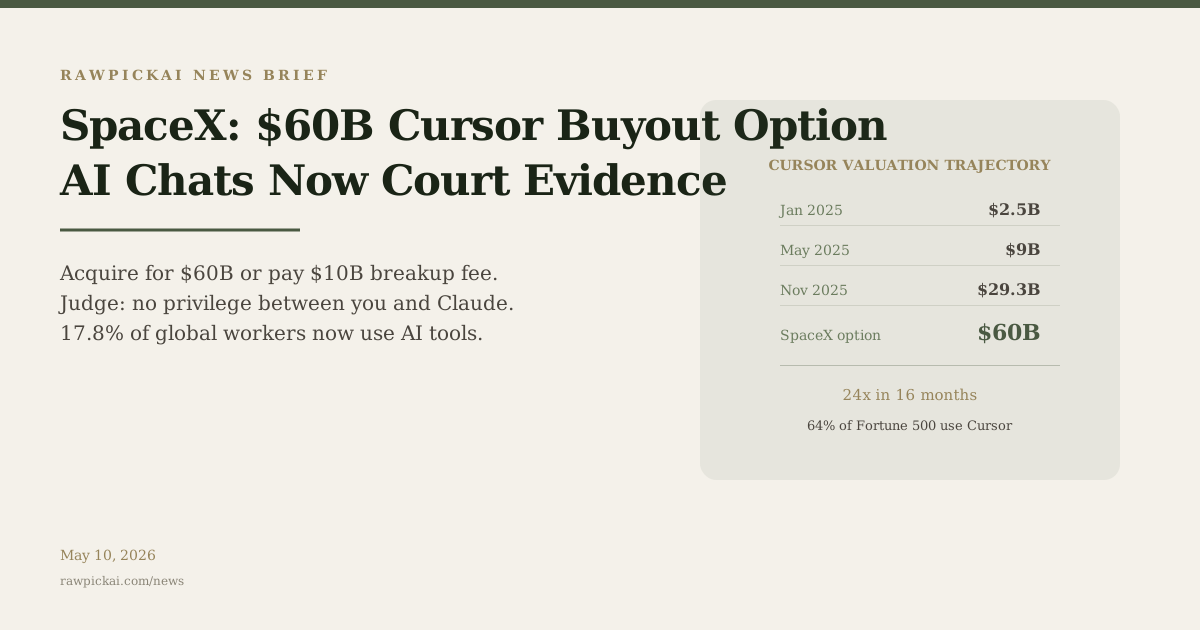
SpaceX announced a deal with Cursor to jointly develop "the world's best coding and knowledge work AI." The deal includes a provision that gives SpaceX the right to acquire Cursor for $60 billion later this year - or pay $10 billion as a collaboration fee if the acquisition doesn't happen.
The timing is telling. Just hours before SpaceX's announcement, Cursor was on track to close a $2 billion funding round at a $50 billion valuation, with Andreessen Horowitz, Thrive, Nvidia, and Battery Ventures lined up. That round would not have been enough to reach cash-flow breakeven, meaning Cursor would have needed to raise again.
Cursor's valuation trajectory is staggering: $2.5 billion in January 2025, $9 billion by May 2025, $29.3 billion in November 2025 (Series D), and now a potential $60 billion exit. SpaceX is delaying the potential acquisition until after its planned summer IPO (targeting $1.75 trillion valuation) to avoid updating confidential financial filings. If it goes through, SpaceX would likely pay in stock.
The competitive context: Cursor is facing growing pressure from Claude Code and OpenAI's Codex. Despite having 64% of Fortune 500 companies as users, Cursor's massive compute needs and the threat from better-funded competitors made staying independent increasingly expensive. SpaceX offers access to its Colossus data centers in Mississippi and Tennessee - the same infrastructure Anthropic just leased for Claude.
My take: This deal reshapes the entire AI coding tools market. If SpaceX acquires Cursor, the top three coding tools would be owned by Anthropic (Claude Code), OpenAI (Codex), and SpaceX/xAI (Cursor). That's a three-company oligopoly in the most lucrative AI product category. For Cursor users today, nothing changes immediately - the team stays intact and gets access to more compute. But long-term, Cursor under Musk's umbrella will have different priorities than independent Cursor. Watch whether Composer (Cursor's AI model) gets merged with xAI's Grok or stays independent. That decision will determine whether Cursor remains the developer-first tool it is today. Current pricing at $20/mo (≈₹1,860/mo) for Pro should hold through 2026 regardless of the acquisition outcome.
Federal Judge: AI Chatbot Conversations Can Be Used as Court Evidence
A federal judge in New York ruled that AI chatbot conversations are not protected by attorney-client privilege and can be subpoenaed as evidence. Manhattan-based U.S. District Judge Jed Rakoff ordered a criminal defendant to produce 31 documents generated using Anthropic's Claude while seeking legal advice. The ruling was clear: no attorney-client relationship "exists or could exist between an AI user and a platform such as Claude."
The immediate fallout has been significant. Major law firms are now explicitly warning clients about AI chatbot use. Kobre & Kim is telling clients to "proceed with caution." Debevoise & Plimpton is advising anyone doing AI legal research at a lawyer's direction to state so in the prompt. Sher Tremonte added language to its March contracts warning that "disclosure of privileged communications to a third-party AI platform may constitute a waiver of the attorney-client privilege."
Meanwhile, a separate case in Michigan reached the opposite conclusion - a judge denied a motion to compel AI-generated documents from a self-represented litigant, finding that work product protection applied. The contradiction between courts means more rulings are needed before the law is settled.
My take: This is one of those stories that affects everyone who uses AI tools - not just lawyers. If you're using ChatGPT, Claude, or Gemini to think through legal situations, contract disputes, business disagreements, or anything that could end up in litigation, those conversations could be subpoenaed. The practical advice: don't type anything into an AI chatbot that you wouldn't want a prosecutor or opposing counsel to read. For sensitive business or legal thinking, use enterprise AI deployments with data retention controls, not consumer chatbot interfaces.
Microsoft Report: 17.8% of World's Workers Now Use AI
Microsoft's AI Economy Institute published its Q1 2026 Global AI Diffusion Report. The headline number: 17.8% of the world's working-age population (ages 15-64) now uses generative AI tools, up from 16.3% in the second half of 2025.
The more interesting data is in the breakdown. The UAE leads global AI adoption at 70.1%. The United States ranks 21st at 31.3% - meaning roughly one in three American workers uses AI regularly. The Global North-South gap is widening: 27.5% adoption in developed countries versus 15.4% in the developing world.
The developer employment data contradicts the "AI will replace programmers" narrative. US software developer employment reached 2.2 million in 2025, up 8.5% year-over-year - a record high. Q1 2026 data shows developer employment 4% higher than a year earlier. Git pushes increased 78% year-over-year globally. The report's explanation: when AI makes coding cheaper, organizations build more software rather than firing developers.
My take: Two numbers matter here. First, 17.8% means over 80% of working-age people haven't tried AI tools yet. The adoption curve is still early. Second, the developer employment data is the strongest evidence yet that AI coding tools are growing the pie, not shrinking it. When I review AI coding tools, the question I hear most often is "will this replace me?" Microsoft's data - across 2.2 million developers - says no, not yet. What it is doing is making each developer more productive, which means companies are building more software. That's good news for anyone learning to use these tools rather than resisting them.
Quick Hits
JPMorgan reclassified AI from experimental R&D to core infrastructure. The bank's 2026 tech budget is $19.8 billion with 2,000 staff dedicated to AI. AI is projected to generate $2.5 billion in annual value through efficiency gains and revenue growth, with models scanning over $10 trillion in daily transactions.
Harvard study (published in Science): OpenAI's o1 reasoning model correctly diagnosed 67% of ER patients versus 50-55% by experienced triage doctors, using only electronic health records. The AI outperformed on diagnostic accuracy but still requires human oversight for treatment decisions.
China's NDRC blocked Meta's $2B acquisition of Manus. The deal would have given Meta access to one of China's most capable AI agent platforms. This is the first major AI acquisition blocked by Chinese regulators and signals growing tech sovereignty concerns.
Published May 10, 2026. Prices at ≈₹93/USD.