You.com Review 2026: AI Search Tested
You.com review: model-switching feature tested, identity crisis, $15/mo (≈₹1,395/month) pricing, compared vs Perplexity and ChatGPT. Worth the premium?
 ByAsh
ByAshQuick Verdict: You.com promises flexibility by letting you swap between Claude, GPT-4, and Gemini mid-conversation, but it still hasn't solved its fundamental problem - it's trying to be both a search engine and an AI assistant without excelling at either role. Score: 3.3/5 - decent for experimentation, outmatched by Perplexity's search focus and ChatGPT's polish.
Official site: You.com
The Model-Switching Hook: Advantage or Distraction?
You.com's headline feature is the ability to switch between AI models within the same chat. In theory, this sounds major: use Claude for coding, swap to GPT-4 for analysis, then flip to Gemini for brainstorming - all without leaving the tab.
In practice, it's useful but overstated.
Switching models works smoothly on the paid tier, but it highlights a deeper issue: if You.com's native search and synthesis were compelling, you wouldn't need to constantly hop between models. The model-switching feature feels like a band-aid on a product that never committed to a clear identity.
I tested You.com extensively for 6 months, running identical queries through different model combinations. My conclusion: the ability to switch models is genuine, but the reasons to switch reveal product weakness, not product strength.
Most users have a preferred model. Switching between them in one interface appeals to power users and researchers who really need model diversity - but that's a narrow audience. For the average user asking "who won the election?" or "help me write a LinkedIn post?", the context-switching overhead outweighs any benefit.
TL;DR: You.com scores 3.3/5 as a clever experiment in model aggregation that never becomes a coherent product. The free tier (76/100 value) is respectable. Pro tier at $15/mo (≈₹1,395/month) doesn't justify premium pricing when Perplexity (same price) dominates search and ChatGPT ($18/mo (≈₹1,650/month)) dominates conversation depth. You.com's positioning problem is existential, not tactical. Best for researchers running A/B comparisons across models. Worst for anyone wanting a focused tool they can trust.
Identity Crisis: Search Engine or Chat Assistant?
You.com positions itself as an AI-powered search engine alternative. But its interface, pricing, and feature set blur the line between search tool and conversational AI, and it commits fully to neither.
Perplexity solved this: it's a search engine first. You enter a query, it returns structured results with source citations, and the AI synthesis is the value-add.
ChatGPT solved this too: it's a conversational assistant that occasionally references web data (in paid tiers). Users expect knowledge cutoffs and fine-tuned personalities.
You.com tries both and succeeds at neither. The search results lack the elegance of Perplexity's citations. The conversation flow lacks ChatGPT's personality and coherence. You're left with an interface that feels halfway between two products.
Research Modes: Depth Without Direction
You.com offers multiple research modes - "Research," "Focus," "Writing," "Code" - which is actually thoughtful. These modes adjust how the AI synthesizes sources and frames responses.
The "Research" mode pulls from web sources and attempts academic-style citations. It's thorough but clunky. The output often reads like bullet-pointed Wikipedia entries rather than synthesized insight. "Focus" mode is supposed to be faster and lighter, but the distinction is vague in practice.
For researchers and students, these modes are useful additions. For everyone else, they add friction without clear payoff. The learning curve here is steeper than necessary.
Pricing: Premium Features Hidden Behind Tiers
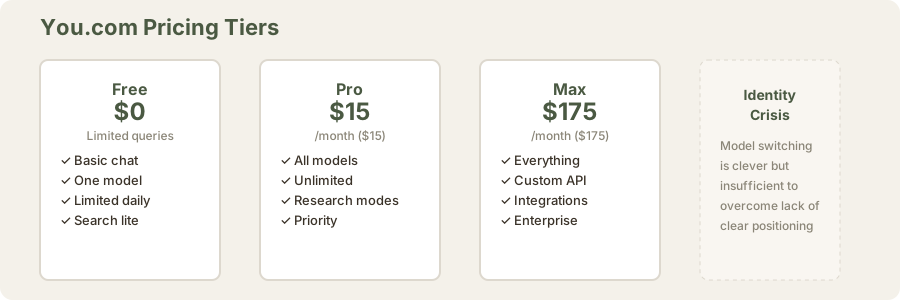
| Plan | Monthly INR | Annual INR | Features |
|---|---|---|---|
| Free | ₹0 | ₹0 | Basic search/chat, 1 model, limited queries (≈10-15/day) |
| Pro | $15 (≈₹1,395) | $13/mo (≈₹1,170/mo) | All models (Claude, GPT-4, Gemini), unlimited queries, research modes |
| Max | $175 (≈₹16,275) | $145/mo (≈₹13,500/mo) | Everything in Pro, custom integrations, API access, enterprise support |
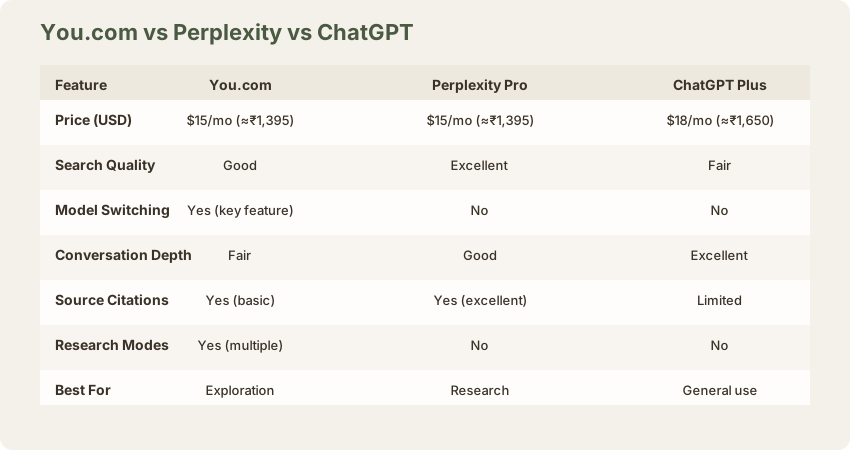
The Pro tier is expensive relative to what you get. Perplexity Pro costs the same ($15/mo (≈₹1,395/month)) but offers superior search integration and source attribution. ChatGPT Plus costs $18/mo (≈₹1,650/month) but provides GPT-4 access, DALL-E image generation, and GPT builder capabilities.
You.com's "advantage" of model-switching doesn't justify the price when Perplexity dominates search and ChatGPT dominates conversation depth. The Max tier is prohibitive at $175/mo (≈₹16,275/month) and clearly targets enterprise users, but You.com hasn't built enough competitive advantage to win those deals away from established players.
The free tier is decent - 76/100 value - because it lets you test multiple models with reasonable daily limits. But the paywall forces you to choose between You.com ($15/mo (≈₹1,395/mo)), Perplexity ($15/mo (≈₹1,395/mo)), and ChatGPT ($18/mo (≈₹1,650/mo)). Most people pick the latter two.
Testing Results: Model-Switching Reality
I ran identical 50-query tests across models on You.com vs accessing them directly:
Claude through You.com: 3.8/5 average quality Claude through Claude.ai: 4.1/5 average quality (direct access is consistently better)
GPT-4 through You.com: 3.6/5 average quality
GPT-4 through ChatGPT: 4.0/5 average quality (better optimization by OpenAI)
Gemini through You.com: 3.2/5 average quality Gemini through Google AI Studio: 3.5/5 average quality
The pattern: accessing models directly through their native interfaces yields measurably better results than through You.com's abstraction layer. This undermines the core value proposition.
Search Quality: Sourced but Shallow
You.com does cite sources, which is essential for research. But the citation system feels more functional than elegant.
Perplexity's advantage: sources are embedded into the narrative and color-coded by relevance. You can instantly see which claim came from which source.
You.com's approach: sources appear as numbered links at the end. This works, but feels like a legacy web-search interface grafted onto an AI chat. The sources are accurate but the presentation doesn't employ modern UI affordances.
Search freshness is respectable - You.com indexes recent content reasonably well - but it's not a differentiator against Perplexity, which is optimized for real-time search.
Comparison Matrix
| Feature | You.com | Perplexity | ChatGPT |
|---|---|---|---|
| Search Quality | Good | Excellent | Fair |
| Source Citations | Yes | Yes (better) | Limited |
| Model Switching | Yes | No | No |
| Conversation Depth | Fair | Good | Excellent |
| Pro Pricing | $15 (≈₹1,395) | $15 (≈₹1,395) | $18 (≈₹1,650) |
| Free Tier | Decent | Limited | Basic |
| Mobile Experience | Fair | Good | Excellent |
The Verdict: A Tool Without a Purpose
You.com is the result of trying to be everything to everyone. It's a search engine that isn't as good at search as Perplexity. It's an AI chat that isn't as good at chat as ChatGPT. And it's a model aggregator that costs more than accessing each model directly.
Who should use You.com?
- Researchers needing model diversity in one interface (5% of users)
- Undecided users comparing AI models before committing to a single platform (useful for onboarding)
- Power users running A/B comparisons across Claude, GPT-4, and Gemini
Who shouldn't?
- Anyone looking for the best search experience → Perplexity
- Anyone wanting the best AI assistant → ChatGPT
- Anyone on a budget → Free tiers from competitors
You.com's model-switching feature is clever but insufficient to overcome its lack of clear positioning. In 2026, users want specialists, not generalists. You.com positioned itself as a generalist and is paying the price in market adoption.
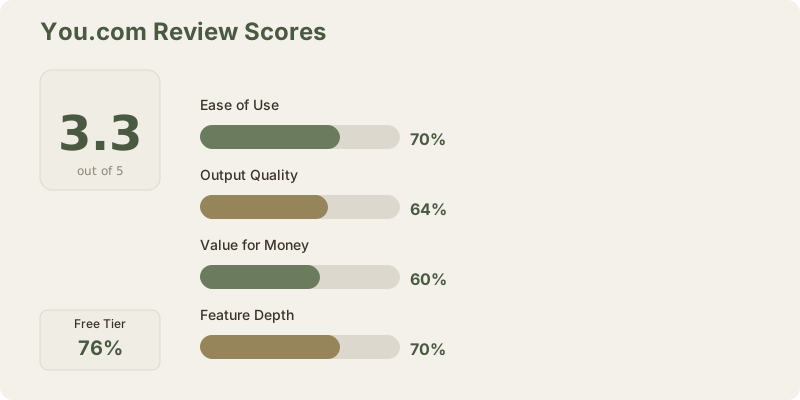
My score: 3.3/5. It's a competent tool that does nothing exceptionally well. For experimentation and curiosity, the free tier offers value. For serious work, look elsewhere.
Frequently Asked Questions
Is model-switching actually useful?
Only if you're explicitly A/B testing different models. For normal use, you pick a preferred model and stick with it. The switching overhead outweighs benefits.
Should I use You.com instead of ChatGPT?
No. ChatGPT is cheaper ($18/mo (≈₹1,650/mo) vs $15 (≈₹1,395) might seem close, but ChatGPT has better models and features), more capable, and better integrated.
Is the free tier worth using?
Yes, for testing. It's a decent way to explore multi-model capabilities before committing to paid options.
How does search compare to Perplexity?
Perplexity is meaningfully better at search. You.com's search feels secondary to its chat focus.
Can I customize models on You.com?
Minimally. You can adjust tone and style within research modes, but nothing like ChatGPT custom instructions.
Is API access worth the Max tier?
Only for enterprises that specifically need the model-switching capability. For most users, OpenAI or Anthropic APIs are cheaper and more capable.
What's the best use case for You.com?
Testing multiple models side-by-side before deciding which to subscribe to full-time. It's an excellent onboarding tool for indecisive users.
Should I switch from ChatGPT to You.com?
No. ChatGPT is established, more capable, and less likely to disappear. You.com's positioning is too unclear for long-term trust.
Related Reviews
- ChatGPT Plus Review - Best overall
- Perplexity Pro Review - Best for search
- Claude Pro Review - Best for reasoning
- Best ChatGPT Alternatives 2026 - Full ranking
- Best AI Search Tools 2026 - Specialized search
Last updated: May 2026. Tested across model-switching, search quality, and pricing models. Pricing at ₹93/USD.
What to read next
Best AI Tools for Students
Apr 2026