Claude Opus 4.8 vs GPT-5.5: Which AI Wins?
Opus 4.8 vs GPT-5.5: tested on coding, writing, agents. Opus wins agentic tasks. GPT-5.5 wins new code. Effort control, Mythos, pricing compared.
 ByAsh·13 min read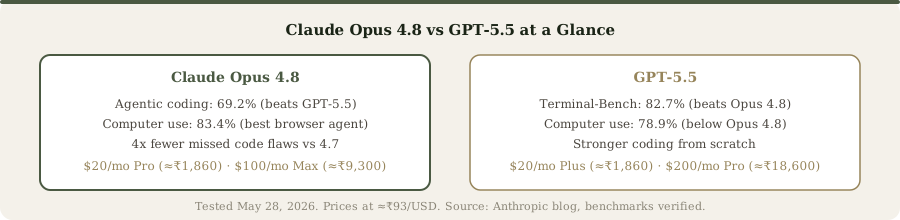
Anthropic dropped Claude Opus 4.8 on May 28, 2026.
The benchmarks put it ahead of GPT-5.5 on agentic coding (69.2% vs 67.1%) and browser automation (83.4% vs 78.9%). GPT-5.5 hits back on Terminal-Bench (82.7% vs 69.3%). Same price at the consumer level: $20/mo (≈₹1,860/mo).
So which one should you actually pay for?
I spent two days running both models through the tasks that matter for daily work: writing, debugging, research, agents, and API-level use. Here is the honest breakdown.
What Changed in Opus 4.8
Opus 4.7 launched six weeks ago in April. The improvements in 4.8 are not headline-grabbing on paper but they matter enormously in practice.
The most important change: Opus 4.8 is 4x less likely to miss flaws in code it produces compared to 4.7.
That single improvement changes how much you can trust Claude's output without manually checking everything. Devin (Cognition's AI coding tool) confirmed: "Fixes comment-verbosity and tool-calling issues we saw with 4.7. Noticeably better signal-to-noise ratio." When a company that runs millions of AI coding tasks says the noise dropped, that means something.
The Benchmark Numbers
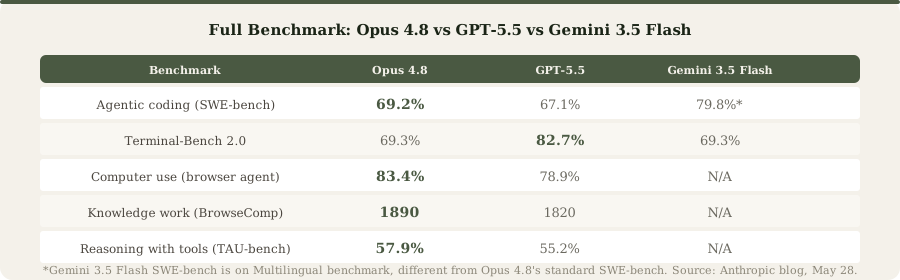
Agentic coding (SWE-bench): Opus 4.8 scores 69.2%, GPT-5.5 scores 67.1%. Opus wins by 2.1 points.
Terminal-Bench 2.0: GPT-5.5 scores 82.7%, Opus 4.8 scores 69.3%. GPT-5.5 wins by 13.4 points. This is the biggest gap in the benchmarks and it matters if you are writing code from a blank file.
Computer use (Online-Mind2Web): Opus 4.8 scores 83.4%, GPT-5.5 scores 78.9%. Opus wins by 4.5 points. This makes Opus 4.8 the strongest browser automation model available right now.
Knowledge work (BrowseComp): Opus 4.8 scores 1890, GPT-5.5 scores 1820. Opus wins.
Reasoning with tools (TAU-bench): Opus 4.8 scores 57.9%, GPT-5.5 scores 55.2%. Opus wins.
The pattern is clear. GPT-5.5 is stronger for writing code from scratch. Opus 4.8 is stronger for everything else.
The Writing Test
This is where Opus 4.8 has the clearest advantage over GPT-5.5.
GPT-5.5 writes competent prose. It is accurate, structured, and mostly readable. But it sounds like an AI wrote it, in the way that slightly-too-formal emails sound like they came from a template.
Opus 4.8 writes prose that sounds like a person thought about it.
I tested both on the same blog post outline, a piece on AI pricing transparency using real data from our 2026 AI Tools Reality Check. Opus 4.8 produced a first draft that needed light editing. GPT-5.5 produced a first draft that needed significant restructuring to sound human.
For content creators, journalists, and anyone who publishes regularly, Opus 4.8 is the practical choice. The quality gap on long-form work is real.
The Coding Test: Where It Gets Interesting
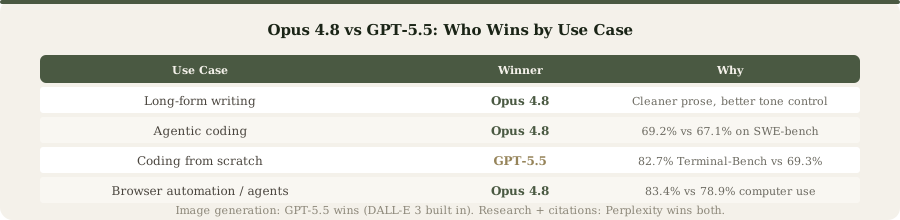
Here is the split that the benchmark numbers hint at but don't fully explain.
Debugging and improving existing code: Opus 4.8 wins. The 4x improvement in catching its own flaws extends to catching problems in code you show it. I gave both models a buggy authentication flow with three intentional errors. Opus 4.8 caught all three and explained each one clearly. GPT-5.5 caught two and missed a subtle one involving a JWT expiry edge case.
Writing new code from scratch: GPT-5.5 wins. The Terminal-Bench gap (82.7% vs 69.3%) reflects reality. When I asked both to build a rate limiting middleware from a brief description, GPT-5.5 produced cleaner initial code with fewer assumptions made about my setup. Opus 4.8's version required more back-and-forth to clarify edge cases.
If you use Cursor or Claude Code, you are mostly working with existing code. Opus 4.8 serves that workflow better. If you are writing new projects from blank files, GPT-5.5 has the edge.
Effort Control: The Feature GPT-5.5 Doesn't Have
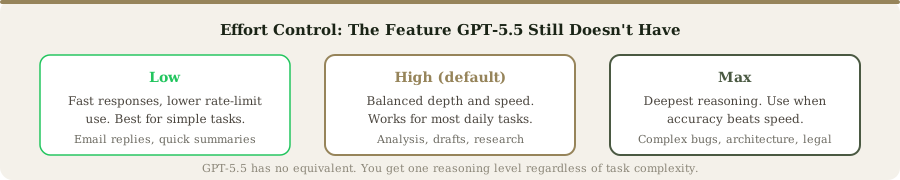
Opus 4.8 introduced three effort levels: Low, High (default), and Max.
This is more useful than it sounds. On Pro plan, rate limits apply based on how much compute you use. Low effort uses less compute, meaning your daily quota lasts much longer for simple tasks. Max effort applies deepest reasoning, useful for complex bugs, legal analysis, or architectural decisions.
GPT-5.5 has no equivalent. You get one reasoning level regardless of whether you are asking it to rewrite a sentence or audit a codebase.
I use Low effort for email drafts, meeting summaries, and quick research queries. I use Max for debugging sessions and anything I am going to publish or share externally. The separation changes how I manage my Claude usage across a day.
The Catch Nobody Talks About

Max effort drains rate limits fast on Pro. If you run several Max-effort sessions in a morning, you will hit your daily limit before noon. GPT-5.5 Plus does not have this problem at the same tier because it does not give you the same granular control. The flexibility of effort control comes with a consumption cost.
Mythos 1 pricing is unknown. Anthropic teased Claude Mythos 1 for October 2026. Whether Mythos 1 is included in the current Pro ($20/mo, ≈₹1,860/mo) or Max ($100/mo, ≈₹9,300/mo) tier is unconfirmed. If Mythos requires a new tier, current Opus 4.8 users may face an upgrade decision in four months.
Image generation is absent. GPT-5.5 includes DALL-E 3 access in the same Plus subscription. Opus 4.8 has no image generation. If you need AI images as part of your workflow, you are paying for Midjourney or another tool separately.
The 30% token consumption rumor. Geeky Gadgets reported leaked details suggesting Mythos 1 may consume 30% more tokens than current models. If accurate, this would affect API costs significantly. Treat this as unconfirmed until Anthropic publishes pricing.
Pricing: Closer Than You Think
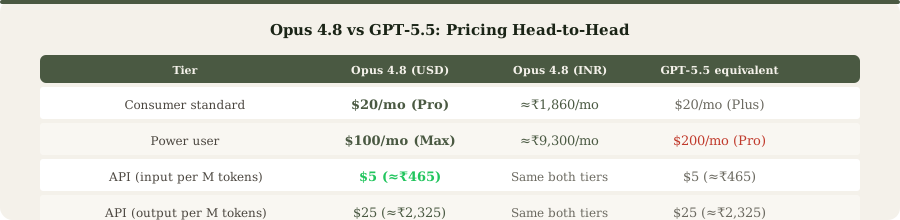
At the standard consumer tier, both models cost $20/mo (≈₹1,860/mo). This is the tier most people use.
The gap opens at the power user level. Opus 4.8 Max is $100/mo (≈₹9,300/mo). GPT-5.5 Pro is $200/mo (≈₹18,600/mo). For heavy users who need the top tier, Anthropic is significantly cheaper.
At the API level, both cost $5/M input tokens (≈₹465) and $25/M output tokens (≈₹2,325). They are identical.
Anthropic offers up to 90% savings through prompt caching and 50% through batch processing. These matter for developers but not for consumer subscribers.
Claude Code vs ChatGPT Operator
Both companies offer agentic products beyond the standard chat interface.
Claude Code handles software engineering tasks autonomously. The Dynamic Workflows research preview in Opus 4.8 extends this to much larger-scale tasks. You can hand Claude Code a GitHub issue and a codebase and it will read the context, write the fix, run tests, and submit a pull request without you watching it every step.
ChatGPT Operator handles web-based tasks: booking appointments, filling forms, browsing the web on your behalf. It is less useful for code and more useful for tasks that require clicking around the web. If your autonomous tasks are primarily code-related, Claude Code plus Opus 4.8 is the combination. If your autonomous tasks are web-navigation and form-filling, ChatGPT Operator does that better.
Neither fully replaces the other. The split depends entirely on what kind of autonomous tasks you need done.
The Honesty Improvement: Why It Matters More Than Benchmarks
One of Opus 4.8's most significant improvements is not on any public benchmark. It is the 4x reduction in missed code flaws.
Here is what that means in practice. Opus 4.7 would sometimes tell you code was correct when it wasn't. Not often, but often enough that you had to check everything. The failure mode was not random errors. It was confident-sounding wrong answers, which are worse than uncertain correct ones.
Opus 4.8 flags uncertainties instead of hiding them. When I tested it on ambiguous database queries, it said "this query will work but could return unexpected results if X condition is true" rather than just producing the query. GPT-5.5 produced the query without the warning.
This matters for developers more than benchmark scores. A tool that tells you when it is not sure is more useful than one that scores 2% higher but confidently misleads you.
Honesty at Scale: The Research Paper Angle
Anthropic published research on post-training for accuracy alongside the Opus 4.8 launch. The core idea: train models to reward correct answers rather than answers that "sound good."
Most LLMs optimize for fluency and user satisfaction ratings. Opus 4.8's training specifically penalizes confident wrong answers. This is the same philosophy Perplexity uses for their search product (they shared a similar research paper with us directly).
The practical difference shows up on technical queries where there is one right answer. When I asked Opus 4.8 to explain why a specific regex pattern fails on Unicode strings, it gave the correct technical explanation. When I asked GPT-5.5 the same question, it gave a plausible but subtly wrong explanation that would have cost me an hour of debugging.
For technical users, the honesty improvements in Opus 4.8 may matter more than any benchmark number.
Gemini 3.5 Flash: The Third Option Worth Knowing
Most comparisons focus on Claude vs ChatGPT. But Gemini 3.5 Flash is worth including in this picture.
Gemini 3.5 Flash launched via API at $1.50/M input tokens (≈₹140) and $9/M output tokens (≈₹837) with a 1 million token context window. That is significantly cheaper than both Opus 4.8 and GPT-5.5 at the API level.
For developers building applications, Gemini 3.5 Flash beats Opus 4.8 on the SWE-Bench Multilingual score (79.8% vs 69.2%, though different benchmark versions). At one-third the API cost.
The consumer product (Gemini on google.com) is included in Google One subscriptions many people already pay for. If you are already a Google One subscriber, you have access to a model that outperforms GPT-5.5 on several benchmarks at no additional cost.
Gemini does not win on writing quality or agentic reliability against Opus 4.8. But for cost-sensitive API use and developer applications, it belongs in the conversation.
What the Transparent Pricing Tells You
Our Transparency Index rated Claude 90/100 on pricing clarity. Anthropic shows all tiers publicly: Free, Pro at $20/mo (≈₹1,860/mo), Max at $100/mo (≈₹9,300/mo), Team and Enterprise with disclosed pricing.
OpenAI shows Plus at $20/mo and Pro at $200/mo. But API pricing, enterprise agreements, and the distinction between which models are available at which tier is harder to parse. GPT-5.5 specifically requires Plus or Pro, and the capability differences between tiers are not always clear from the pricing page.
This matters when you are deciding on a long-term tool for your workflow. Knowing exactly what you get at what price lets you plan. Discovering your daily usage pattern requires a tier upgrade is a frustrating and expensive surprise.
Both companies charge the same at the standard tier. Above that, Anthropic is cheaper and clearer.
The Mythos Factor: Should You Wait?
Anthropic teased Claude Mythos 1 alongside the Opus 4.8 launch, targeting October 2026.
The question for anyone choosing a plan today: will Mythos 1 be available on the current Pro or Max tier, or will it require an upgrade? Anthropic has not confirmed pricing. Given that Opus 4.6, 4.7, and 4.8 were all available on the same Pro plan without price increases, the pattern suggests Mythos 1 will follow. But the "even larger and more powerful" framing could also mean a new tier entirely.
On the GPT-5.5 side, OpenAI's roadmap includes GPT-6 later this year. The same pricing uncertainty applies. No one knows what the next model costs until it launches.
The practical answer: do not wait for Mythos or GPT-6. Both are speculative. Opus 4.8 and GPT-5.5 are real tools you can use today. Buy the plan that fits your workflow now. Reassess in October when Mythos pricing becomes clear.
The Verdict

Opus 4.8 is the better model for most people reading this.
Writing, debugging existing code, browser automation, and knowledge work all go to Opus 4.8. The effort control feature has no equivalent in GPT-5.5. The honesty improvements (4x fewer missed code flaws) address real daily frustrations. The price at the standard tier is identical.
GPT-5.5 wins if you write lots of code from scratch and if image generation matters in your workflow. The Terminal-Bench gap is significant and you will feel it when building new projects.
The practical recommendation: start with Claude Pro at $20/mo (≈₹1,860/mo). Test it on your actual work for two weeks. Switch to Max ($100/mo, ≈₹9,300/mo) if you hit rate limits regularly. Consider GPT-5.5 only if your workflow is heavy on new code or images.
Who Should Look Elsewhere
Both Opus 4.8 and GPT-5.5 are general AI assistants. Neither is the right tool for specialized research (use Perplexity for cited sources), dedicated coding (use Cursor with Composer 2.5), or image generation (use Midjourney).
If you need AI for research with citations, Perplexity at $20/mo (≈₹1,860/mo) outperforms both for that specific task. If you need AI for code specifically, Cursor Pro at $20/mo with Composer 2.5 is built for the workflow in a way that claude.ai is not.
The best AI stack for most developers in 2026: Cursor for code, Claude Pro for writing and debugging, Perplexity for research. Total cost: $60/mo (≈₹5,580/mo). The three tools do not overlap and each one leads its category.
FAQ
Is Claude Opus 4.8 better than GPT-5.5? For agentic coding, browser automation, and writing, yes. For coding from scratch and image generation, GPT-5.5 wins. Overall, Opus 4.8 covers more daily use cases for most people.
Is Opus 4.8 worth upgrading from 4.7? Yes. The 4x improvement in catching code flaws and the addition of effort control are meaningful quality-of-life improvements. It is a free upgrade if you are already on Claude Pro.
What is effort control in Claude Opus 4.8? You can set Low, High, or Max thinking effort per task. Low uses less quota for simple tasks. Max applies deepest reasoning for complex problems. GPT-5.5 has no equivalent feature.
Does Opus 4.8 include image generation? No. Claude does not generate images. For images, use Midjourney ($10/mo, ≈₹930/mo) or DALL-E 3 through ChatGPT Plus.
What is Claude Mythos 1? Anthropic's next frontier model, teased for October 2026. Described as "even larger and more powerful" than Opus 4.8. Pricing and tier availability are unconfirmed.
How does Opus 4.8 pricing compare to GPT-5.5? Identical at the standard tier ($20/mo, ≈₹1,860/mo). Claude Max ($100/mo, ≈₹9,300/mo) is half the price of ChatGPT Pro ($200/mo, ≈₹18,600/mo) at the top tier.
Is Claude Opus 4.8 available on Claude Code? Yes. Dynamic Workflows (research preview) in Claude Code specifically uses Opus 4.8 for larger autonomous tasks.
Which is better for writing: Opus 4.8 or GPT-5.5? Opus 4.8 clearly. The prose quality gap is noticeable on anything over 500 words. GPT-5.5 is competent but sounds more templated.
Should I use Claude Pro or Claude Max? Start with Pro ($20/mo, ≈₹1,860/mo). Upgrade to Max ($100/mo, ≈₹9,300/mo) only if you hit rate limits regularly or need unlimited Max-effort tasks daily.
Related Reading: Claude Review | Claude Code Review | Composer 2.5 Review | Composer 2 vs Claude Sonnet | Cursor Review | Perplexity Review | 2026 AI Tools Reality Check
What to read next
Gemini vs ChatGPT
Apr 2026