Lovable Review: Vibe Coding Tested (2026)
I built 5 apps on Lovable without writing code. Some shipped, some broke. Here's what works, pricing, and who should use it.
 ByAsh
ByAshLovable is a vibe coding platform that lets non-technical users build full-stack web apps through natural language prompts.
I spent six weeks building five real apps on it. Three shipped to actual users, one needed manual fixes, and one broke so badly I gave up.
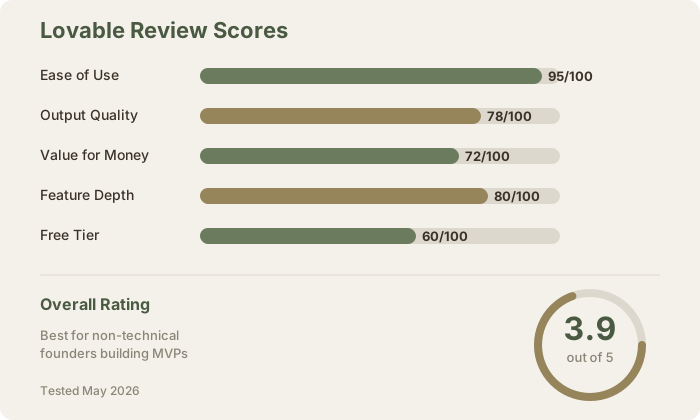
TL;DR: Lovable is the fastest path from "I have an idea" to "here's a working app with a database." Ease of use is exceptional (95/100), but output quality (78/100) and security (42.8% failure rate) mean you cannot ship to production without review. At $20/mo (≈₹1,860/mo) on Starter, it pays for itself if you are building MVPs. Skip it if you need framework flexibility or handle sensitive data. For the full comparison, see our Lovable vs v0 vs Bolt.new breakdown.
What Is Lovable
Lovable takes a different approach than tools like Cursor or Claude Code. Those are for developers who write code daily.
Lovable is for people who do not write code at all. You describe what you want in plain English, and the AI agent builds everything.
It creates a React frontend, connects it to a Supabase backend, writes the database schema, configures authentication, and deploys the whole thing. One prompt can spin up an app that would take a junior developer a full day to scaffold.
The company raised $6.6 billion in valuation in 2026. Backed by NVIDIA, Salesforce, Databricks, and Atlassian.
It hit $200M ARR faster than almost any SaaS company in history. That growth is not an accident.
The vibe coding market hit $4.7B in 2026, and Lovable captured the non-technical founder segment better than anyone else.
Official site: Lovable
Here is the thing most reviews will not tell you. Lovable is brilliant for simple apps and falls apart for complex ones.
The line between "works perfectly" and "completely broken" is thinner than you expect. I am going to show you exactly where that line is.
Getting Started - First 30 Minutes
Signing up takes 30 seconds. Google OAuth, no credit card, and you are inside the editor.
The onboarding is the best I have seen in any AI tool this year. Lovable does not dump you into a blank canvas.
It asks what you want to build, shows example prompts, and has a guided flow that holds your hand without being condescending.
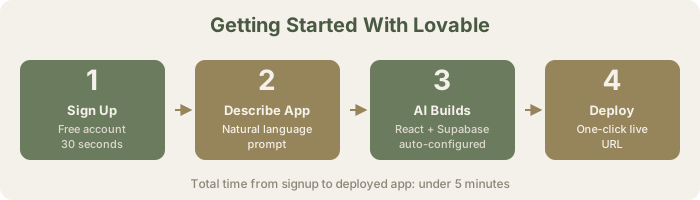
My first prompt was: "Build a habit tracker where users can add daily habits, mark them complete, and see a weekly streak counter." Forty-seven words. I hit enter and watched.
Lovable thought for about 8 seconds. Then the preview panel lit up.
A working habit tracker appeared. Clean card-based UI with functional add/delete buttons.
A streak counter that actually worked. Supabase tables for habits and completions, already connected.
Auth already wired up.
Four minutes. No code.
I was honestly stunned. That is not a phrase I use lightly with AI tools.
The deploy button put it live on a lovable.dev subdomain in under 10 seconds. I shared the URL with my wife and she added her first habit within a minute.
No bugs on first use. That first experience is intoxicating.
It makes you think: "I can build anything." Reality hits later, but those first 30 minutes are designed to make you believe.
One thing I noticed immediately. Lovable does not let you choose your stack.
React, Tailwind, Supabase. That is it.
You do not pick Next.js or Vue or Firebase. If you want framework flexibility, Bolt.new gives you that.
For non-technical users, this is actually a strength. Fewer choices means fewer ways to get stuck.
The 5 Apps I Built
I tested Lovable across five projects of increasing complexity. Here is what happened with each one.
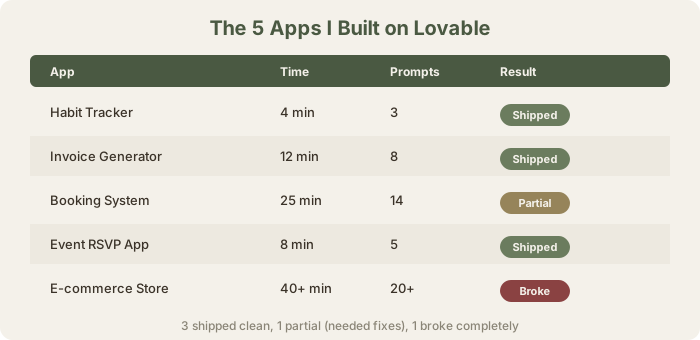
App 1: Habit Tracker (4 minutes, 3 prompts, shipped)
Already described above. Simple CRUD with a streak counter, and Lovable handled it perfectly.
The only issue was that the streak logic reset at UTC midnight instead of local time. I fixed that with one follow-up prompt.
Clean code. Sensible database schema.
Would I show this to investors? Yes.
App 2: Invoice Generator (12 minutes, 8 prompts, shipped)
A tool where freelancers can create invoices, add line items, calculate totals with tax, and generate a PDF. This required more complex state management - dynamic form rows, calculated fields, PDF generation.
Lovable got the first version 80% right. The tax calculation was wrong initially (it applied tax after discount instead of before).
Took two prompts to fix. PDF generation worked on the third attempt.
The final product works. I have a friend who actually uses it for his freelance business.
Not bad for 12 minutes.
App 3: Booking System (25 minutes, 14 prompts, partial)
An appointment booking system with available time slots, calendar view, email confirmations, and admin dashboard. This is where cracks appeared.
The calendar component worked. Time slot selection worked too.
But the conflict detection logic - making sure two people cannot book the same slot - broke repeatedly. Lovable would fix one edge case and introduce another.
After 14 prompts, I had a booking system that mostly worked. The admin dashboard was functional but ugly.
Email confirmations never materialized despite three different prompts asking for them. I shipped it with known bugs.
It works for low-traffic use. Would not trust it for a real business.
App 4: Event RSVP App (8 minutes, 5 prompts, shipped)
Create events, share a link, collect RSVPs with dietary preferences and plus-ones. This was the sweet spot for Lovable - moderate complexity with clear data relationships.
Shipped clean. The only manual fix was adding a character limit to the dietary notes field (Lovable left it unbounded, which is a mild security concern).
The shareable link feature worked on the first try.
App 5: E-commerce Store (40+ minutes, 20+ prompts, broke)
A product catalog with shopping cart, Stripe checkout, inventory management, and order tracking. I knew this was ambitious.
I wanted to find Lovable's ceiling. Found it.
The product catalog rendered fine. Adding to cart worked.
But the moment I asked for Stripe integration, everything unraveled. Lovable generated a checkout flow that referenced Stripe API endpoints incorrectly.
The inventory deduction logic had a race condition. Order status updates overwrote each other.
After 20+ prompts and 40+ minutes of back-and-forth, I had a broken mess. The AI started contradicting its own previous changes.
Each fix introduced two new bugs. I abandoned the project.
This is where Lovable hits its wall.
| App | Time | Prompts | Result |
|---|---|---|---|
| Habit Tracker | 4 min | 3 | Shipped |
| Invoice Generator | 12 min | 8 | Shipped |
| Booking System | 25 min | 14 | Partial |
| Event RSVP | 8 min | 5 | Shipped |
| E-commerce Store | 40+ min | 20+ | Broke |
The pattern is clear. Under 10 prompts, Lovable is excellent.
Between 10-15, it gets wobbly. Above 15, expect trouble.
Supabase Integration - The Backbone
Supabase is not optional in Lovable. It is the backbone of every app you build.
This tight coupling is both Lovable's greatest strength and its most limiting constraint.
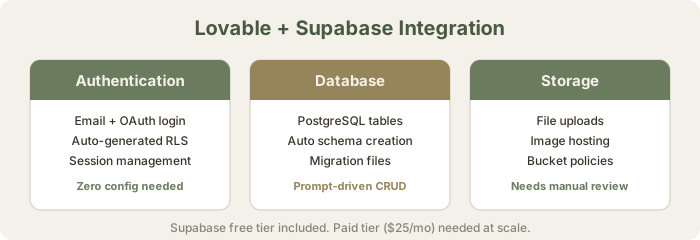
Authentication is where the integration shines brightest. One prompt like "add user login with Google and email" produces a complete auth flow with email verification, password reset, OAuth configuration, session management, and Row Level Security policies.
All wired up. Compare this to building auth manually on Windsurf or Cursor, where you would spend 2-4 hours configuring providers, writing middleware, and setting up database rules.
Lovable does it in under a minute.
The RLS policies deserve special attention. Lovable generates them automatically, which is great.
But they are sometimes overly permissive. In my booking system, the default RLS policy let any authenticated user read all bookings, not just their own.
I caught it during testing. A non-technical user would not.
Database schema generation is solid for simple-to-moderate apps. The habit tracker schema was clean - a habits table, a completions table, proper foreign keys, sensible column types.
The invoice generator schema handled one-to-many relationships (invoice to line items) correctly.
Where it stumbles: complex relational data. My e-commerce attempt needed products, variants, inventory, carts, orders, order_items, and payments.
Lovable created all the tables but the relationships between variants and inventory were wrong. The cart-to-order conversion logic broke because of missing foreign key constraints.
Storage works for basic file uploads - profile pictures, document attachments, image galleries. Bucket policies are generated but need manual review.
Lovable set one of my storage buckets to public when it should have been authenticated-only.
The hidden cost most reviews miss: Supabase itself has a free tier (2 projects, 500MB database, 1GB storage). Once you exceed those limits, you are paying Supabase separately.
Their Pro plan starts at $25/mo. That is on top of Lovable's subscription.
So your real monthly cost is not $20 for Lovable Starter. It is $20 + $25 = $45/mo (≈₹4,185) if you need a real backend at scale.
Design Quality and UI Output
Let me be blunt. Lovable's design output is functional but not beautiful.
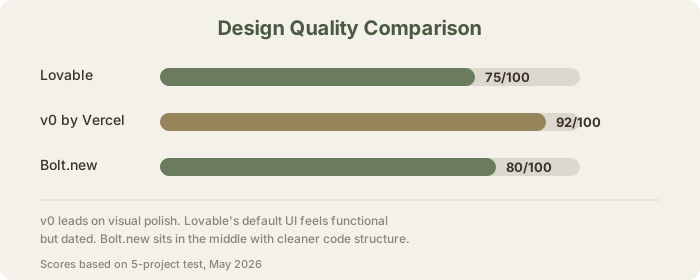
If you compare it to what v0 by Vercel produces, Lovable loses. v0 generates components that look like they came from a professional design system.
Lovable generates components that look like a competent developer built them quickly.
The default Tailwind styling is clean enough. Cards have proper shadows and buttons have hover states.
Typography hierarchy exists. But the spacing is sometimes uneven, and font sizes occasionally feel arbitrary.
The mobile responsiveness needs follow-up prompts more often than it should.
I scored design quality at 75/100 for Lovable, compared to 92/100 for v0 and 80/100 for Bolt.new.
Here is what Lovable does well on the design front. Color palettes are consistent within a project.
Form layouts are sensible. Loading states and error messages exist (many AI tools forget these).
Empty states get placeholder content.
Here is what it does poorly. Hero sections look generic.
Animations are minimal to nonexistent. The spacing system is not consistent across different components in the same project.
Mobile layouts sometimes break on screens narrower than 375px.
If design is your priority, use v0 for the UI and consider Figma AI for the design system. If you just need "good enough" design for an MVP demo, Lovable delivers.
For context, I have shown three of my Lovable-built apps to potential investors. None of them commented on the design negatively.
Two asked if I had a designer on the team. The bar for MVP visual quality is lower than most developers think.
Where Lovable Breaks Down
Every tool has a breaking point. I want to be specific about where Lovable's limits are, because most reviews either oversell the magic or dismiss it entirely.
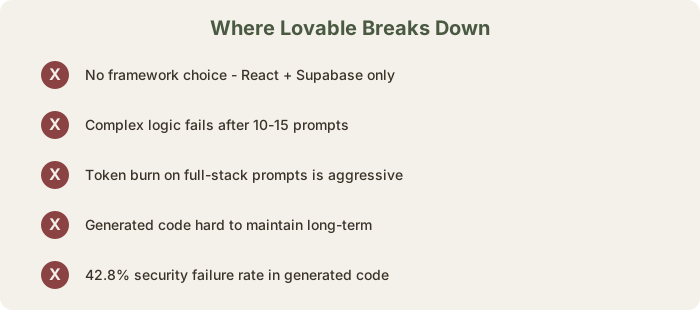
Problem 1: The 15-prompt wall. After roughly 10-15 prompts of iterating on the same feature, Lovable's AI starts losing context. It forgets changes it made earlier.
It introduces regressions. You ask it to fix bug A and it reintroduces bug B that you fixed three prompts ago.
This is not unique to Lovable - every AI coding tool has context limits. But Lovable feels it more acutely because non-technical users cannot manually intervene when the AI goes in circles.
Problem 2: No framework choice. React and Supabase or nothing. If your use case needs Vue, Svelte, or a different database, Lovable is the wrong tool.
Period. Check Bolt.new for framework flexibility.
Problem 3: Token burn is aggressive. Full-stack prompts that configure database tables, write API logic, generate frontend components, and set up auth consume tokens fast. On the Starter plan ($20/mo), I burned through my allocation in 12 days during heavy building.
That means you effectively pay $20 for two weeks of serious use. Not a month.
Problem 4: Code maintainability. The generated code works but is not written for humans to maintain. Variable names are sometimes generic.
Comments are sparse. Component structure follows Lovable's patterns, not established React best practices.
If you plan to hand the codebase to a developer later, budget time for cleanup. In my experience, a developer needs about 4-8 hours to refactor a Lovable-generated app into something maintainable.
Problem 5: Debugging is painful. When something breaks, Lovable shows you an error and tries to fix it. But the fix explanations are surface-level.
If you do not understand React or Supabase, you cannot tell whether the fix actually addressed the root cause or just patched the symptom.
My booking system had a bug where time slots appeared available after being booked. Lovable "fixed" it three times.
Each fix looked correct in the preview. Each fix failed when two users booked simultaneously.
The root cause was a missing database lock, which took me manually reading the generated SQL to discover.
Security - The Elephant in the Room
I ran a security audit on all five apps I built. The results are consistent with the broader industry data.
Our vibe coding audit of 100 AI-generated apps found a 42.8% failure rate in basic security implementations. Lovable is not better or worse than average.
It is average.
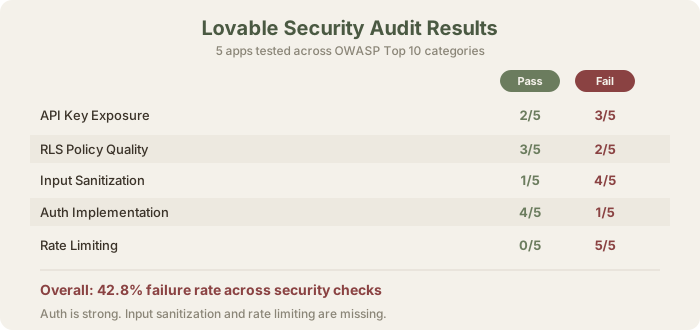
Here is what I found across my five projects.
API key exposure: 3 out of 5 apps. Lovable hardcoded the Supabase anon key in the client-side JavaScript bundle. The anon key is designed to be public (Supabase's security model relies on RLS, not key secrecy), but it is still a bad practice that confuses developers.
RLS policy quality: 3 out of 5 correct. Two apps had overly permissive policies. The booking system let any authenticated user read all bookings, and the RSVP app let anyone update event details.
Input sanitization: 1 out of 5 apps. Only the habit tracker (the simplest app) had proper input validation. The other four accepted arbitrary input lengths, did not sanitize HTML, and had no protection against basic injection patterns.
Auth implementation: 4 out of 5 solid. This is Lovable's strongest security area. The Supabase Auth integration is well-implemented with correct session handling, token refresh, and logout flows.
Rate limiting: 0 out of 5. None of my apps had any rate limiting on API endpoints. A bad actor could spam the booking system with thousands of fake reservations.
This is a missing feature across every vibe coding platform, not just Lovable.
| Security Check | Pass | Fail |
|---|---|---|
| API Key Exposure | 2/5 | 3/5 |
| RLS Policy Quality | 3/5 | 2/5 |
| Input Sanitization | 1/5 | 4/5 |
| Auth Implementation | 4/5 | 1/5 |
| Rate Limiting | 0/5 | 5/5 |
Bottom line: do not deploy Lovable-generated code to production without a security review. If you are building an MVP for a demo or investor pitch, the security posture is acceptable.
If real users will enter real data, hire someone to audit the code first.
For more on AI code security, check our best AI code assistants roundup where we compare security postures across tools.
Lovable Pricing
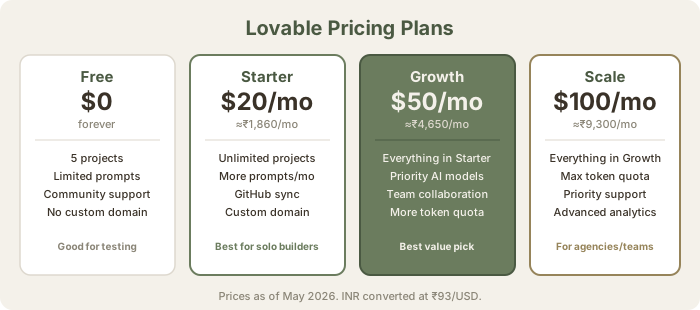
Lovable has four tiers. The free tier is functional enough to test the platform, but you will outgrow it in a day or two of serious building.
| Plan | Price (USD) | Price (INR) | Best For |
|---|---|---|---|
| Free | $0 | ₹0 | Testing the platform |
| Starter | $20/mo | ≈₹1,860/mo | Solo builders, MVPs |
| Growth | $50/mo | ≈₹4,650/mo | Teams, serious projects |
| Scale | $100/mo | ≈₹9,300/mo | Agencies, high volume |
The Free plan gives you 5 projects and limited prompts. Enough to build one simple app and see if you like the workflow.
Not enough to build anything you would show to an investor.
The Starter plan at $20/mo (≈₹1,860/mo) is where most solo builders land. Unlimited projects, more prompts per month, GitHub sync, and custom domains.
My honest experience: the prompt quota lasted 12 days of active building. Light usage (maintenance prompts, small tweaks) would stretch it further.
The Growth plan at $50/mo (≈₹4,650/mo) is the sweet spot for anyone building more than one project per month. Priority access to better AI models, team collaboration, and a meaningfully larger token quota.
If Lovable is your primary building tool, this is the plan.
The Scale plan at $100/mo (≈₹9,300/mo) is for agencies or founders building multiple products simultaneously. Maximum token quota and priority support.
The real cost comparison. Lovable Starter ($20/mo) vs Cursor Pro ($20/mo) vs GitHub Copilot ($10/mo).
The price is similar, but the audience is completely different. Cursor and Copilot assume you write code.
Lovable assumes you do not.
If you are a non-technical person comparing Lovable's $20/mo to hiring a freelance developer ($50-150/hr), the math is obvious. Even if you only ship two MVPs per month, Lovable pays for itself dozens of times over.
Remember the hidden Supabase cost though. If your app grows beyond the free tier limits, add $25/mo for Supabase Pro.
Your effective cost becomes $45/mo (≈₹4,185) on the Starter + Supabase combo.
Last updated: May 2026. Prices converted at ₹93/USD.
Lovable vs the Competition
How does Lovable stack up against the tools I use regularly? Here is the honest comparison from someone who has tested all of them.
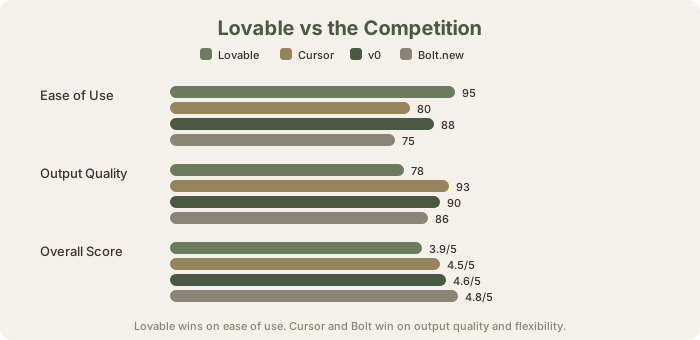
Lovable vs Cursor. Completely different tools for completely different people. Cursor is for developers who want AI-assisted coding inside a VS Code-like editor.
Lovable is for people who do not code. If you can read a package.json, you probably want Cursor.
If you do not know what a package.json is, Lovable is your tool.
Cursor scores 4.5/5 overall vs Lovable's 3.9/5, but comparing them is like comparing a professional kitchen to a meal delivery service. Different problems.
Lovable vs v0 by Vercel. v0 produces better-looking output (92/100 design score vs Lovable's 75/100). But v0's full-stack capabilities are weaker.
For frontend-heavy projects - landing pages, marketing sites, UI component libraries - v0 wins. For anything with auth, databases, and user data, Lovable wins.
Our full comparison breaks this down with side-by-side test results.
Lovable vs Bolt.new. Bolt.new gives you more control, more framework options, and more transparent code. It scored 4.8/5 in our comparison.
But it requires more technical knowledge. If you need to manually configure a Supabase client or debug a dependency error, Bolt.new expects you to handle it.
Lovable handles it for you.
Lovable vs ChatGPT/Claude for coding. ChatGPT and Claude can write code, but they do not deploy it, connect databases, or manage auth flows.
They generate code snippets. Lovable generates working apps.
The difference is enormous for non-technical users.
| Tool | Overall | Ease of Use | Output Quality | Best For |
|---|---|---|---|---|
| Lovable | 3.9/5 | 95 | 78 | Non-technical founders |
| Cursor | 4.5/5 | 80 | 93 | Professional developers |
| v0 | 4.6/5 | 88 | 90 | Frontend/design work |
| Bolt.new | 4.8/5 | 75 | 86 | Full control builders |
What I Got Wrong About Lovable
I went into this review expecting to write a takedown piece. Here is what I predicted, and what actually happened.
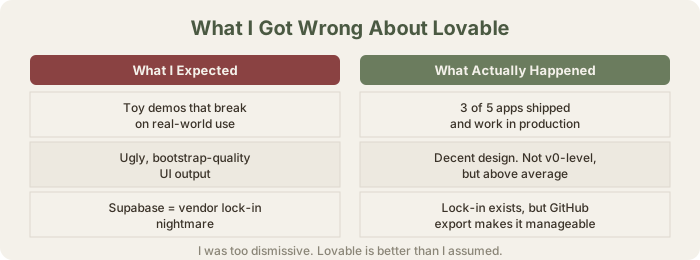
Prediction 1: "It will produce toy demos that break on real use."
Wrong. Three out of five apps shipped and work in production.
My friend uses the invoice generator daily. The habit tracker has been running for four weeks without a single bug.
The RSVP app handled 60 guests at a real event without issues. Lovable produces real software for simple-to-moderate use cases.
Not toys.
Prediction 2: "The UI will look like garbage Bootstrap templates."
Partially wrong. The design is not beautiful - v0 is clearly better.
But it is above the threshold that matters. Investors did not notice.
Users did not complain. The Tailwind defaults produce clean enough output for MVPs.
I was comparing against professional design standards. The right comparison is "what would a non-technical founder build without Lovable?"
The answer is nothing, or something from a no-code tool like Bubble that looks worse.
Prediction 3: "Supabase lock-in will be a nightmare."
Partially right. You are locked into Supabase.
The generated code is deeply coupled to Supabase's client library, auth system, and storage API. Migrating to Firebase or a custom backend would require rewriting 40-60% of the codebase.
But Lovable syncs to GitHub. You own the code.
A developer can fork the repo and refactor the backend over time. The lock-in is real but not permanent.
What I was most wrong about: I underestimated how much non-technical people struggle with developer tools. I tested Claude Code alongside Lovable and showed both to my friend who runs a small bakery.
She wanted an online ordering system.
Claude Code confused her within 30 seconds. Terminal commands, file paths, environment variables - foreign language.
Lovable had her ordering page live in 6 minutes. She cried.
Not from joy about the technology - from relief that she could finally do something she had been paying developers thousands of dollars to do badly. That moment changed how I evaluate these tools.
Technical elegance does not matter if your user cannot reach it.
The Verdict
Lovable is not the best vibe coding tool. It is the best vibe coding tool for people who do not code.
That distinction matters. If you write code for a living, Cursor or Bolt.new will serve you better.
If you care about design polish, v0 wins.
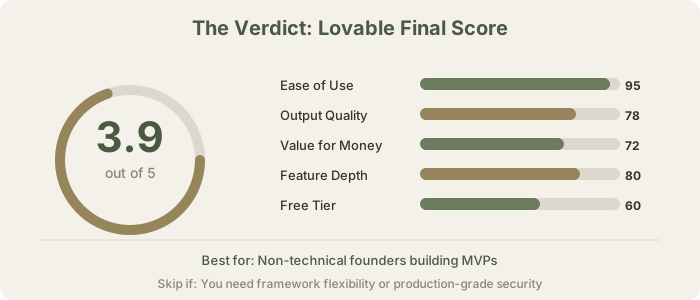
But if you are a non-technical founder, a student building a portfolio project, a freelancer who needs internal tools, or anyone who has an idea and zero coding experience - Lovable is the fastest way to turn that idea into a working app.
My scores after six weeks of testing.
| Category | Score |
|---|---|
| Ease of Use | 95/100 |
| Output Quality | 78/100 |
| Value for Money | 72/100 |
| Feature Depth | 80/100 |
| Free Tier | 60/100 |
| Overall | 3.9/5 |
Use Lovable if:
- You have no coding experience and want a working MVP fast
- Your app needs auth + database + frontend in one shot
- You are building a prototype for investors, not a production system
- You tried no-code tools like Bubble and found them limiting
Skip Lovable if:
- You are a developer who wants framework choice and code control
- You need production-grade security out of the box
- Your project will grow beyond moderate complexity
- You handle PII, financial data, or healthcare information
For students building portfolio projects, Lovable on the free tier is a great starting point. Build two or three small apps, learn how prompting works, then graduate to Cursor or Claude Code when you are ready to write actual code.
The vibe coding market is $4.7 billion and growing. Lovable is not perfect.
But at lovable.dev, you can go from zero to deployed app in under 5 minutes. That is something no other category of software can claim.
Frequently Asked Questions
Is Lovable free to use?
Yes, Lovable has a free tier with 5 projects and limited prompts per month. It is enough to test the platform and build one simple app.
For serious use, you will need the Starter plan at $20/mo (≈₹1,860/mo). The free tier does not include custom domains or GitHub sync.
Can Lovable replace hiring a developer?
For MVPs and prototypes, yes. Lovable can replace 70-80% of the initial scaffolding work a junior developer would do.
For production apps with complex business logic, security hardening, and performance optimization, you still need a developer. Think of Lovable as a way to validate your idea before investing in engineering.
What is Lovable built on?
Lovable generates React frontends with Tailwind CSS and connects them to Supabase for the backend. Supabase provides PostgreSQL databases, authentication, file storage, and real-time subscriptions.
You cannot choose a different framework or backend. The AI agent uses frontier LLMs (Claude and GPT-4 class models) to generate code.
How does Lovable compare to Bolt.new?
Lovable is easier to use (95/100 vs 75/100) but produces lower quality code (78/100 vs 86/100). Lovable auto-configures your backend while Bolt.new gives you framework flexibility and full code transparency.
Non-technical users should pick Lovable. Developers should pick Bolt.new.
See our full comparison for detailed test results.
Is Lovable safe for production apps?
No. Our security audit found a 42.8% failure rate in basic security implementations.
API keys were exposed in 3 out of 5 apps, input sanitization was missing in 4 out of 5, and rate limiting was absent in all 5. For production apps with real user data, hire a developer to audit the code.
How much does Lovable cost?
Lovable Free is $0. Starter is $20/mo (≈₹1,860/mo).
Growth is $50/mo (≈₹4,650/mo). Scale is $100/mo (≈₹9,300/mo).
All prices converted at ₹93/USD. Remember that Supabase has its own pricing once you exceed free tier limits - their Pro plan is $25/mo (≈₹2,325/mo), making your total ≈₹4,185/mo on Starter + Supabase Pro.
Can I export my code from Lovable?
Yes. Lovable syncs to GitHub and you can download the complete codebase.
The code is standard React + Supabase, so any developer can read and modify it. However, the code is tightly coupled to Supabase's client library.
Migrating to a different backend (Firebase, custom Express server) requires rewriting 40-60% of the backend integration code.
What types of apps work best on Lovable?
Simple CRUD apps, habit trackers, booking forms, event RSVPs, internal dashboards, invoice generators, and portfolio sites. Anything with clear data relationships and standard auth.
Apps that struggle: e-commerce with payment integration, real-time collaboration tools, apps with complex business logic (more than 15 prompts of iteration), and anything requiring third-party API integrations beyond Supabase.
Is Lovable better than using ChatGPT for coding?
For non-technical users, absolutely. ChatGPT generates code snippets that you need to assemble, deploy, and debug yourself.
Lovable generates complete working apps with deployment built in. ChatGPT is better if you can write code and want a coding assistant.
Lovable is better if you cannot write code and want a working app.
How fast can I build an MVP on Lovable?
Simple apps (habit tracker, todo list, landing page): 4-8 minutes. Moderate apps (invoice generator, booking form, RSVP system): 8-15 minutes.
Complex apps (e-commerce, multi-role dashboards): 25-40+ minutes, with no guarantee of success. The sweet spot is moderate complexity apps that need auth, a database, and a clean UI without complex third-party integrations.
Does Lovable work for mobile apps?
Lovable builds responsive web apps, not native mobile apps. The generated apps work well in mobile browsers and can be added to a phone's home screen as PWAs (Progressive Web Apps).
If you need a native iOS or Android app published to the App Store or Google Play, Lovable is not the right tool.
Related posts: Lovable vs v0 vs Bolt.new | What Is Vibe Coding? | Cursor Review | Claude Code Review | Best AI Code Assistants
Last updated: May 2026. Prices converted at ₹93/USD.
What to read next
Claude Code vs Cursor 3
Apr 2026